2025 Sustainability Report
A note from our Interim Vice-Chancellor
For the University of Melbourne, embedding sustainability across all aspects of our institution is a priority. This report marks the midpoint of our Sustainability Plan 2030 and presents an important opportunity to reflect on our progress and ensure our goals align with our ambition to build a more resilient future for generations to come.
We have progressed delivery across most of our Sustainability Plan 2030 targets since the launch of the plan in 2022. Almost three-quarters (72 per cent) of these targets were met or partially met in 2025, and our global leadership was recognised with a ranking of equal 11th in the 2026 QS World University Rankings: Sustainability.
We can now say that sustainability is deeply integrated across our core priorities. We have appointed sustainability leaders in all nine of our faculties and identified approximately 740 staff contributing to sustainability across research, education and operations. We also awarded 297 Sustainability Advocacy credentials to students and embedded sustainability into laboratory practice for over 3,000 first-year Chemistry students.
Across research, University teams are contributing to sustainability through applied and internationally partnered work, including collaborative genomic research informing conservation of the critically endangered Southern Corroboree Frog.
In 2025, we achieved major operational milestones. The University attained carbon neutral certification for our business operations for the 2025 calendar year, under the Australian Government’s Climate Active program. This reflects both emissions reductions across our Australian operations and the procurement of high-quality carbon offsets. We also met the goal of sourcing 100 per cent of our electricity from renewable sources (scope 2). We reduced air travel emissions by 26 per cent from 2019 levels. We expanded our organics recovery program to 26 campus retailers diverting approximately 43 tonnes of food waste, and we achieved 98 per cent diversion from landfill during the Brownless Library demolition.
Our community and international partnerships also continued to grow. This included hosting our second Sustainability Week with more than 40 events and over 2,000 participants, strengthening engagement with Pacific Island nations through Melbourne Climate Futures and the Australia Awards Fellowship, and supporting food security programs in Carlton and the Goulburn Valley.
Looking ahead to the next five years, our focus is on continuing to deliver meaningful social and environmental impact, guided by our Strategy 2030: Resilience. Priority initiatives will include further embedding sustainability in education, enhancing integration of academic expertise and campus sustainability, reducing waste to landfill, mitigating tree loss on our campuses, and enhancing climate resilience preparedness across all functions.
I am pleased to confirm that the University of Melbourne reaffirms our support to the United Nations Global Compact and its Ten Principles in the areas of Human Rights, Labour, Environment and Anti-Corruption. In our Communication of Engagement, we describe the actions that our organisation has taken to support the UN Global Compact and its Principles. We also commit to sharing this information with our stakeholders.
Progress in sustainability relies on our community. Our 2025 Sustainability Report highlights the collective efforts of our students, staff and partners. We recognise that while we have achieved a lot, there is more to do. I invite our community to engage with this report and contribute to achieving our sustainability goals for 2030 and beyond.
About this report
At the midpoint of Sustainability Plan 2030, the University reflects on its progress and the work still needed to meet its long-term sustainability goals. This report outlines the University’s key achievements in 2025 across education, research and operations, and identifies key areas of improvement in the years ahead. The University has made progress on the majority of its targets with a 2025 deadline, with 72 per cent ‘met’ or ‘partially met’. A small group of ambitious targets remained unmet, signalling priority areas for renewed focus during the planned refresh of Sustainability Plan 2030 in 2026.
This report also provides information on the University’s progress towards broader commitments it has made as signatory of national and global sustainability and climate initiatives, including:

United Nations Global Compact
See Sustainability Governance and Community of Sustainability Learners and Practitioners for information on how the University is embedding sustainability in its strategy, culture and day-to-day operations.
Nature Positive Universities Alliance
See Healthy Ecosystems for information on how the University is reducing its impacts on nature in line with the Nature Positive Pledge.

Race to Zero initiative
See Climate Leadership for details of the University's progress towards its Climate Leadership targets. The University is reviewing its Climate Leadership targets for 2030 as part of the broader Sustainability Plan 2030 refresh in 2026 to further align with the Race to Zero initiative.

United Nations Principles for Responsible Investment
See the University's Sustainability Financing Framework and Responsible Investments for information on the University's efforts to manage its investments responsibly.
Our sustainability framework
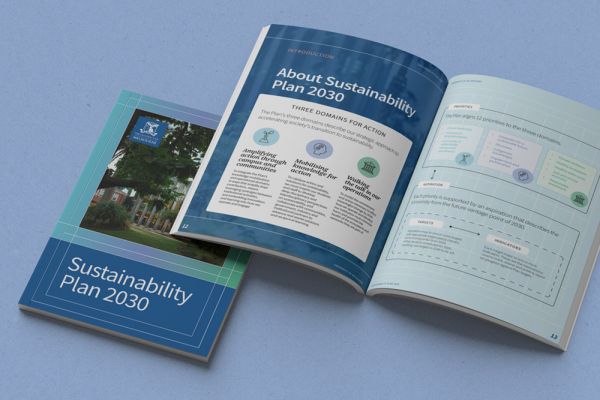
Sustainability at the University of Melbourne is guided by the sustainability framework, consisting of an enduring Sustainability Charter, Sustainability Plan 2030, and annual sustainability reports. The Sustainability Charter holds that global values and actions must be ecologically sound, socially just and economically viable, with success in one area not coming at the expense of the others. Sustainability Plan 2030 is a road map for delivering on the commitments of the Sustainability Charter, with three domains for action:
- Amplifying action through campus and communities: the University links operational practice with knowledge mobilisation to drive climate leadership, strengthen living laboratories and support a connected sustainability community.
- Mobilising knowledge for action: the University brings together education, research, Indigenous knowledges and partnerships to build capability and enable practical sustainability outcomes.
- Walking the talk in our operations: the University embeds sustainability into daily decisions to boost climate resilience, protect ecosystems, improve water use, advance a circular economy and ensure responsible investment.
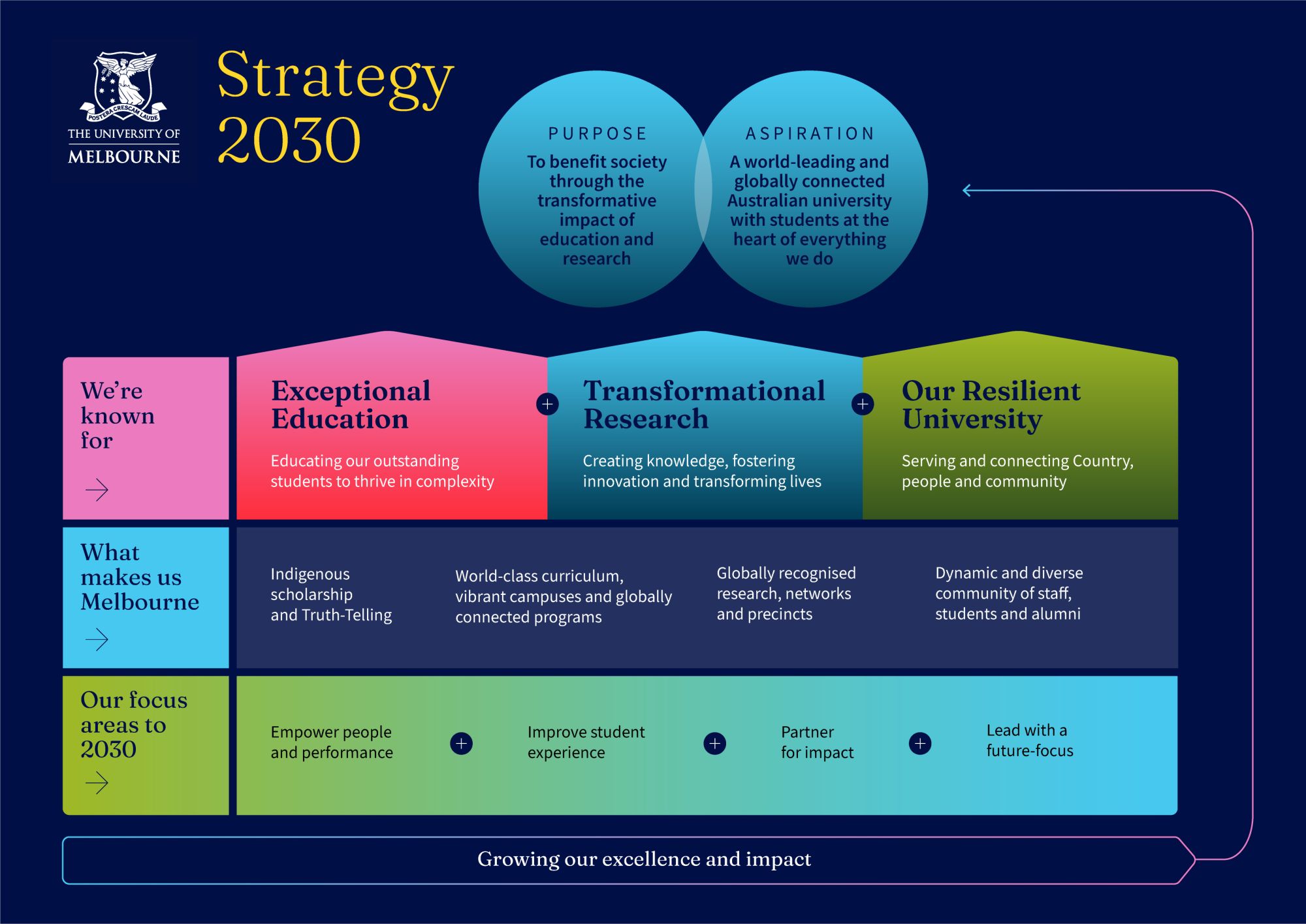
Sustainability Plan 2030 signals a strategic ambition to lead towards a globally sustainable future and a commitment to the University’s people, partners and place in the world. It aligns with the goals of the University’s Strategy 2030: Resilience and the United Nations Sustainable Development Goals.
Sustainability Plan 2030 contains 28 targets for embedding sustainability in education, research and operations. Twenty-five of these targets had a deadline of 2025, with outcomes from the University’s efforts to address these targets presented in this report.
Sustainability Plan 2030 sits alongside a suite of institutional strategies designed to enhance the University’s positive impacts and contribution to society, including social, economic and environmental aspects of sustainability:
Sustainability Governance
The Vice Chancellor's Advisory Group is the governance body for sustainability, providing high-level governance and strategic counsel to the Vice Chancellor regarding the progress and implementation of Sustainability Plan 2030 targets.
Performance against targets
In 2025, the University reached the key midpoint milestone of Sustainability Plan 2030, which was the deadline year for 25 of the Plan’s 28 targets. With 72 per cent of these targets ‘met’ or ‘partially met’ since the Plan was established in 2022, the University has made significant progress towards its sustainability goals. However, it remains focused on further actions and efforts towards 2030 for greater impact.
There are some areas where the University has not progressed as intended. Several targets that are ‘not met’ at the Plan’s mid-point in 2025 reflect the high degree of leadership ambition with which the University established Sustainability Plan 2030 targets. These targets will be key areas of focus during the Sustainability Plan 2030 refresh in 2026, to ensure the University meaningfully progresses its sustainability goals and addresses areas of underperformance.
The University reviewed the status of each target, gathering data from its Faculties and Chancellery portfolios. The process included a preliminary assessment by the Sustainability team; review by a group of senior cross-functional leaders, and endorsement of the final target status report by the Vice Chancellor’s Advisory Group.
The assessment was based on the following target status descriptions:
 |  |  |
Met or exceeded | Partially met | Not met |
Data demonstrates that the University has met or exceeded the target. | Data demonstrates that the target has not been met, but there has been a significant improvement and performance is trending towards the target. | Some action has been taken to address the target, but data demonstrates that this has been insufficient to meet or partially meet the target. |
A summary of the Sustainability Plan 2030’s 2025 target status is presented below.[1]
| SP2030 priority area | Target | Status |
|---|---|---|
Climate leadership | The University is certified carbon neutral by 2025 |
|
Campuses as living laboratories | The University has curated living labs covering the priority areas of this Plan |
|
Community of sustainability learners and practitioners | The University’s Academic Divisions and portfolios support and learn from each other to embed sustainability in practice and in learning – formal, non-formal and informal |
|
The University community shows increased uptake of positive sustainability skills, knowledge and behaviours through non-formal and informal learning |
| |
The University offers a suite of student-centred, formal and non-formal applied sustainability learning opportunities, informed by inter and trans-disciplinary approaches |
| |
Academic and professional staff have increased their participation in and contribution to formal and non-formal learning to develop their general and role-specific sustainability skills |
| |
The University has increased its engagement with alumni regarding sustainability |
| |
Graduates for a sustainable future | Sustainability is integrated into curriculum to an extent that conscientiously extends, beyond a base threshold, each discipline’s (and associated professions/industries’) knowledge of the helpful and harmful impacts it has for the environmental and human systems we depend on |
|
Graduates have increased capabilities to shape, lead and succeed in the careers, communities and industries of sustainable societies (year on year). |
| |
Discovery | Sustainability research is integrated with campus operations and planning, to be an international exemplar of a sustainable community |
|
The highest quality research is conducted that contributes to knowledge, action, and impact across the disciplinary and interdisciplinary dimensions of sustainability. |
| |
Researchers make considered decisions on the sustainability impact of their research practices and activities |
| |
Indigenous knowledges | The University has an increased understanding of sustainability from an Indigenous perspective through co-created or Indigenous-led reciprocal learning |
|
Engagement and partnerships | The University’s community partnerships demonstrate localised and co-created approaches to sustainability. |
|
The University has led or influenced discussions with precinct partners to further precinct-specific approaches to sustainability |
| |
The University is playing a leading and convening role on sustainability challenges and opportunities internationally, with particular focus on vulnerable and disadvantaged people in Asia and the Pacific |
| |
Climate resilience | The University reaches and maintains a ‘high’ climate change preparedness level |
|
Healthy ecosystems | Each campus achieves no net loss of biodiversity relative to defined baseline years by 2025 |
|
Healthy water cycles | The University has reduced total water consumption by 10% relative to a 2019 baseline |
|
The University has significantly increased the proportion of water consumption from non-potable sources compared to a 2019 baseline |
| |
Just and circular economy | The University has reduced waste to landfill to 10kg per person |
|
The University has reduced the flow and improved the circularity of materials passing through the University |
| |
The University has principles for ethical and sustainable consumption and service provision embedded into operations and procurement practices |
| |
The University tracks spend with social and Indigenous suppliers, setting targets from 2024 |
| |
Responsible investment | Enhanced transparent reporting of the University’s investment portfolio |
|
Plans for 2026
In 2026, Sustainability Plan 2030 will be refreshed to reflect the changing strategic landscape for sustainability at the mid-point of the plan’s implementation. This refresh was scheduled when the Plan was released in 2022, enabling the University to remain flexible and responsive in the action it takes to achieve its overarching aspirations to 2030. The updated strategy will be published after this refresh is completed.
Footnotes
[1] Note that three additional targets have a 2030 deadline and are ‘not yet started’.
Our sustainability strategy
At the University of Melbourne, our efforts in sustainability are guided by Sustainability Plan 2030 - a roadmap for sustainable delivery of the University's Strategy 2030: Resilience.
Read more about how we are advancing sustainability at the University:
