2025 Sustainability Report
Our impact
The University of Melbourne’s 2025 Sustainability Report is the fourth report against the ambitious targets outlined in the University’s Sustainability Plan 2030. This plan underpins the aspirations outlined in Strategy 2030, guiding sustainable delivery of our commitments across the three key areas of Exceptional Education, Transformational Research and Our Resilient University.
Transforming Chemistry learning to embed sustainability
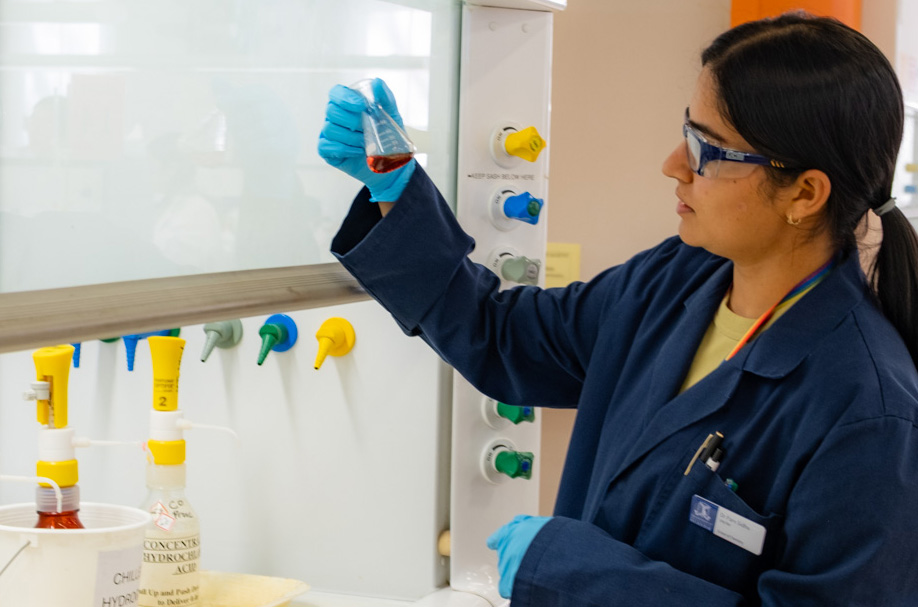
The Faculty of Science’s School of Chemistry is reshaping the way thousands of students engage with foundational chemistry studies at the University. Driven by the dual goals of improving learning outcomes and embedding sustainability into laboratory practice, the Undergraduate Chemistry Practical Subject Rejuvenation project has transformed both curriculum design and operational behaviour in one of the University’s largest teaching laboratories.
Each year, more than 3,000 first-year students undertake chemistry practicals that were previously resource-intensive and not always well-aligned to lecture content. The rejuvenation project, led by Chemistry teaching assistant Dr Parvinder Sidhu, addresses these challenges by integrating sustainability concepts into learning materials and creating self-guided opportunities for exploration. The redesigned learning program positions sustainability as a core component of scientific thinking rather than an add on, enabling students to understand the real-world impact of laboratory decisions from the time they commence their studies.
Educationally, the project has created an important shift in the way students engage with chemistry studies. Every experiment now includes a ‘sustainability takeaway,’ prompting students to critically reflect on waste, resource use and safer chemical choices. Sustainability is built into assessment tasks, signalling its importance and ensuring every student develops an understanding of sustainable laboratory practices. These changes promote graduates who are not only technically skilled, but also environmentally responsible and prepared to contribute to sustainability over their careers.
The practical benefits of these changes also reinforce educational outcomes. Students now work with reusable glassware which replaced single-use plastics, improved waste sorting systems and redesigned workflows that demonstrate how thoughtful choices minimise environmental impact. These hands-on experiences reinforce theoretical concepts, while providing a living example of best practice. Postgraduate students and laboratory staff also benefit, gaining professional development in sustainable laboratory operations that align with global standards.
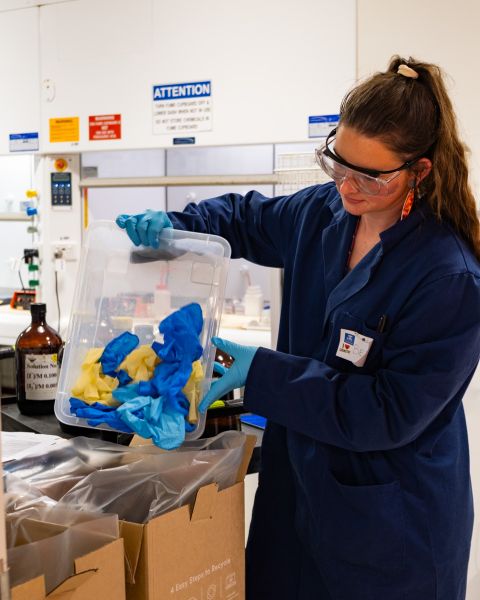
At the foundation of the project was the achievement of My Green Lab “Green” Level Certification, a global benchmark for sustainable laboratory practice. This illustrated to students what leadership in sustainability looks like, and has encouraged a culture of accountability and continuous improvement across the teaching team. The project also won two 2025 University of Melbourne Sustainability Awards, for Operational Impact, and Engagement and Behaviour Change.
By aligning curriculum, operations, and culture, the Undergraduate Chemistry Practical Subject Rejuvenation project established a model in which sustainability is embedded into scientific education. Its influence also extends beyond the laboratory: students will carry forward the principles they learn into future research, industry roles and broader community settings. As a result, the project delivers both immediate educational value and long-term societal impact, equipping the next generation of scientists to lead with sustainability at the centre of their practice.
Tiny frog research with big conservation impact
A team of scientists led by the University of Melbourne sequenced the complete genome of one of Australia’s most iconic and endangered frogs – the Southern Corroboree Frog (Pseudophryne corroboree).
The species has been decimated by chytridiomycosis, an infectious disease caused by the chytrid fungus, and is considered ‘functionally extinct’. There are no viable wild populations and the species is only able to survive through breeding programs in zoos.
This transformational research, nearly a decade in the making, evolved from a collaboration between the University of Melbourne, Zoos Victoria and international partners on four continents.
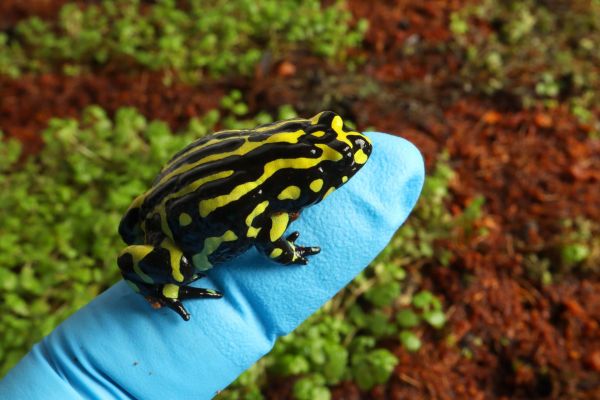
The team found that despite their small size, Corroboree Frogs have remarkably large genomes, nearly three times the size of the human genome. This makes it one of the largest genomes of any Australian frog and significantly larger than many other species of Australian ground frogs.
The University’s researchers, Dr Tiffany Kosch, Associate Professor Lee Berger and Professor Lee Skerratt now hope to use the genome, which acts as an organism's genetic blueprint and set of DNA instructions, to help return the species to its natural habitat in the New South Wales (NSW) Snowy Mountains.
The research team are collaborating with Melbourne Zoo, Taronga Conservation Society AustraliA and NSW Department of Climate Change, Energy, the Environment and Water to investigate how and why individual frogs and populations respond differently to chytridiomycosis infection.
The genome will allow them to understand down to the gene level which factors increase or decrease susceptibility to the chytrid disease. They are developing approaches to increase the frequency of potential genes that may boost the immune system to fight the disease. They will then apply this knowledge to selectively breed Corroboree Frogs for increased disease resistance, giving them an increased chance to persist in the wild once again.
This research is advancing the boundaries of knowledge in amphibian conservation. By identifying genes that impact resilience to major threats, the research is informing conservation strategies globally for frog species threatened by chytridiomycosis and other environmental challenges.
For the Southern Corroboree Frog, the ultimate goal is to translate these findings into real-world conservation action with enduring impact, helping to secure a future for this species in the wild.
University of Melbourne achieves 100 per cent renewable electricity (Scope 2)
In 2025, the University achieved a significant milestone in its decarbonisation journey, sourcing 100 per cent renewable electricity for the first time across all campuses (Scope 2). This achievement eliminates the University’s Scope 2 emissions from electricity - the greenhouse gases released when purchased electricity is consumed.
In previous years, the University had combined renewable electricity supply and also retired carbon credits. In 2024, for example, the University sourced renewable electricity equivalent to 70 per cent of its annual electricity consumption and retired carbon credits to cover emissions for the remaining 30 per cent sourced from Victoria’s electricity grid. In 2025 no carbon credits were used and all of the electricity for Scope 2-related buildings and facilities was generated or procured from renewable sources that produce zero greenhouse gas emissions.
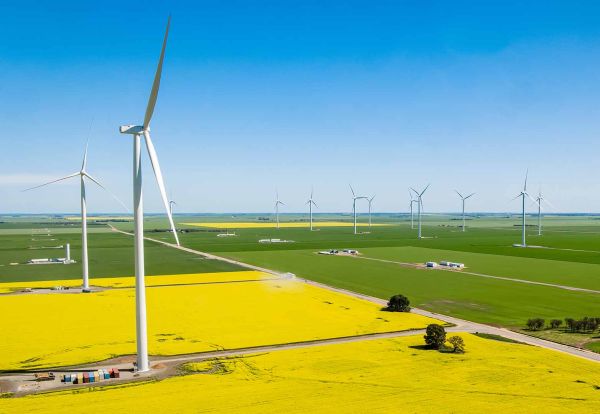
In 2025, the transition to 100 per cent renewable electricity (Scope 2) is estimated to have avoided approximately 91,000 tonnes of carbon dioxide (CO2) equivalent entering the atmosphere.[2] To put this in context, if the University relied entirely on grid electricity, electricity would represent over one-third of its operational greenhouse gas footprint.[3]
This milestone was achieved via years of cross-functional collaboration across the University’s Treasury and Financial Investments, Energy, Procurement and Sustainability teams, and close partnership with external providers and community stakeholders. The result is a demonstration of institutional climate leadership: cutting emissions at source; supporting renewable infrastructure; and strengthening energy resilience across campuses.
Two long-term power purchase agreements played a crucial role towards meeting this 2025 target. The University, collaborating with a total of 17 partners, entered renewable electricity purchased arrangements from two wind farms (Crowlands and Murra Warra) in Western Victoria.
While the majority of energy is covered via the power purchase agreement and onsite solar generation, the University's size meant that some grid electricity is also required to support its full operations. To cover this, the University procures additional renewable energy certificates (RECs) to source 100 per cent renewable electricity.
Footnotes
[2] This estimate represents the level of emissions generated under the market-based approach for Scope 2 emissions which the University currently reports under.
[3] This does not include greenhouse gas emissions from investments which are considered financed emissions and are reported separately. Read more about Responsible Investments [link].
Our sustainability strategy
At the University of Melbourne, our efforts in sustainability are guided by Sustainability Plan 2030 - a roadmap for sustainable delivery of the University's Strategy 2030: Resilience.
Read more about how we are advancing sustainability at the University:
