2023 Sustainability Report
Climate leadership
Domain: Amplifying action through campus and communities
Aspiration to 2030: Through demonstration of its operations, the University has catalysed ambitious climate action by others.
Progress against targets
| Target | Target status | Progress in 2023 |
|---|---|---|
| The University is certified carbon neutral by 2025[1]. |  On track |
|
| The University has achieved climate positive status by 2030. |  Not yet started | This will follow achievement of 2025 carbon neutral target (above). |
Explore our progress
and our stories

Our progress
Greenhouse gas emissions in 2023
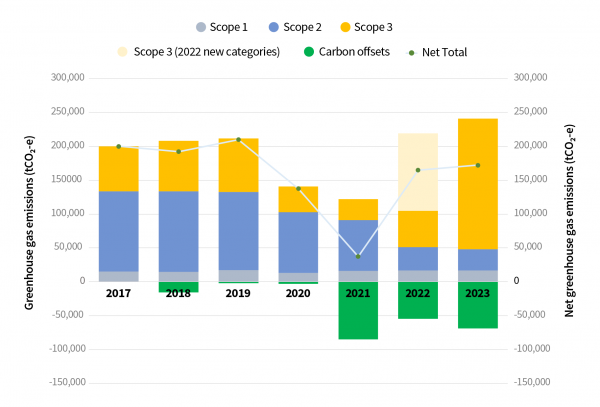
UoM GHGI emissions, 2017-2023
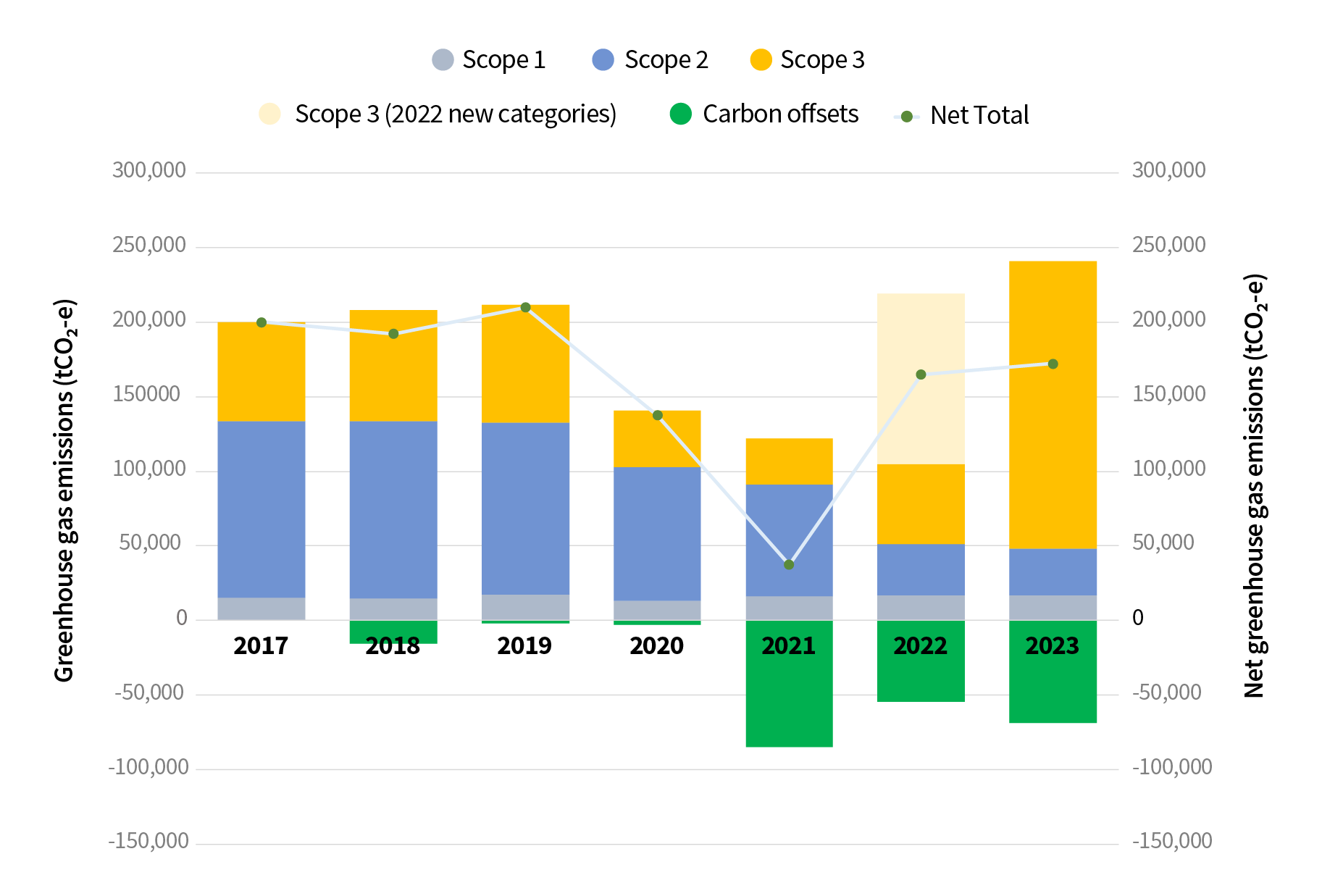
In 2023, we continued our focus on understanding and addressing our direct and indirect carbon emissions. Once again, we commissioned consultants to provide a comprehensive, Climate Active compliant greenhouse gas inventory encompassing our entire procurement spend of over $1 billion across all purchasing categories.
Overall, our gross carbon emissions for 2023 were 241,128 tonnes of carbon dioxide equivalent (tCO2-e). This was an increase of 21,641 tCO2-e from the 2022 level. The University purchased 68,852 tCO2-e of carbon offsets, resulting in net emissions for 2023 of 172,276 tCO2-e.
Scope 1 (direct) emissions from sources we own
Our Scope 1 (or direct) emissions, generated from consumption of natural gas, liquefied petroleum gas (LPG), fuel for our vehicle fleet and refrigerants, were slightly reduced from 2022. This is due to lower natural gas consumption, largely as result of a milder winter in Melbourne. Our long-term program to replace gas infrastructure with electric alternatives continued, with phase 1 of the electrification of Dookie campus implemented in 2023 and electrification works for two buildings on Parkville campus approved.
Scope 2 (indirect) emissions from purchased energy
The University consumed 66 per cent renewable energy in 2023, and again met our target of zero net emissions from electricity. To achieve this, we voluntarily retired over 53,000 renewable energy certificates (LGCs), sourced primarily from our wind farm Power Purchase Agreements (PPAs), and 35,293 tCO2-e. Details of our offset purchases are here.
Scope 3 (indirect) emissions from our supply chain
Total scope 3 emissions increased from 168,192 tCO2-e in 2022 to 193,049 tCO2-e in 2023. This increase was largely due to increased emissions from air travel. Calculated emissions also varied across a number of other categories, including professional services, food, office equipment and supplies, and staff commuting and working from home. Details of our carbon emissions by category are here.
The University’s emissions from business air travel approximately doubled in 2023, to 33,556 tCO2-e. This increase in reported emissions is due to the combined effect of a return to pre-pandemic travel patterns; and an increase in Climate Active[2] emission factors to account for radiative forcing[3] which is outside the University’s control. To support our initiatives to reduce emissions from flights, we worked with our travel provider in 2023 to make carbon emissions for each ticket option visible to travel bookers at the point of decision-making. This initiative, combined with a planned air travel emissions reduction program, will enable more informed flight decisions as we progress towards carbon neutrality. All business air travel emissions were offset with purchased carbon offset credits.
For access to other GHG data please click on these respective links: GHG emissions by category 2023, GHG emissions by scope, GHG emissions by FTE, EFTSL, and Gross floor area .
FOOTNOTES
[1]Climate Active carbon neutral certification.
[2] Climate Active is the federal government program providing carbon neutral certification for Australian businesses.
[3] For 2023, Climate Active increased their emissions factors for air travel by over 30 per cent on average to include the effect of radiative forcing, resulting in a disproportionate increase in the University's carbon emissions from air travel to 33,556 tCO2-e.
Energy consumption in 2023
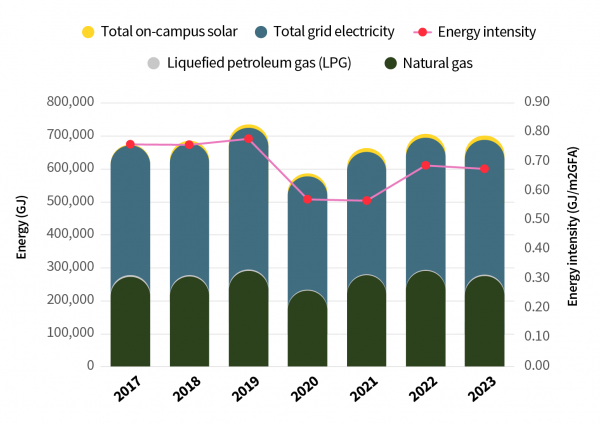
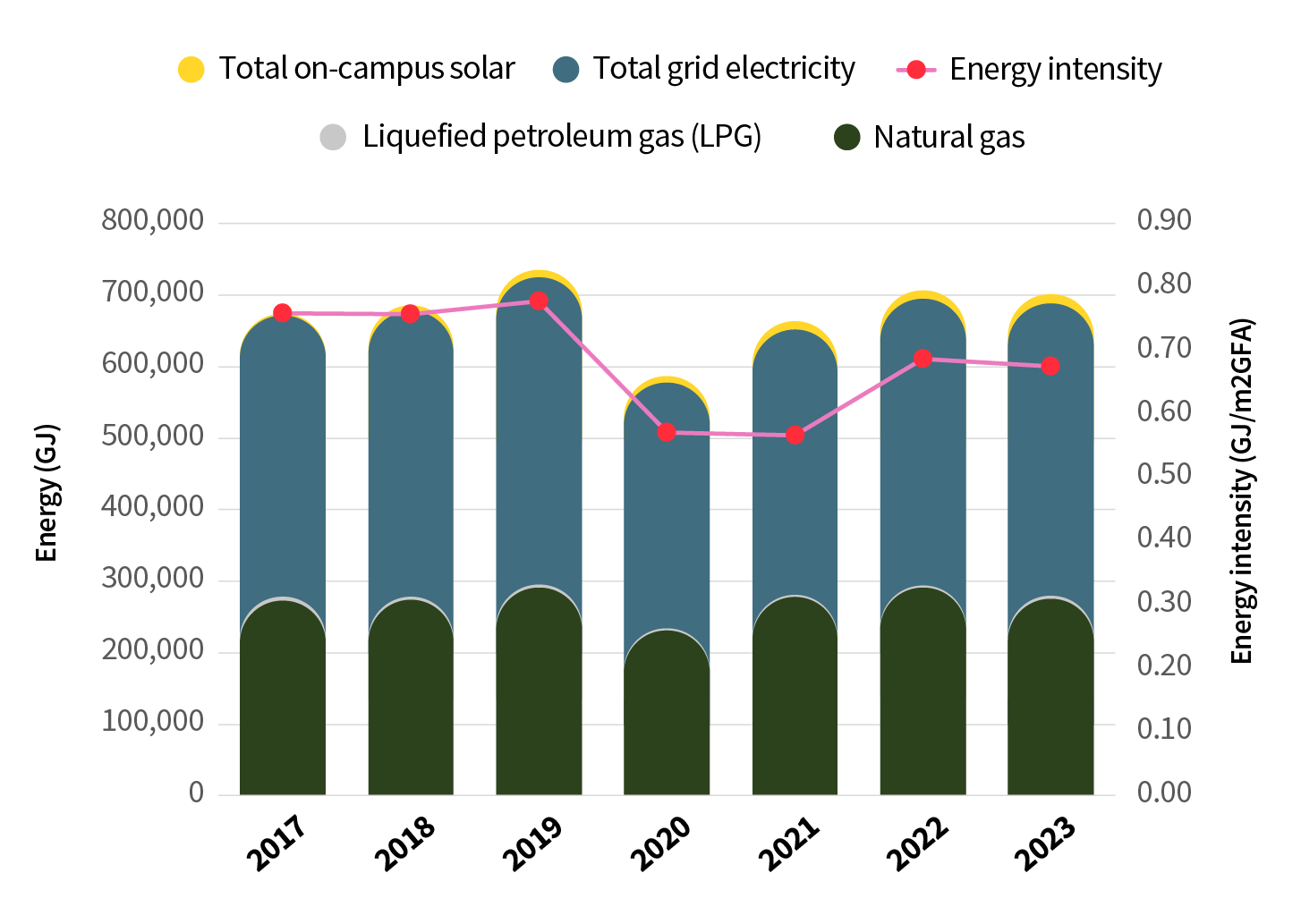
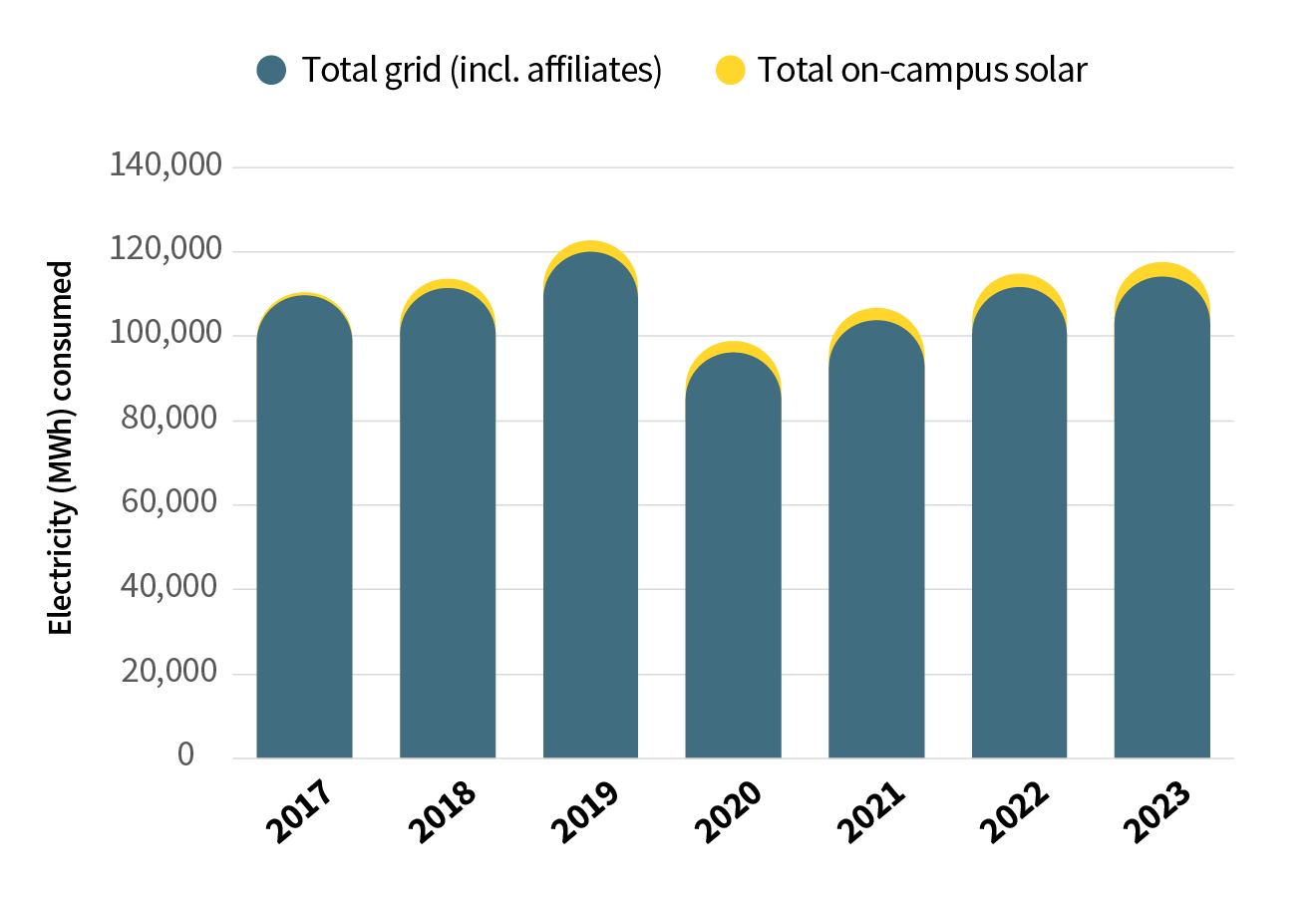
While the University’s electricity consumption increased by 2 per cent in 2023, our overall energy consumption reduced by 0.7 per cent. Energy intensity also reduced by 1.7 per cent.
Consumption of natural gas was 5 per cent lower in 2023 than the previous year, mainly due to a mild winter in Melbourne, requiring less gas for space heating. LPG consumption at Dookie campus returned to pre-pandemic levels, however this will reduce significantly as the Dookie campus electrification project is rolled out in 2024.
In 2023, our onsite solar generation increased 7 per cent to 3,493 MWh. The University has maximised our opportunity to install solar panels on our campuses. There are currently 11,000 solar panels installed at 44 locations across four campuses, with limited opportunities for new onsite solar systems.
Total energy consumption by source, 2017-2023
Click here to see data table of dataset used above
Total electricity usage, 2017-2023
Our stories
Energy efficiency improvements in research computing

The University’s Research Computing Services and Data Centre have delivered a range of solutions to reduce research computing energy consumption. These efforts contributed to the University receiving a 5.5 star NABERS Award for Data Centre energy efficiency and optimisation in 2022-23.
Research computing requires vast data storage, an energy-intensive cloud and high-performance computing infrastructure. Our researchers use these systems for complex analysis and computational processes, many of which cannot be simply switched off.
When the team analysed the University’s Information Technology systems, they found that research computing accounts for 70 per cent of total energy consumption in this area, much of which is devoted to cooling facilities which generate significant heat while operating. This contributes significantly both to the University’s carbon footprint and electricity bills. The team found that some high-performance computing servers were set to use maximum power at all times, regardless of actual usage of each node in the server. By adjusting the servers’ power management settings, nodes now draw 40 per cent less power when in idle mode, significantly reducing energy usage.
The teams have introduced a range of measures to reduce energy consumption in the University’s Data Centre, including:
- Hot air containment – transferring hot air away from the computers and cooling it using chilled water. This increases energy efficiency by 25 per cent compared to using air conditioning units for the same purpose.
- Evaporative cooling pads – water-filled pads were added to the Data Centre’s chillers to cool the facility in a more efficient manner.
- Electro-commutated fans –smart, computer-controlled fans which adjust automatically to cool computers when needed rather than running consistently at full speed.
- LED lighting – replacing all less energy efficient lighting throughout the facility.
- Periodic audits – to ensure equipment is powered off when no longer in use.
Campus energy efficiency and decarbonisation initiatives
The Smart Campus Energy Upgrades Program continues its work to improve energy efficiency and generation across our campuses. The program delivered $3 million in projects through 2023, including central plant upgrades, digital twin plant optimisation, LED lighting and solar panel installation. These projects will reduce the University’s energy usage by 1.2GWh annually – the equivalent of powering 260 houses for one year.
The University continued the development of an institution-wide electrification program to replace gas infrastructure with electric alternatives powered by renewable electricity. This program will be delivered over the longer term, in alignment with the new Estate Master Plan.
Phase 1 of the electrification of Dookie campus was implemented in 2023, with completion in January 2024. This will reduce gas consumption at Dookie by 70 per cent. Electrification works for two buildings on Parkville campus were approved, with electrification of a further nine buildings at the concept design stage.
Our sustainability strategy
At the University of Melbourne, our efforts in sustainability are guided by Sustainability Plan 2030 - a roadmap for sustainable delivery of our institutional strategy Advancing Melbourne.
Read more about how we are advancing sustainability at the University:
