2023 Sustainability Report
Just and circular economy
Domain: Walking the talk in our operations
Aspiration to 2030: The University’s approach to the procurement and use of products, services and materials has stimulated a more just and circular economy and catalysed change in our campus communities.
Progress against targets
| Target | Target status | Progress in 2023 |
|---|---|---|
| The University has reduced waste to landfill to 10kg per person. |  In progress |
|
| The University has reduced flow and improved circularity of materials passing through the University. | In progress |
|
| The University has principles for ethical and sustainable consumption and service provision embedded into operations and procurement practices. | In progress |
|
| The University tracks spend with social and Indigenous suppliers, setting targets from 2024. | In progress |
|
Explore our progress
and our stories

Our progress
Post-pandemic uplift in waste to landfill and recycling
Waste to landfill rates per person increased significantly in 2023, up by 92 per cent from 2022 levels. However, waste production remains at 23 per cent less than 2019 (pre-pandemic) levels, which reflects ongoing waste prevention and reduction efforts by the University and improvements in waste data accuracy.
This increase was anticipated, due to the return to campus by staff and students post-pandemic, and poor waste management practices in key areas, including insufficient infrastructure, significant volumes of avoidable waste including packaging waste, high contamination levels, and lack of education and awareness around correct source separation behaviours across the University community. Changes in our reported waste also reflect a broadscale change of methodology for waste collection and data capture. The University transitioned our waste management operations to our new service provider in 2023, which will provide greater transparency and granularity in our waste collection data going forward. A number of further approaches to address these issues have been identified, including reducing waste at the source, installing appropriate source separation infrastructure, consolidating waste hubs on campuses and behaviour change initiatives.
To explore issues around source separation, the Sustainability team, Campus Management conducted a waste audit on the Parkville campus in late 2023. The team analysed 1587 kg of waste (1400kg from landfill bins and 187kg from recycling bins), finding that 66 per cent of waste in landfill bins consisted of organics (over 50 per cent), mixed recycling, and paper and cardboard, which could have been diverted from landfill. 11 per cent of waste in the recycling bins was classified as contamination, potentially impacting the capacity to recycle the remaining contents of these bins. This indicates ongoing issues with the use of the bins by staff, students and visitors on our campuses. A waste education roadshow will be delivered in 2024 to raise awareness and encourage correct use of the bins.
Total waste to landfill and recycling, 2017-2023

Our stories
Circular material flows at the University
Rehoming furniture and equipment across the University
The University’s Furniture and Equipment Reuse Service (FERS) plays a vital role in enhancing the circularity of materials at the University and embedding sustainability in everything we do. Managed by the Campus Assist team, the FERS collects, stores and redeploys furniture and equipment across the University campuses and off-site facilities.
Circularity of furniture and equipment at the University

The University’s Furniture and Equipment Reuse Service (FERS) plays a vital role in enhancing the circularity of materials at the University and embedding sustainability in everything we do. Managed by the Campus Assist team, FERS collects, stores and redeploys furniture and equipment across University campuses and off-site facilities.
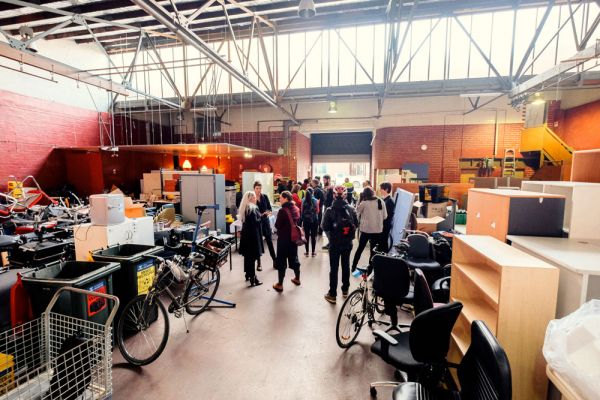
Since FERS was first piloted in 2012, the University has become a leader in the sector for reusing its equipment, providing an example for others to follow. A key factor in the success of FERS is its integration with its parent program, the Campus Assist service, which lifts and shifts furniture, hard waste, e-waste and other items. By providing an integrated reuse, collection and delivery service, the Campus Assist team is able to maximise its efficiency, redeploying furniture and equipment to where it is needed across our campuses and delivering substantial cost savings in the process. As at end 2023, the program has redeployed over 43,200 items, saving over 952 metric tonnes of waste from landfill, and more than $22 million on retail replacement value. In 2023 alone, FERS relocated 5430 items, diverting 114 tonnes of waste from landfill and delivering an estimated saving of $2.3 million on retail replacement value.
In addition to one-off services, the team also works on larger University development projects, partnering with project managers to maximise reuse in demolition and fit out projects.For example, 393 items formerly used at the Parkville campus will be reused in the Dookie Student Accommodation project.
Reducing single-use plastic use with the Choose to Reuse Plate Program
The University community’s use of the Choose to Reuse Plate program and events service increased by 31 per cent on the level of uptake in 2022. A total of 199,341 items were washed over the year and Reusable Event kits were hired for 90 events. To support the uptake of the program, new crockery collection points and signage were installed across the student precinct.
Preventing disposable coffee cups going to landfill with Green Caffeen
The Green Caffeen initiative provides a free reusable coffee cup system at cafés on the University’s Parkville campus, helping us to play our part in reducing the estimated 2.7 million single-use coffee cups disposed of in Australia every day. The program operates like a library system, where users borrow a cup using the Green Caffeen app and return it to any participating café within 30 days. In 2023, over 3200 cups were swapped, preventing the equivalent of disposable cups from going to landfill.
Scaling up waste reduction efforts at major University events

Building on the ongoing positive impact of the Choose to Reuse Plate program, the University expanded our waste prevention focus to larger events in 2023. The Sustainability team, Campus Management collaborated with event staff and the University's cleaning contractor ISS World to make the University’s Semester 1 Orientation Week and Melbourne Commencement Ceremonies single-use plastic free. To achieve this, we partnered with Green My Plate, a reusable crockery service. All food trucks were provided with plates, bowls and cups to serve students, and collection points were stationed at all bins so crockery could be collected, cleaned and redistributed as needed. A total of 7948 plates, bowls and cups were washed and reused, preventing the equivalent number of disposable items from going into landfill.
Following the successful waste prevention outcomes from these events, Green My Plate was used at other events throughout 2023, including Open Day and Graduation Ceremonies. This prevented a further 6035 single use items from going to landfill. These efforts to embed sustainability into operations and the student experience address several priorities in SP2030, reducing waste to landfill, improving circulation of reusable materials and supporting environmentally positive practices among the University community.
Giving research equipment
a new life
In 2023, one of the University’s specialist workshops was relocated, with a range of engineering, mechanical and glass blowing equipment, tools and consumables no longer required and in need of a new home. The Faculty of Science, Campus Management, and Procurement Services formed a cross-functional team to address this challenge, engaging an experienced third-party auction partner. An online auction was held where 433 bidders participated and purchased all 591 lots, rehoming 100 per cent of the equipment and preventing any waste. This included approximately 35 tonnes of heavy machinery and five tonnes of other machinery and tools. The auction benefitted both the University and the wider community, delivering significant cost savings and waste reduction, and proving a model for rehoming specialist equipment which can be replicated across the University. The project demonstrated the importance of proactive asset management, exploring external partnerships for sustainable solutions and repurposing equipment to prevent unnecessary waste.
Minimising waste in the Victorian College of Arts workshops
The Faculty of Fine Arts and Music’s Victorian College of the Arts (VCA) workshops are supporting a just and circular economy through art practices. Staff in the VCA Workshops have established recycling processes for the extensive range of materials used across diverse artistic practices, and developed new teaching processes to support student sustainability learning.
For example, the Costume Workroom is working to minimise waste to landfill through meticulous stock management and the development of new waste management practices. The Workroom repurposes fabric in innovative ways, including creating storage bags and half-scale mannequin cases with recycled materials. Students are actively engaged in the process, experimenting with fabric scraps for their design and pattern-making exploration. Staff have also established a partnership with a nearby recycling facility to recycle plastic wrap and bags used in deliveries. Data collection and quality remains a challenge, with efforts in 2024 focused on accurately quantifying and tracking the volume of materials saved from landfill in the Costume Workroom.
Enhancing the visibility of our Indigenous and social procurement
The University is a member of Supply Nation and, from November 2023, partnered with Kinaway Chamber of Commerce who provide business support and advice, help improve visibility and networks, strengthen relationships and create opportunities for Aboriginal and Torres Strait Islander businesses across Victoria.
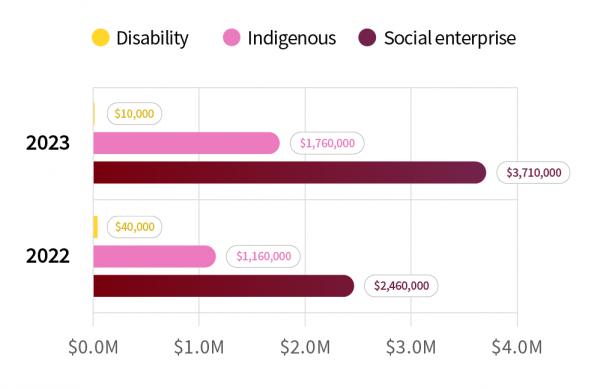
We are working to enhance our understanding of Indigenous and social procurement as a proportion of total procurement spend. In 2023, the University spent $5.48 million with 125 social enterprise, disability and Indigenous suppliers, a 50 per cent overall increase since 2022. This included $2.64 million for business services and $1.63 million in grants. This increase in reported spend is partly because additional suppliers are now flagged as social enterprise, disability or Indigenous in our systems. We are evolving our approach to reporting on our social spend and suppliers, and information from our external partners including Supply Nation, Kinaway and Social Traders on the social procurement status of suppliers is also consistently updated. Therefore, with more processes in place to capture social and Indigenous spend at the University and by our partners, our visibility over the University’s actual spend in these categories has increased. Spending with disability-flagged suppliers decreased by 75 per cent on 2022 levels to $10,000 in 2023 due to variation in services required by the University year-on-year.
Social enterprise, Indigenous and disability
procurement spend, 2022-2023

Our sustainability strategy
At the University of Melbourne, our efforts in sustainability are guided by Sustainability Plan 2030 - a roadmap for sustainable delivery of our institutional strategy Advancing Melbourne.
Read more about how we are advancing sustainability at the University:
