2023 Sustainability Report
Discovery
Domain: Mobilising knowledge for action
Aspiration to 2030: We aspire to be justifiably regarded as a place where students and academics do the highest-quality sustainability research that addresses difficult questions and major challenges.

Progress against targets
| Target | Target status | Progress in 2023 |
|---|---|---|
| Sustainability research is integrated with campus operations and planning, to be an international exemplar of a sustainable community. |  In progress |
|
| The highest-quality research is conducted, contributing to knowledge, action and impact across the disciplinary and interdisciplinary dimensions of sustainability. |
On track |
|
| Researchers make considered decisions on the sustainability impact of their research practices and activities. | In progress |
|

Explore our progress
and our stories
Our progress
Mapping the sustainability impact of the University’s research outputs
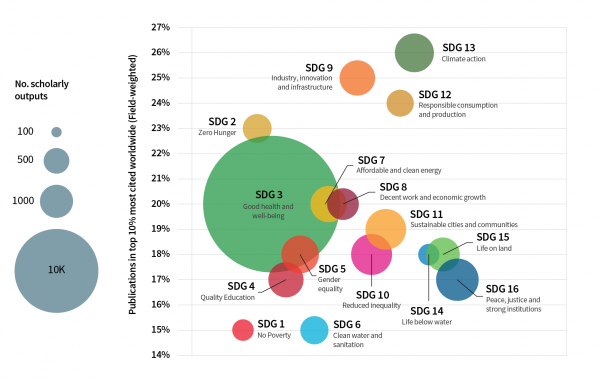
At an institutional level, the University’s research activities appear to making the most impact in relation to SDG 3 – Good Health and Well-being and SDG 13 – Climate Action.
SDG 3 – Good Health and Well-being
- 16,087 outputs published between 2020 and 2023 were mapped to SDG 3 – Good Health and Well-being (Source: SciVal), approximately 10 times more than the next highest, which was 1547 outputs mapped to SDG 16 - Peace, justice and strong institutions.
- 20 per cent of the outputs mapped to SDG 3 were amongst the top 10 per cent most cited. This metric is used to benchmark an institution’s contribution to the most influential, highly cited publications; a random sample of outputs from all institutions should have 10% of outputs in the top 10% most cited, therefore a percentage above 10% of outputs in the top 10% most cited indicates that the University is significantly better than average.
- SDG 3 also had the highest number of news and social media, and policy-related and patent mentions in 2023 (Source: Altmetric Explorer).
SDG 13 – Climate Action
- SDG 13 had the highest proportion of outputs published between 2020 and 2023, being amongst the top 10 per cent most cited at 25.5 per cent (Source: Scival).
- SDG 13 also had the second highest number of news and social media and policy-related mentions, and third highest patents mentions in 2023 (Source: Altmetric Explorer).
Percentage of SDG-related research outputs in the top 10% of citations (field weighted)
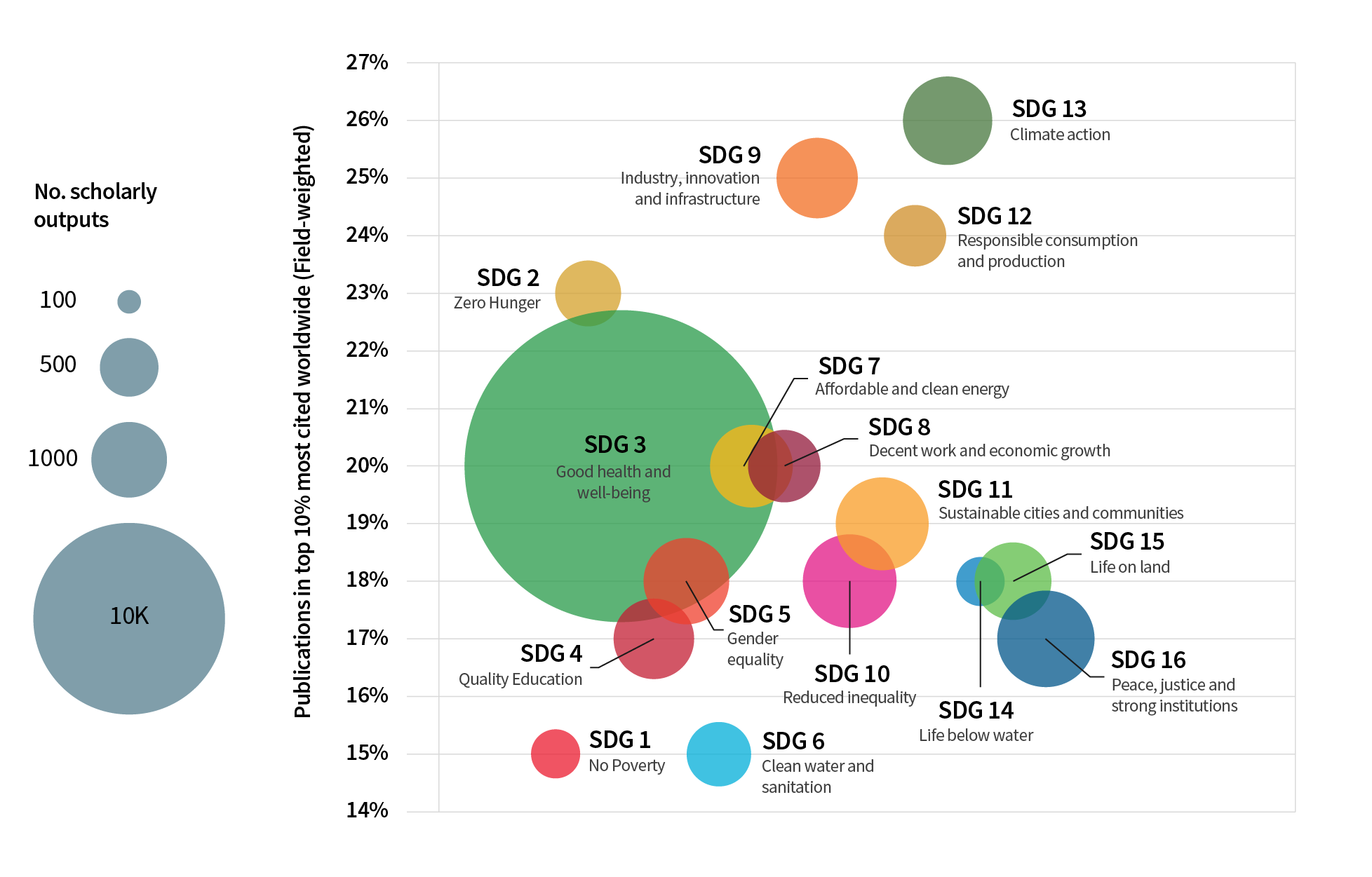
Source: SciVal. SDG mapping based on Elsevier 2023 method. Elsevier does not map to SDG 17.
Click here to see data table of dataset used above
Number of patent, policy and news/social media mentions for research outputs mapped to SDGs
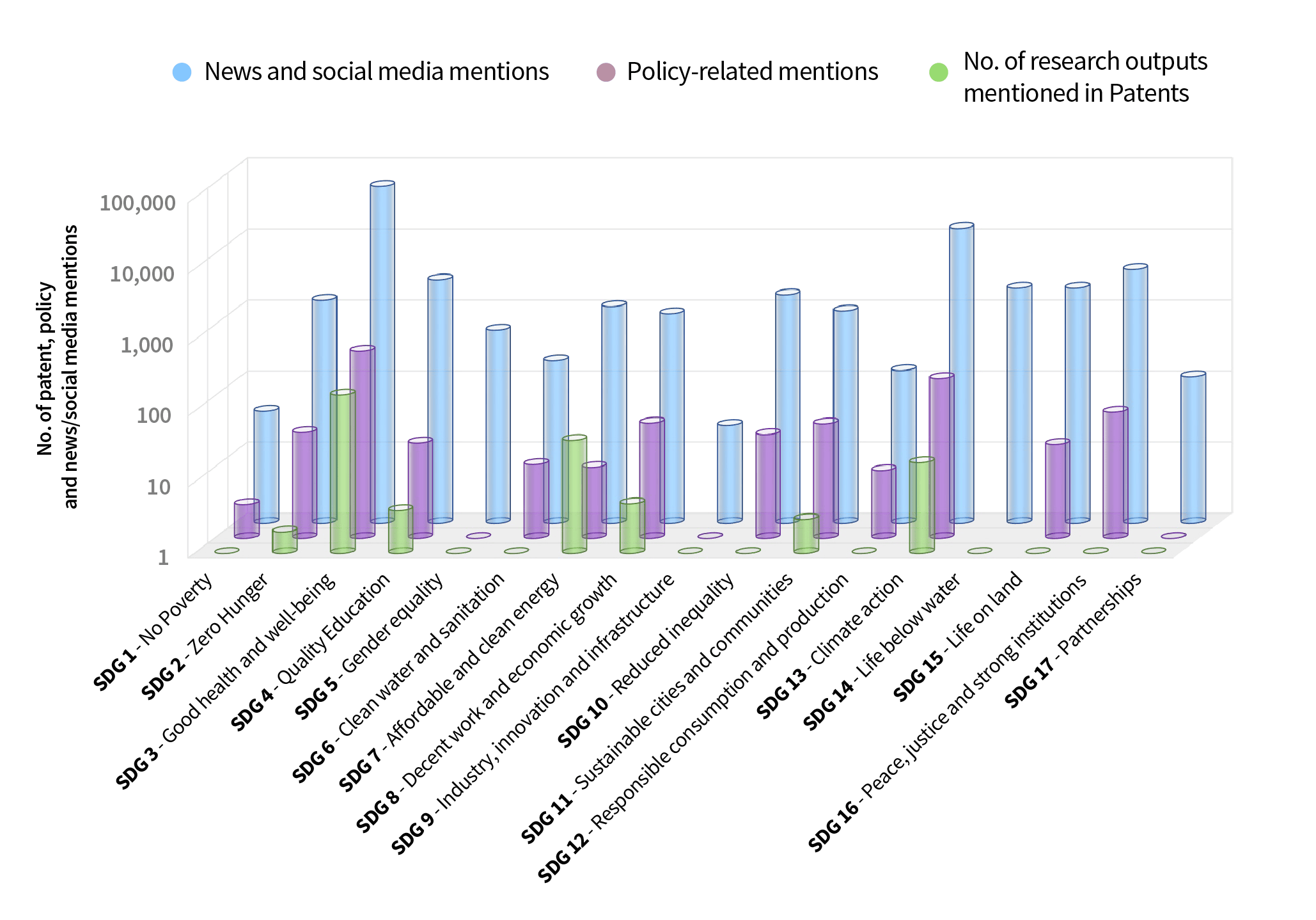
Source: Altmetric Explorer. SDG mapping based on SpringerNature/Digital Science method.
Click here to see data table of dataset used above
Research to address the 'triple planetary crisis'
Climate change, biodiversity loss and pollution are rapidly intensifying, with many sectors unprepared for existing impacts and how these will be magnified over time. The United Nations has framed climate change, biodiversity loss and pollution as a ‘triple planetary crisis’. University researchers collaborate across disciplines on a broad spectrum of issues associated with these interlinked crises, and their impacts on environmental and human systems:
- Melbourne Climate Futures focuses on addressing climate change challenges through research, innovation and actionable solutions. MCF works with research partners across the University and beyond on climate modelling, renewable energy, urban sustainability, biodiversity conservation, policy analysis, community resilience and more.
- Melbourne Biodiversity Institute is a collective of researchers, innovators and problem-solvers dedicated to addressing Earth’s biodiversity crisis by learning from First Nations people, supporting businesses to protect biodiversity, informing local and global governance, and collaborating with local communities.
- Melbourne Energy Institute is dedicated to advancing research in clean energy, collaborating with community, industry and government. Key research programs include energy systems, hydrogen and clean fuels, power generation and energy materials. Read more about MEI’s contribution to the Net Zero Australia Project.
- The Indigenous Knowledge Institute aims to advance research and education in Indigenous knowledge systems, promoting research linkages and collaboration across the University, which are vital contributions to sustainability.
- The Melbourne Social Equity Institute conducts interdisciplinary research to address social inequities, including those in health, education, housing, culture, work and transport, contributing to sustainable societies by advancing knowledge and facilitating effective responses.
- The Melbourne Disability Institute conducts interdisciplinary research to build an evidence base for social and disability policy reforms, advancing opportunity and equity for people with disabilities, their families, and carers.
Read about the latest sustainability, environment and climate research from our interdisciplinary research institutes on the One Planet website.
Our stories
Spotlight on pollution and climate change research in the Faculty of Science
Researchers in the Faculty of Science are mobilising knowledge for action through a range of interdisciplinary research efforts focused on pollution and climate change.
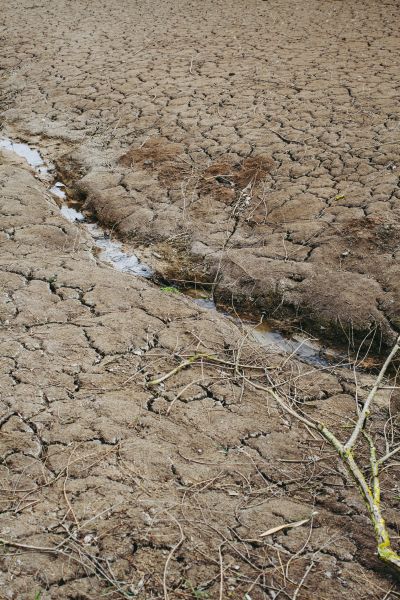
SoilTox Laboratory
The SoilTox Laboratory focuses on contaminants in soil (and groundwater) and reducing the impacts of pollution on plants, invertebrates and human health. The team uses ecotoxicology, soil chemistry and environmental risk assessment approaches to study the impacts of traditional contaminants (e.g. metals and hydrocarbons) as well as emerging contaminants (e.g. microplastics and PFAS). Led by Associate Professor Suzie Reichman, SoilTox Lab research is used by government, industry and the community to determine risks, make decisions and more safely manage polluted environments.
Melbourne TrACEES Platform
The University offers staff and students a range of specialised surface chemical and structural analysis services and state-of-the-art equipment through its Melbourne Trace Analysis for Chemical, Earth and Environmental Sciences (TrACEES) Platform. These services cover water, soil, biological, polymers, constructions and geological samples including nutrients, trace elements, toxic heavy metals and organic compounds. The platform supports new and existing research requiring the expert analysis of chemical and structural compositions.
Australian Earth-System Simulator National Research Infrastructure (ACCESS-NRI)
The University is a key partner in the Australian Earth-System Simulator National Research Infrastructure (ACCESS-NRI), a collaboration between the Bureau of Meteorology, CSIRO, five Australian universities and international partners. ACCESS-NRI aims to create world-class modelling infrastructure to predict Australia’s weather and climate to better mitigate the impacts of climate change.
Coastal erosion monitoring for mitigation
The Coastal Laboratory analyses the effects of sea level change, sedimentation and increasingly frequent storms on sand and gravel beaches, rocky shores and muddy estuaries.
As part of this work, Professor David Kennedy helped establish the Victorian Coastal Monitoring Program, which trains citizen scientists to collect drone footage that is used to produce 3D models and precisely track shoreline changes. The team regularly shares its research at community forums and other public engagements, and its evidence informs coastal management policies and practices.
Unlocking effects of climate change on Victoria’s forests
An Australian-first study at Starvation Creek near Warburton is helping discover how climate change, fire and other factors affect eucalypt forests. Professor Patrick Baker is leading a team hand-counting more than fifty thousand trees in the 16ha plot. The annual survey is part of the Forest Global Earth Observatory network, which is includes 76 forests in 29 countries and is coordinated by the Smithsonian Institution in the US.
Hacking the Anthropocene: Co-created climate curriculum for young people
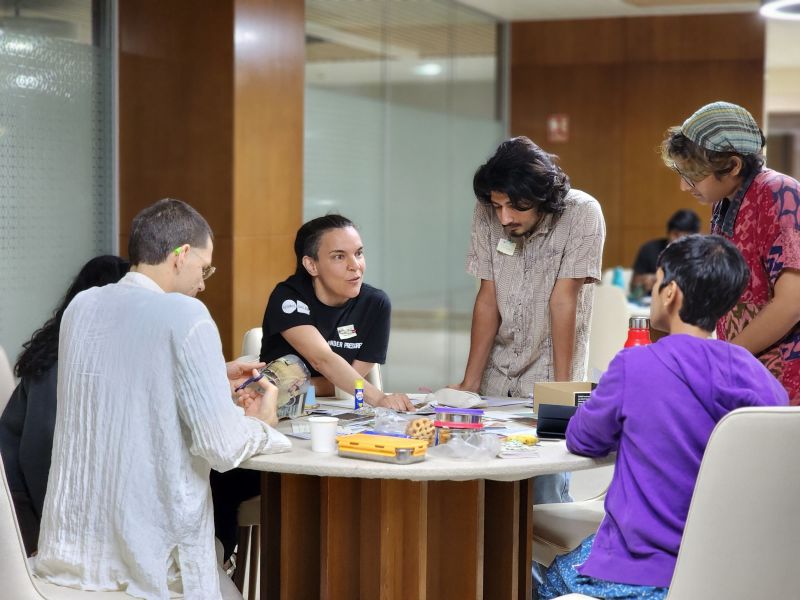
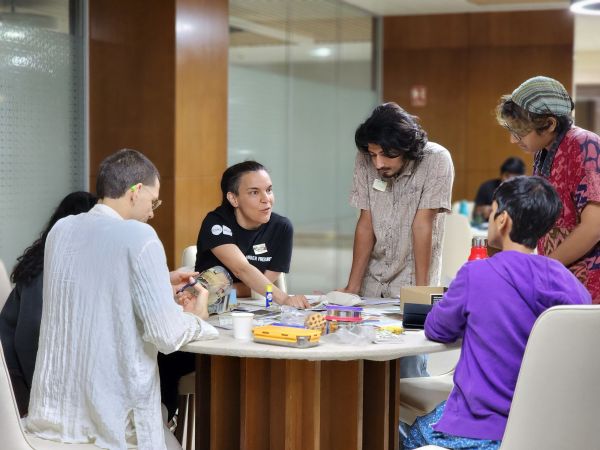
The Speculative Wanderings in Space and Place (SWISP) Lab in the Faculty of Education has created a climate curriculum by working with young adults across the world. The program, Hacking the Anthropocene, provides young people an opportunity to learn about the Anthropocene, reflect on human relationship with carbon and climate change, and interact with other young adults to share hopes and fears about the climate crisis. In 2023, project leaders Dr Kate Coleman and Dr Sarah Healy partnered with Science Gallery Bengaluru in India to deliver two workshops for young people aged 15-28 years old to explore climate stories at the intersection of creative and scientific inquiry. The international Science Gallery Network, an interdisciplinary collaboration of leading universities, has identified Hacking the Anthropocene as a signature global project. The SWISP Lab also partnered with Emory University to co-host a side event and exhibit at the United Nations climate conference COP28 in December 2023, presenting climate stories and artefacts from student workshops and a COP28 on-site residency.
Collaborating to make sustainable labs the ‘new normal’
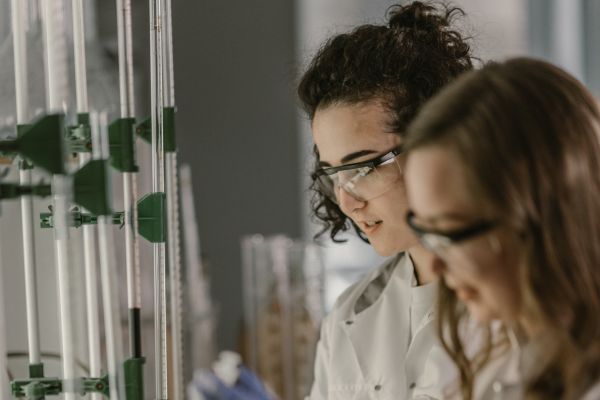
Our sustainability and procurement staff are collaborating with scientific equipment suppliers to enhance sustainability in the University’s laboratories. In 2023, we held a Sustainable Labs Expo at the Parkville campus during the University’s inaugural Sustainability Week, with approximately 80 attendees. This event provided a platform for the University community to explore sustainable laboratory practices and equipment, engaging with five leading science suppliers: Thermo Fisher Scientific, Bio-Strategy, Eppendorf, Interpath Services and McFarlane Medical. These suppliers showcased innovative laboratory equipment and consumables that utilise sustainable materials, employ new technologies or follow environmentally friendly manufacturing practices. The event also included presentations on using existing equipment and maintaining equipment sustainably. The project highlighted the power collaboration between suppliers, researchers, students and industry in starting the process of making sustainable labs the ‘new normal’, with further collaboration planned for 2024 and beyond.
Our sustainability strategy
At the University of Melbourne, our efforts in sustainability are guided by Sustainability Plan 2030 - a roadmap for sustainable delivery of our institutional strategy Advancing Melbourne.
Read more about how we are advancing sustainability at the University:
