2023 Sustainability Report
Climate resilience
Domain: Walking the talk in our operations
Aspiration to 2030: Our campuses and operations enable the University community, and the broader communities we are part of, to become more resilient to the impacts of climate change.
Progress against targets
| Target | Target status | Progress in 2023 |
|---|---|---|
| The University reaches and maintains a 'high' climate change preparedness level. |  On track |
|
Explore our progress
and our stories

Our progress
The University's Climate Change Preparedness Framework
The University assesses our progress towards being climate resilient using a climate-preparedness maturity framework. The framework was applied for the first time in 2023, finding that the University demonstrates a medium or high level of climate change preparedness in most functions, except in financial planning and reporting. Results of the assessment are presented below, along with notes on each University function assessed.
Climate Change Preparedness Framework
| Awareness of climate change and its potential impacts | Analytical capacity to understand climate change impacts | Action to reduce climate impacts and enhance ability to recover | |
| Low | Decision-making not informed by climate change information | No / limited capability to understand implications of climate change information | No actions taken to increase resilience to climate change |
| Medium | Decision-making informed in a limited way by climate change information (e.g. due to quality of the information and/or how information is included in the decision-making process) | Reliant on external expertise to understand implications of climate change information | Limited actions taken to increase resilience to climate change |
| High | Decision-making is, on most occasions, informed by high quality climate change information | In-house capability to understand implications of climate change and/or to integrate specialist input from external experts | Multiple and/or systematic actions taken to increase resilience to climate change |
Climate Change Preparedness assessment for 2023
| University function | Awareness | Analytical capacity | Action |
| Governance and strategy | M | M | M |
| Health & Safety | H | H | H |
| Business Continuity | H | M | M |
| Emergency Management and Critical Incident Management | H | H | H |
| Estate and buildings | M/H | M/H | H |
| Financial planning and reporting | L | L | L |
-
In 2023, the University added a sustainability and climate change risk to the University Risk Register, meaning that University Council and its Audit and Risk Committee now have oversight of how the University manages climate change risk. At a management level, the risk register is reviewed by the University Executive’s Risk Management and Compliance Committee. The Chief Operating Officer is the risk ‘owner’.
Day-to-day responsibility for identifying and managing climate risks and opportunities sits with the leadership of various teams, such as those involved in health and safety, emergency management, business continuity, estate and buildings, and financial planning and reporting, as summarised in this table.
The leadership of the wider University is made aware of climate change related risks and opportunities via the University’s annual Environmental Scan. The scan’s release aligns with the commencement of the University’s high-level strategic and business planning cycle. Sustainability and climate-related information aims to inform leaders of critical sustainability issues so they are appropriately addressed across the University.
-
The Health and Safety team monitors seasonal weather forecasts and co-ordinates relevant training. For example, over December and January 2023/24, the Emergency and Business Resilience team within Health and Safety Services held a series of free summer fire season safety briefings which were attended by 70+ staff and students. These sessions outlined the fire risk forecast for the 2023/2024 season, including discussion of the impact of climate change on fire risk and behaviour in the Victorian landscape.
-
Business Continuity Plans were developed, tested and reviewed throughout 2022/23 across various Chancellery departments, faculties, schools and campuses, including consideration of a range of disruptive impacts from natural hazards and disasters including severe weather, floods and fires.
-
The University applies AS3745 Planning for Emergencies in Facilities, regularly maintaining, updating and testing its suite of emergency preparedness, response and recovery procedures for all campuses and high-risk buildings. The University delivered customised emergency response training to more than 270 emergency wardens during 2023. Several campus and site-specific sessions were also delivered to Emergency Control Organisations (ECOs) to provide them with the skills, knowledge and capability required to undertake their roles. A specific exercise was undertaken at Dookie campus to practice a whole-campus evacuation and shelter-in-place in response to a simulated grassfire emergency with additional support also provided to the Creswick ECO as part of bushfire season preparedness.
The University maintains a Critical Incident Management Framework for significant disruptive events that is aligned to the Australasian Inter-Service Incident Management System (AIIMS) used by emergency services agencies. In 2023, 44 additional staff were onboarded to join the pool of more than 125 members of the Critical Incident Management Team (CIMT) in order to strengthen response capability. 100+ CIMT members undertook comprehensive incident management refresher training across 16 scheduled activities, including workshops and role-specific sessions throughout 2023. A range of scenarios discussed during these sessions included those related to natural disasters.
Two critical incident response exercises were delivered, including a full team half-day stand-up in response to an earthquake event. During 2023, a range of incidents were escalated to rostered Duty Officers and Incident Coordinators by University Security – nine of these were assessed as at a ‘watch and act’ severity level, with the CIMT activated once in response to the Optus outage in October. Of the incidents escalated, several were related to natural hazards including flooding, fires and severe weather.
-
Climate change risk assessments are required for major projects under the University's building design standards. Assessments in accordance with AS5334 Climate change adaptation for settlements and infrastructure are undertaken by external consultants, supported by in-house expertise, to inform the planning and design of major building projects and campuses. Unacceptable risks are managed through design and operational activities. In 2023, consultants were engaged to develop enabling plans in support of the University’s Estate Master Plan. Part of their scope is to update the University’s campus climate change risk assessments.
-
The University's Financial Accounting, Tax and Budgeting team and Sustainability Strategy team have begun focused collaboration given the expected changes to Australian Accounting Standards.
Our stories
Bringing opera to flood-affected communities in Creswick

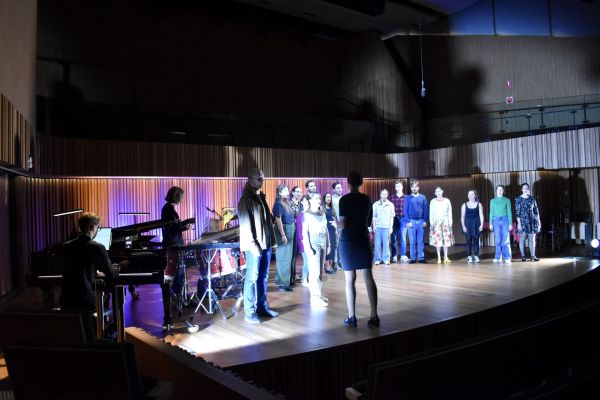
Students in the Faculty of Fine Arts and Music's Conservatorium of Music created a moving mini opera responding to the flooding and storms which hit Creswick in country Victoria in January 2022. Guided by Dr Gillian Howell, Dr Sarah Woodland and Professor Jane Davidson, students from the Master of Music (Opera Performance) devised the mini opera entitled ‘The Storm’, co-created with community members.
The artistic process began using media reports and articles as stimuli for initial musical responses. A short work was generated and shared with some flood-affected community members and their responses informed the development of the final opera. The exchanges between community members and students took place in a closed meeting and were deeply felt. The community members regarded the opportunity to have their stories documented as highly significant, permitting broader sharing and understanding of their confronting experiences. Verbatim testimony from the community members featured strongly in the final work and the students developed poetic and musical responses to the events and emotion described. The final opera is a poignant evocation of the storm and its aftermath, and a strong acknowledgement of what community members had experienced.
In October 2023, the students performed the completed version of The Storm at Clunes Town Hall near Creswick. The performance and subsequent de-brief were moving experiences for all involved. The Storm was reprised on 23 and 24 March at the Melbourne Mini Opera Festival, held in the Conservatorium of Music. Listen to reflections about Storm from performers and community members.
Enhancing awareness of the role of digital infrastructure for Climate Resilience
In 2023, the Faculty of Engineering and Information Technology held a forum on Digital Infrastructure for Climate Resilience. The one-day event aimed to bring together a global network of industry partners to discuss the challenges and opportunities for climate resilience, focusing on digital infrastructure and how it can promote climate resilience through connecting land, energy and infrastructure. The event was led by Professor Abbas Rajabifard and members of the CSDILA Research Centre, in collaboration with the World Bank.
Strong attendance on the day highlighted the number of professionals from diverse sectors who are interested in climate resilience, with over 150 industry representatives in attendance and 40 insightful presentations. Attendees benefitted from exposure to a broad range of ideas and applications of digital technologies to enhance climate change preparedness and resilience, and opportunities to network across diverse sectors. The event supported climate resilience in SP2030 by raising awareness of climate change impacts and opportunities to enhance preparedness through digital technology. The event also supported SP2030 priority areas 'Community of sustainability learners and practitioners' through the sharing of sustainability knowledge and ideas with staff, students and industry and 'Engagements and partnerships' by supporting the development of professional networks around climate resilience.
Our sustainability strategy
At the University of Melbourne, our efforts in sustainability are guided by Sustainability Plan 2030 - a roadmap for sustainable delivery of our institutional strategy Advancing Melbourne.
Read more about how we are advancing sustainability at the University:
