2023 Sustainability Report
Campuses as living laboratories
Domain: Amplifying action through campus and communities
Aspiration to 2030: The University’s campuses and operations enable real-world opportunities to develop, test and apply sustainability skills and solutions.

What are Campus Living Laboratories?
A campus living lab is an activity where an attribute of the University (e.g. physical asset, data asset, people or practices) is used as a real-world focus or setting for academic benefit (e.g. teaching, research), ideally with operational benefits as well. Living labs can involve:
- Experiments - activities that answer specific research questions and/or provide specific learning opportunities
- Platforms or enablers - underlying physical, digital or organisational infrastructure that enable / support multiple experiments
Progress against targets
| Target | Target status | Progress in 2023 |
|---|---|---|
| The University has curated living labs covering the priority areas of this Plan. |  In progress |
|
Explore our progress
and our stories

Our progress
Enhancing the curation of Campus Living Laboratories for sustainability
In 2023, the University conducted a review to understand key barriers to scaling up the University’s campus living lab activities. The review identified that successful living labs in the past were often the result of personal networks between academic and professional staff initiated by committed individuals. For those wanting to establish a living lab, it was often unclear what potential approvals might be required, leading to delays and frustration. Lack of resources, money and time to connect with the right people and navigate approvals often meant that promising ideas did not progress.
In order to scale up the University’s living labs, we need to find more effective ways to connect academic and professional staff around common interests. To address these issues, a guide was developed outlining a process that people can follow and sharing tips on how to increase chances of success. In 2024, the University will pilot a formal living lab program, offering seed funding to support the establishment of new living labs which address our sustainability challenges while drawing on the expertise of our academics and providing opportunities for research.
Engaging students in sustainability challenges on our campuses
The University’s sustainability teams continued their collaboration with academic staff and students, providing real-world examples of sustainability challenges for students to address in formal learning in 2023.
- The Sustainability team, Campus Management continued its strong collaboration with teaching and learning, providing input on sustainability issues on our campuses in 14 subjects at both undergraduate and postgraduate levels across three faculties.
- 14 interns completed 1360 sustainability internship hours across Campus Management. Projects focused on asset management, biodiversity, communications, smart buildings, energy and waste.
- The Sustainability Strategy team gave guest lectures in a range of subjects, including Environmental Engineering Capstone (ENEN 30001) and Introduction to High Performance Design (APBL90424)
- Professional staff from the University’s Property and Sustainability teams collaborated with academic staff from the Faculty of Engineering and Information Technology on the Bouverie Creek Living Laboratory, supporting an engineering subject focused on Environmental Management ISO14000.
Our stories
Fostering student learning on campus with the Bouverie Creek Living Laboratory
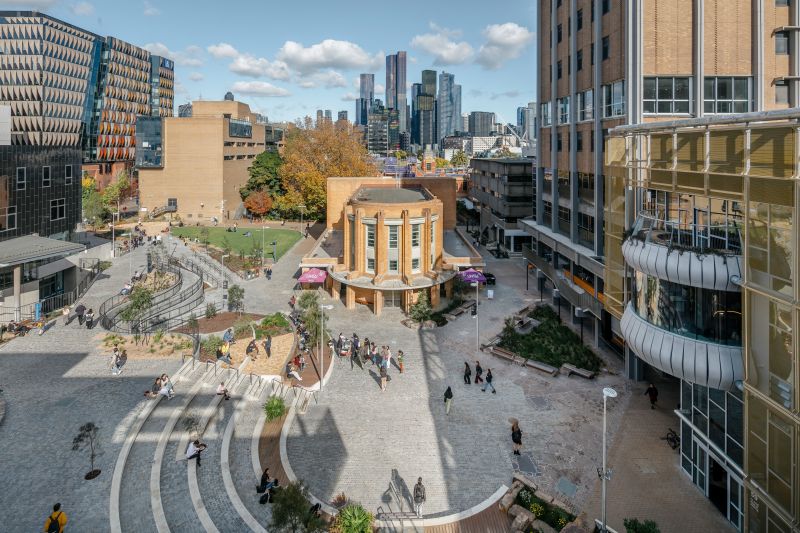
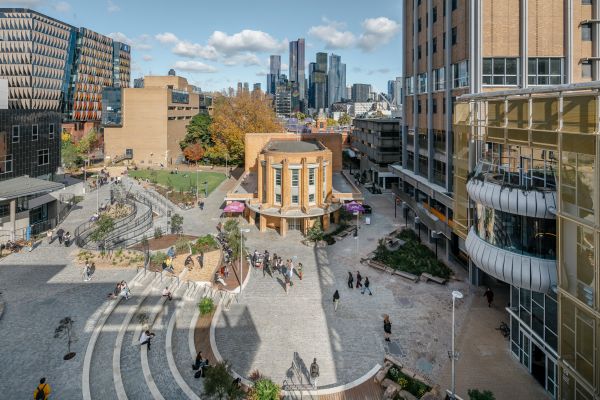
Before 1853, the University’s Parkville campus was part of a surface water system that included Bouverie Creek and swampy areas that supported river red gums. This land and water have been modified to suit the purposes of the University over time, but Wurundjeri Woiwurrung memory of the historic watercourse is now a signature feature of the Student Precinct Project development.
The Bouverie Creek Living Laboratory was created to enable place-based learning for students completing a graduate engineering subject, Environmental Management ISO14000 (ENEN90005). The project was developed collaboratively by a multidisciplinary team of over 20 academic and professional staff and external contractors, whose collective efforts supported student learning about interdisciplinary practices used in contemporary environmental management. The team developed a multi-faceted learning experience, which included a field trip on the Student Precinct Project site. Professional staff engaged directly with students to share their knowledge of campus facilities and management systems. Student feedback from the first implementation in April 2023 highlighted the benefits of field-based studies on the University’s campuses, and how this encouraged them to think deeply about their connection to the land on which they study.
The project received an Excellence Award in Professional Excellence and Innovation at the Faculty of Engineering and Information Technology’s 2023 Excellence Awards.
Ensuring the integrity of our carbon offset procurement
To achieve Climate Active-certified carbon neutrality by 2025, the University must first reduce emissions where possible, then purchase carbon offsets equivalent to the residual emissions. Complementary to our work on reducing emissions, the University has developed a Carbon Offset Procurement Framework, which outlines principles and a process to maximise our impact from carbon offset procurement.
The Framework was developed by researchers in Melbourne Climate Futures (MCF), in partnership with the University’s Sustainability Strategy Team and the City of Melbourne. There are significant complexities in the carbon offset market, with a vast range of different products and projects available. These vary considerably in their quality and integrity, and are governed by differing standards and regulations. The Framework provides clear guidance to the University on how to select a portfolio of carbon offsets to balance risk, appropriately align with our broader goals, adhere to global best-practice and address budgetary constraints.
The University’s Treasury and Sustainability Strategy Teams successfully piloted the approach in 2023, purchasing carbon offsets to meet the University’s 2023 commitments (see carbon offsets table). Feedback to MCF following the pilot has resulted in an updated framework that will guide future carbon offset purchases for the University, with a goal to share the learnings more widely in 2024.
Our sustainability strategy
At the University of Melbourne, our efforts in sustainability are guided by Sustainability Plan 2030 - a roadmap for sustainable delivery of our institutional strategy Advancing Melbourne.
Read more about how we are advancing sustainability at the University:
