2024 Sustainability Report
Just and circular economy
Domain: Walking the talk in our operations
Aspiration to 2030: The University’s approach to the procurement and use of products, services and materials has stimulated a more just and circular economy and catalysed change in our campus communities.
Progress against targets
| Target | Target status | Progress in 2024 |
|---|---|---|
| The University has reduced waste to landfill to 10kg per person. |  In progress |
|
| The University has reduced flow and improved circularity of materials passing through the University. | In progress |
|
| The University has principles for ethical and sustainable consumption and service provision embedded into operations and procurement practices. |  On track |
|
| The University tracks spend with social and Indigenous suppliers, setting targets from 2024. | In progress |
|
Explore our progress
and our stories


Our progress
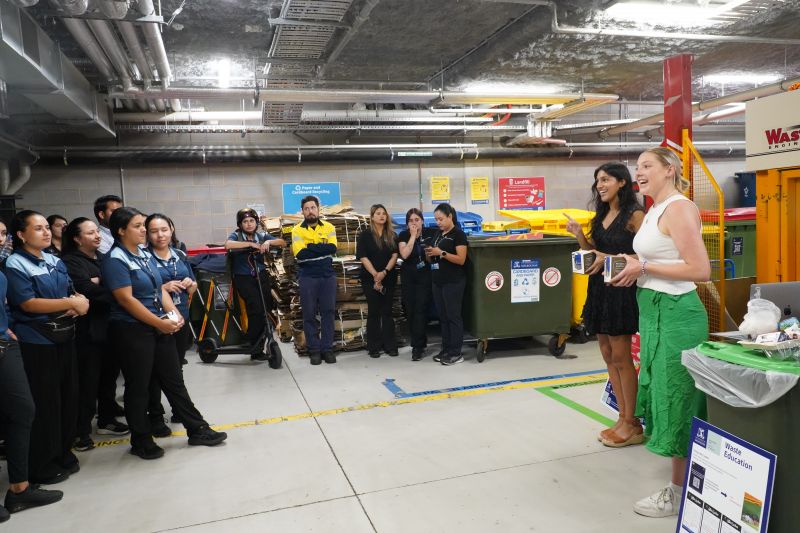
In 2024, waste to landfill dropped from 22.5 kg to 18.5 kg per person, an 18 per cent reduction from 2023. This improvement reflects initiatives like expanding organics collection, trialling soft plastics collection, and enhancing waste education. The reuse programs including the Furniture Equipment and Reuse Service and the Choose to Reuse Plate program significantly increased their impact, preventing almost 300,000 items from going to landfill.
Ethical and sustainable procurement is on track, with progress in modern slavery risk assessments, sustainability tagging in the University’s eMarket, and mandatory adherence to the supplier code of conduct. Additionally, the University is embedding social and Indigenous procurement targets, working with key partners to drive impact in major contracts.
Total waste to landfill and recycling | 2017-2024
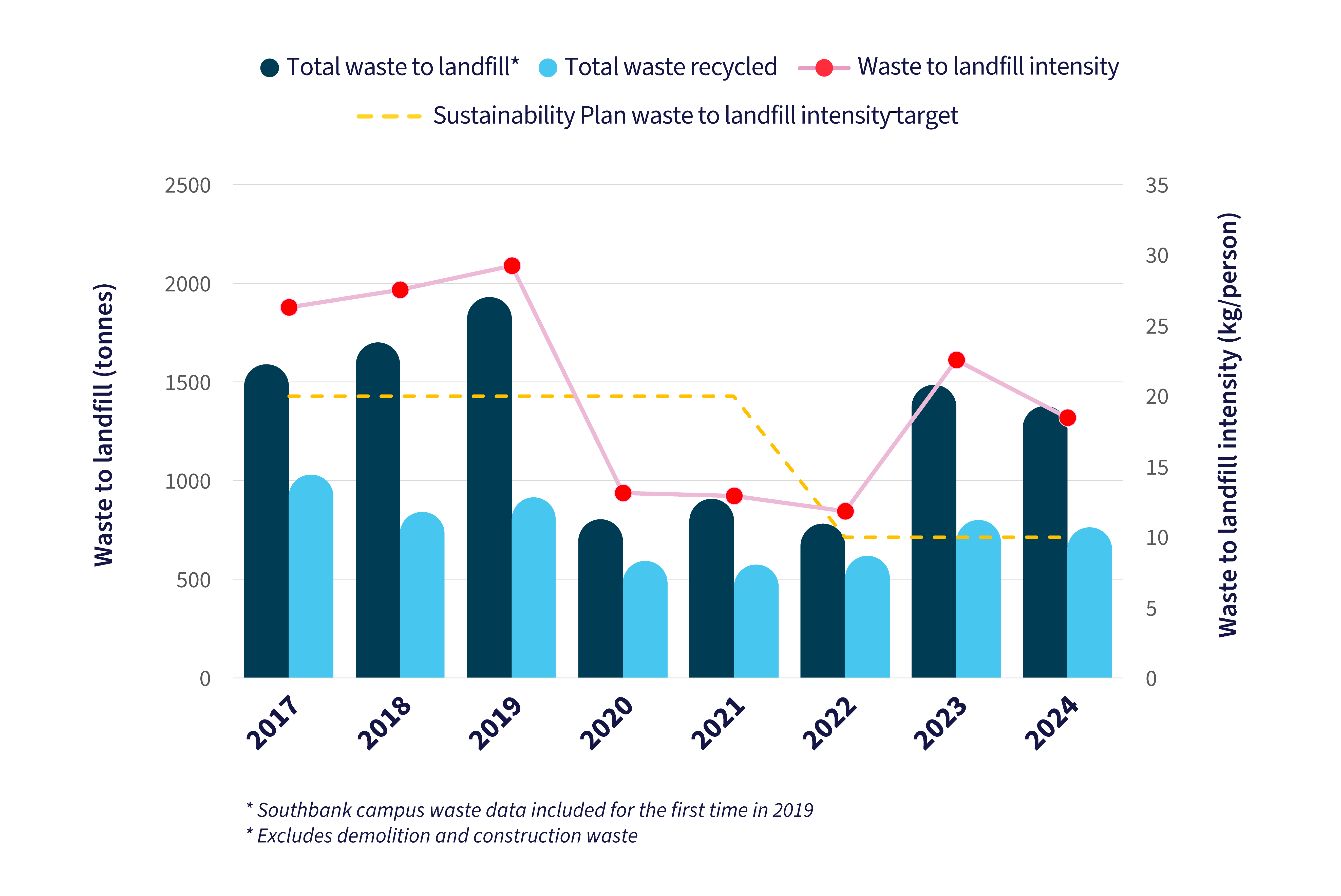
Click here to see data table of dataset used above
Our stories
Improving circularity at Parkville: Enhancing cardboard recycling
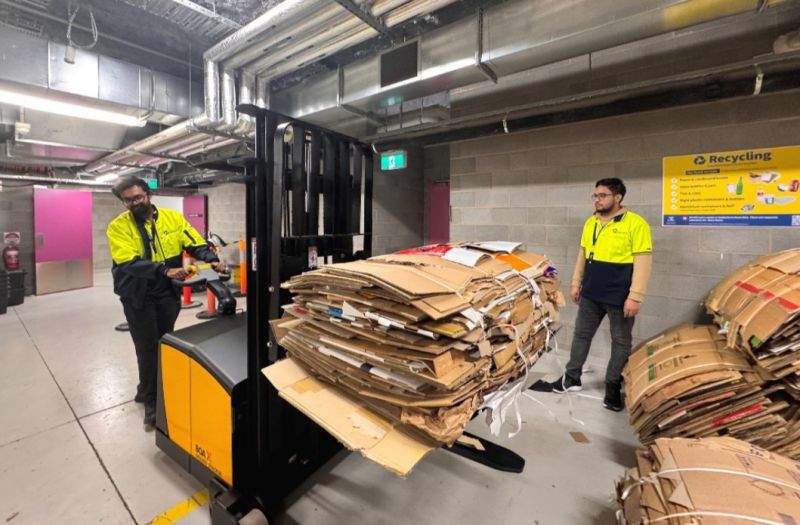
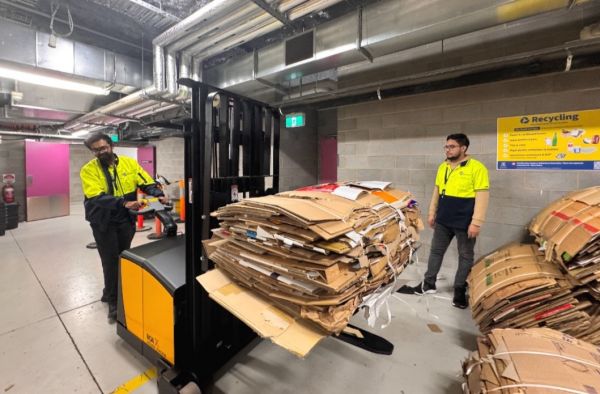
Cardboard is a valuable resource, but unfortunately it often ends up in general waste or recycling bins rather than designated paper and cardboard bins. In September 2024, the Cleaning team onboarded two dedicated ISS cleaning staff members to serve as Waste Monitors to improve the circularity of cardboard. Their role was to expand cardboard collection and other waste streams across the Parkville campus. This included reducing contamination, transporting cardboard to a waste hub and baling it for collection. This process produces 10 bales per week, each weighing 100 kg. Since the initiative began, 23 tonnes of cardboard have been collected, improving recycling, waste recovery, and reducing contamination levels.
This collaboration improved communication between the University and the cleaning contractor, enabling better waste management and reducing landfill waste costs. In 2025, a cardboard compactor will be installed on the Parkville campus to further improve collection.
Repurposing green waste on our campuses
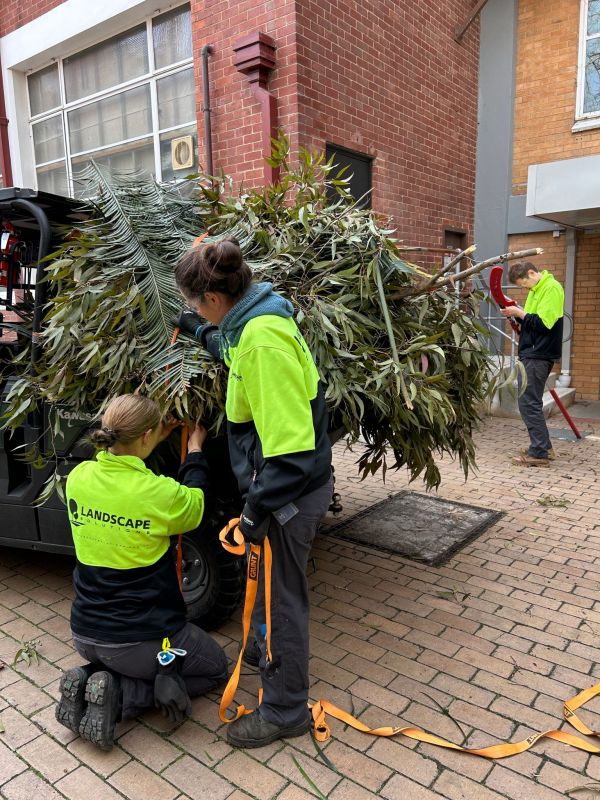
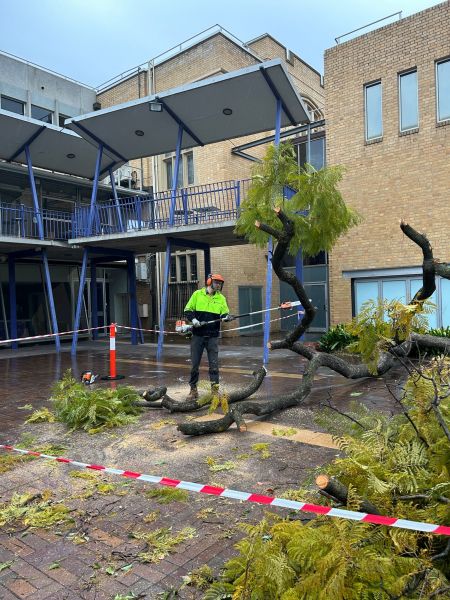
The University’s Grounds team collaborated with Landscape Solutions and Repurpose It, a closed loop resource recovery facility, to maximise the reuse of green waste that is removed from the University’s campuses. Hard green waste, vegetation, leaf litter and small branches are now kept out of landfill and recycled into mulch, soil and compost. These products are then brought back on to our campuses and used in garden beds. In 2024, 66.1 tonnes of material were processed, with approximately 413m3 of mulch redistributed across the gardens and grounds of the Parkville and Werribee campuses. In 2025, the program aims to expand to the Burnley campus. Bringing repurposed mulch back to the University has resulted in a reduced need for chemical treatment of weeds and fertiliser application, leading to increased productivity in the other areas of ground maintenance. The mulch has also improved water retention in garden beds, reducing irrigation requirements during warm weather, and increased biodiversity through a healthier soil profile.
Minimising polystyrene use in laboratory packaging
After a laboratory raised concerns about excessive packaging for small consumables, the Sustainability and Procurement teams formed a working group to investigate the issue. Their findings revealed that polystyrene was used unnecessarily, i.e. insulating and protective packaging requirements were not called for. While polystyrene can be recycled if collected and processed separately, it does not break down naturally and can cause significant environmental damage.
To address this issue, the working group conducted a supplier survey to assess current packaging practices for research consumables and explore alternative materials. Procurement Stores increased clean waste stream collection by manually removing contaminant from the polystyrene packaging. As a result, in 2024, the University reduced its polystyrene packaging consumption by 24 per cent, indirectly helping to reduce carbon emissions from its production, cutting collection costs and reducing polystyrene going to landfill. The University remains committed to further reducing its reliance on polystyrene and is investigating reusable packaging options, with the ultimate goal of eliminating its use.
Optimising waste management with visual audits
To improve waste management, the University and cleaning contractor ISS partnered with Shrunk to launch the Litter Looker program in August 2024. This initiative enabled cleaning staff to capture images of bins across campus for visual audits, identifying contamination sources and opportunities for additional waste streams or improved signage.
By the end of the year, almost 3,000 visual audits were conducted, revealing significant contamination and mismanagement, particularly with cardboard, paper towels and soft plastics. These findings have enabled the University to tailor waste education and training for ISS staff and building users more effectively.
A student volunteer trial for front-of-house bin audits was also conducted and will become a dedicated program in 2025. The University will expand Litter Looker to other campuses to identify contamination hotspots, optimise waste separation, and implement targeted waste interventions.
Addressing sustainability in our supply chain
Procurement related greenhouse gas (GHG) emissions made up the majority (~60 per cent) of GHG emissions in 2024. The University is partnering with suppliers to gather specific GHG emissions data related to the University’s actual procured goods and services and reduce procurement related GHG emissions.
This approach has four key elements:
- Maturing the collection of GHG data: the University has started to move from solely using generic spend- based factors to tracking company specific GHG data to capturing actual supplier GHG emissions. This approach has significantly improved the accuracy of emissions reporting. In several cases this enhanced reporting has resulted in a reduction in the amount of emissions recorded against particular contracts. Specific and targeted accounting has also enabled the University to more accurately track supplier GHG emission performance over time.
- Utilisation of global standards: Science Based Targets initiatives (SBTi) and emission reduction targets are now being included in the contracts for key categories of spend ensuring emission reduction targets are aligned or validated with a global standard.
- The University is assisting the journey its largest suppliers are taking to reduce their GHG footprint via education, workshops (such as the Symposiums), and two-way discussions on the University’s approach.
- The University is taking a collaborative approach, sharing emission reduction activity insights across the University sector to enhance efficiency for universities and their suppliers i.e. tender questions, contract clauses and investigating options for reporting.
Student stream:
Promotion of Migrant Justice Institute research survey for international students completed (207 UoM specific responses). Research outcomes and UoM tailored report to improve support services is expected from Q1 2025.
Supply chain stream:
The University is a member of the Australasian Universities Procurement Network Modern Slavery Sector Risk Working Group that aims to establish a transparent, effective, and scalable process to leverage collective university resources to manage and remediate shared supplier’s modern slavery risk. 2024 activity focused on medical equipment & laboratory supplies, sending SAQs to 72 suppliers, with 47 responding. In 2025 five suppliers have been approached to pilot a collaborative continuous improvement plan approach, focused on areas of opportunity identified in their 2024 SAQ responses.
In 2024 modern slavery due diligence continued to be reviewed through the University’s supplier onboarding uplift project, which includes modern slavery risk including sanctions as considerations in the onboarding risk evaluation matrix.
Controlled entities stream:
During the reporting period, an information session was held for University of Melbourne controlled entities which included highlighting modern slavery obligations. Modern slavery risks were assessed and mitigations discussed with each entity.
Research stream:
RIC has been preparing for the transition to the new RMS and ERP systems which seek to streamline due diligence processes via system reporting (which includes assessing partner risks). This reporting includes identification of new parties, applying flags to parties that require further assessment, and the classification of different customer types using an integrated organisation identification database.
Our sustainability strategy
At the University of Melbourne, our efforts in sustainability are guided by Sustainability Plan 2030 - a roadmap for sustainable delivery of our institutional strategy Advancing Melbourne.
Read more about how we are advancing sustainability at the University:
