2025 Sustainability Report
Just and circular economy
Domain: Walking the talk in our operations
Aspiration to 2030: The University’s approach to the procurement and use of products, services and materials has stimulated a more just and circular economy and catalysed change in our campus communities.
Progress against targets
| Target | Target status | Progress in 2025 |
|---|---|---|
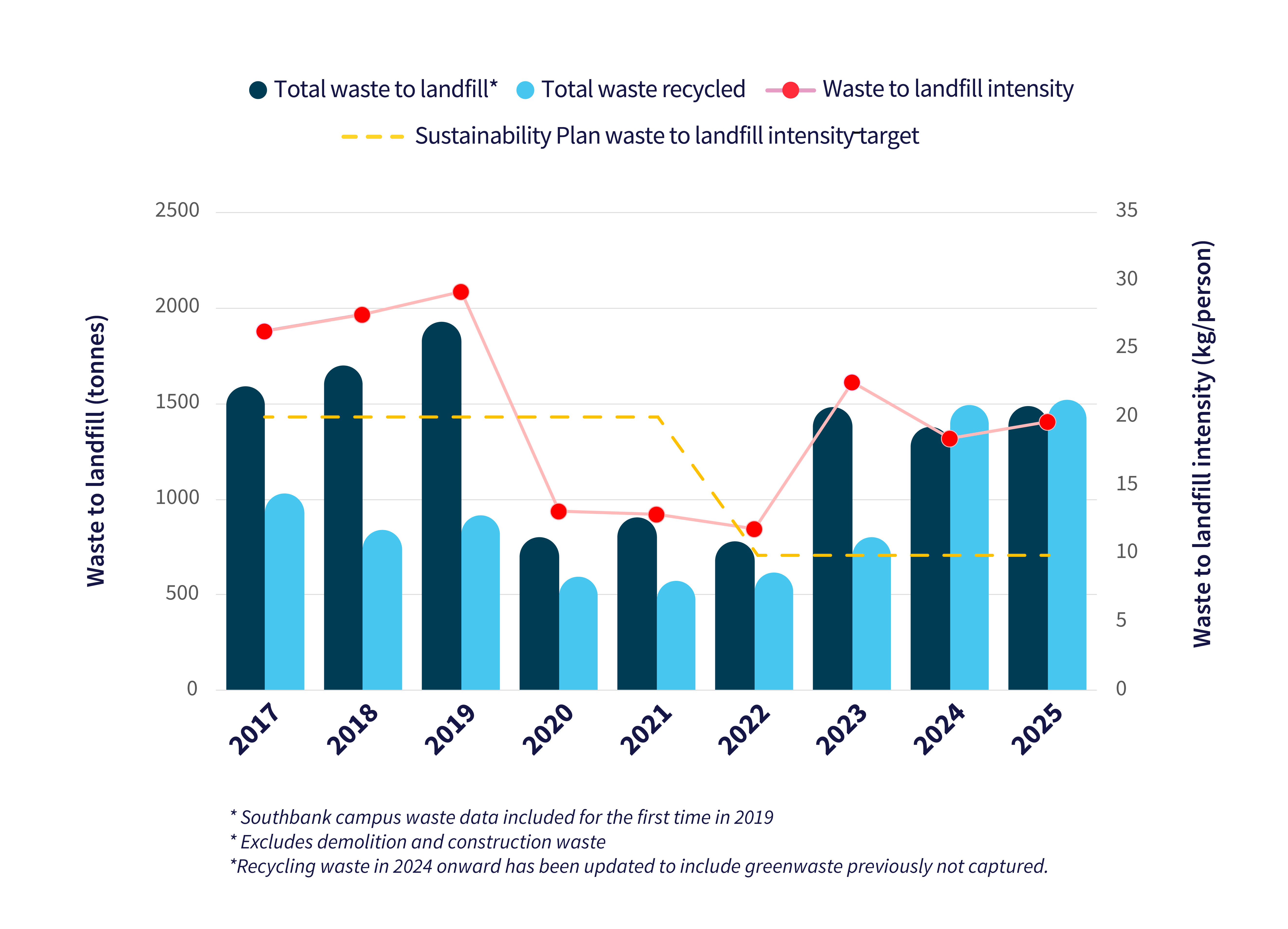
| The University has reduced waste to landfill to 10kg per person. |  | Waste-to-landfill totalled 18.3 kg per person, comparable with 18.5 kg in 2024 and above the 10kg target. |
| The University has reduced flow and improved circularity of materials passing through the University. | | While there were efforts to determine how to measure progress against these indicators, an overall circulatory approach for the University has not yet been developed. Improving the measurement of circularity at the University will be an area of focus in the refresh of Sustainability Plan 2030 in 2026. |
| The University has principles for ethical and sustainable consumption and service provision embedded into operations and procurement practices. |  |
|
| The University tracks spend with social and Indigenous suppliers, setting targets from 2024. | | The University tracks Indigenous and social impact spend and has established a target of three per cent addressable spend for Indigenous spend by 2027; and a one per cent target for social spend. |
Our progress
Waste performance
In 2025, the University continued its efforts to reduce waste sent to landfill. While positive progress was made towards reducing waste in key streams, the University's target of reducing waste to 10kg per person by 2025 was not achieved. Waste-to-landfill totalled 18.3 kg per person, comparable with 18.5 kg in 2024, reflecting the complexity of managing waste across a large and diverse campus.
To increase the visibility and traceability of waste streams, the University improved oversight of on-campus waste, investing in critical infrastructure such as waste transport systems, cardboard and landfill compactors. It also strengthened its waste diversion strategy through the targeted expansion of its organics program and enhancements to back-of-house food waste collection. This enabled organic waste to be recovered from an additional 11 retailers on campus, bringing total participation to 26 retailers, and diverting approximately 43 tonnes of food waste from landfill. This initiative is expected to continue expansion in 2026. Complementary initiatives, including a soft plastics collection trial in high-volume areas, further improved diversion outcomes, diverting 0.5 tonnes from landfill. Additionally, a container deposit scheme (CDS) removed 2.2 tonnes from landfill and comingled recycling streams, collecting 55,714 CDS items.
In 2026, the University will focus its efforts on improving waste management on its campuses, including reviewing its targets as part of the Sustainability Plan 2030 refresh. Current plans focus on investing in specialised waste infrastructure to improve oversight, tracking accuracy, contamination reduction and waste sorting.
Total waste to landfill and recycling | 2017-2025
Click here to see data table of dataset used above
Demolition waste and circular economy
The University is working to quantify construction and demolition waste from its development projects. In 2025, data was available for two major projects. The demolition of the Brownless Library and Australian Institute of Infectious Diseases early works resulted in 22,184 tonnes of total waste removed, with 98 and 95 per cent diverted from landfill, respectively.
The proportion of materials and equipment managed at end-of-use according to circular economy principles has not been quantified overall for the University. However, 12.5 tonnes of landfill was avoided as a result of 578 items collected by Project Net Zero, a 100 per cent Indigenous-owned business. The Furniture and Equipment Reuse Service repurposed 5325 items (89 tonnes), with a replacement value of $2.2 million. This was 24 per cent fewer items than in 2024 due to a reduced supply of items in 2025 across the University available to be repurposed. In terms of sustainable procurement, in 2025 the University enhanced its systemic approach to addressing this target, by embedding more outcome-focused questions in tenders, enhancing modern slavery clauses and implementing an improved process to collect subcontracted impact spend. Since 2020, the University has reported on modern slavery, with the 2025 Modern Slavery Statement due to be published in June 2026. The University’s Supplier Code of Conduct is also embedded in the supplier onboarding process for all suppliers.
Tracking Indigenous and social procurement spend
The University tracks Indigenous and social impact spend and has established a target of 3 per cent addressable spend for Indigenous spend by 2027 (Murmuk Djerring target); and a 1 per cent target for social spend.
Indigenous spend: In 2025, the University’s direct expenditure with Indigenous businesses totalled $1.76 million which is an increase of $140,000. This managed spend marks a measurable increase from its baseline, however it remains below the Murmuk Djerring target of 3 per cent addressable spend by 2027 and improvements can be made in this area. In 2025, indirect (subcontracted) spend was $234,000. The construction sector was the major contributor to this increase. In 2025, the University formed an Indigenous Procurement Working Group made up of key University cross-functional representatives to better enable progress in this area.
Social spend: In 2025, the University’s direct expenditure on social businesses totalled approximately $950,000 with 24 suppliers.
Our stories
A circular approach to demolition and site renewal
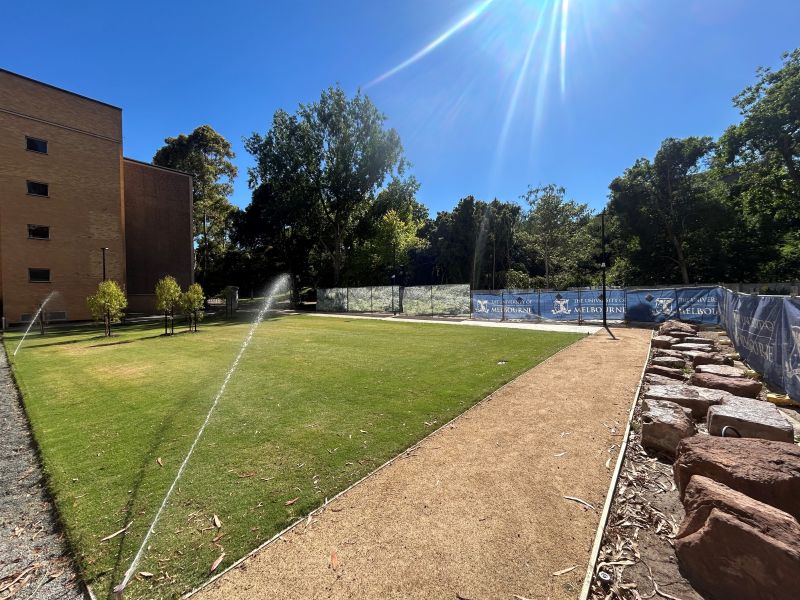
The demolition of the Brownless Library was undertaken to enable the future construction of a new University development. Delivered by the University’s main contractor, Kane Constructions, with demolition works undertaken by City Circle, the project adopted a strong circular economy approach to ensure the site continued to serve a purpose and to manage waste responsibly. Materials were prioritised for reuse, recovery and donation wherever possible, embedding resource stewardship into every stage of demolition.
In total, 5,148 tonnes of waste were removed, with 98 per cent diverted from landfill. The University also partnered with Project Net Zero, a 100 per cent Indigenous-owned business, to maximise material recovery and divert reusable items from landfill. Through this partnership, 578 items were recovered, avoiding 2.5 tonnes of landfill. A further 508 items were donated to Habitat for Humanity Victoria, extending the life of valuable materials while supporting the community.
Significant building fabric was reused, including approximately 3,000 bricks, two pallets of carpet tiles, 42 doors and six 1m x 1m precast concrete panels. Post-demolition, the site was transformed into a temporary green space featuring 100 per cent salvaged brick paving. Bricks were laid on a sand bed to enable future uplift and reuse, embedding circularity into the installation method.
Strengthening waste visibility across campus
In 2025, the University transformed its waste operations through strategic investment and the internalisation of collections, acquiring an electric compactor truck, an electric waste tug and trailer, and leased landfill and cardboard compactors. With the support of ISS, the University’s cleaning contractor, these assets enabled the movement and consolidation of all landfill and cardboard waste in-house, providing direct operational control before external disposal.
This new approach shifted operations from a contractor-scheduled model to an actively managed system, improving waste visibility, reducing contamination, and increasing recycling outcomes, particularly for cardboard. By the end of 2025, the University reduced bulk skip services by 62 per cent and rear-lift collections by 24 per cent, demonstrating more efficient waste consolidation and servicing.
These new processes will further reduce landfill through improved segregation and higher-quality recycling streams, while supporting evidence-based decision-making at or near cost neutrality. Additionally, the expansion of the electric waste fleet will contribute to lower diesel emissions and reduce reliance on external waste trucks.
From waste to resource: soft plastics collection program
In 2025 the University introduced a targeted soft-plastic collection program at seven back-of-house loading docks across the Parkville campus. These locations were chosen because of their high delivery volumes and consistent generation of soft plastics such as pallet wrap.
The program successfully diverted approximately 0.5 tonnes of soft plastics from landfill, reinforcing the need to develop tailored recycling strategies to achieve effective improvements in waste management operations. Collected materials were transported offsite to recycling partners, where they were shredded and processed into oil. This oil is then refined into resin for new plastic consumer goods, combined with upcycled materials to produce kitchen benchtops, roof panels and wall materials, or used as an asphalt additive in road construction.
In future, the University plans to increase collection capacity at existing locations, expand the program to additional loading docks and campuses, and partner with a new service provider to reduce costs and streamline collections.
Our sustainability strategy
At the University of Melbourne, our efforts in sustainability are guided by Sustainability Plan 2030 - a roadmap for sustainable delivery of the University's Strategy 2030: Resilience.
Read more about how we are advancing sustainability at the University:
