2025 Sustainability Report
Responsible investments
Domain: Walking the talk in our operations
Aspiration to 2030: The University’s investment portfolio and strategies support our aspiration to be leaders for a sustainable future.
Progress against targets
| Target | Target status | Progress in 2025 |
|---|---|---|
| The University’s investment portfolio[7] will be included in our commitment to be climate positive by 2030.[8] |  |
Estimated carbon emissions from listed equities (Australian Equities and International Equities), Credit and Fixed Interest components of the University’s Investment Portfolio are reported below. This data informs how the University considers and manages the inclusion of its Investment Portfolio within its climate positive commitment. |
| Enhanced transparent reporting of the University’s investment portfolio. |
|
Metrics reported across listed equities, Credit and Fixed Income) include:
Metrics reported for listed equities only:
Coverage Expansion: In 2025, reporting on absolute financed carbon emissions from Credit and Fixed Income asset classes were added for the first time, reflecting the University’s commitment to progressively increasing reporting coverage as methodologies and data coverage improves in the industry. The University continues to explore ways to estimate the absolute financed carbon emissions of the balance of the Investment Portfolio. |

Our progress
This section reports on progress against the University’s Responsible Investment commitments under Sustainability Plan 2030. It focuses on transparency using currently available industry data and methodologies. The reported metrics do not represent full coverage of the University’s Investment Portfolio and should be interpreted as directional over long-term trends rather than definitive. Reporting scope will continue to expand as data quality and methodologies improve.
The University’s Investment Portfolio is managed separately from its operational activities. The investment model for financial assets is predominantly outsourced, consistent with our investment scale and focus on leadership and excellence in education and research. The prudent and responsible investment of the University’s accumulated financial resources and funds donated to the University underpin the activities of the University to enable it to achieve its purpose.
The University’s Implemented Consultant, JANA, provides strategic investment advice to the University and implements the investment strategy on behalf of the University through external investment managers. The University’s strategic investment decisions are implemented by JANA primarily via investment in pooled investment trusts. Therefore, the University does not make individual investment decisions on whether to buy or sell specific company holdings, nor does it undertake direct activity with respect to corporate actions.
JANA has a long history of successfully providing investment consulting and investment management services in Australia and integrates sustainability considerations into investment decisions.
Responsible investment metrics
Summary
For 2025, the University is reporting on responsible investment metrics first reported in 2022, with the only change in 2025 being the expanded coverage of absolute financed carbon emissions reporting, to include other asset classes in the Investment Portfolio.
As of 2025, the University includes absolute financed carbon emissions reporting for credit and fixed interest, in addition to listed Australian equities and international equities. This coverage represents slightly under three quarters of the University’s Investment Portfolio by investment value and reflects asset classes that have reasonable data and calculation methodologies available. This represents an increase of around one quarter of the portfolio.
A key challenge with responsible investment reporting is the breadth and consistency of data available from data vendors to support good quality reporting. The University is committed to evolving its reporting as available data improves.
The University acknowledges that drawing definitive conclusions from absolute financed carbon emissions data remains challenging, even as methodologies improve. While it may take several years to draw robust conclusions and interim data may not always show linear progress, given the inherent complexity of these assessments, it is essential to remain engaged in this process and collaborate with like-minded investors to advocate for improved practices.
Metrics
The metrics reported for June 2025 broadly align with prior years, though material data revisions have occurred due to evolving methodologies and improvements in reporting by companies and data providers. JANA, utilising external data providers, estimated the University’s financed emissions using the ‘Enterprise Value Including Cash’ (EVIC)[10] method. This approach measures the University’s share of a company’s emissions based on its proportionate investment in the company’s total value. This method is consistent with the Paris Aligned Investment Initiative’s Net Zero Investment Framework (PAII NZIF) and estimates financed emissions using the Partnership for Carbon Accounting Financials (PCAF) standard.
The EVIC method enables the University to actively monitor the absolute financed carbon emissions of its Investment Portfolio, while also providing JANA with actionable data to engage investment managers on the emissions profile of their investments.
There are recognised limitations with estimating financed carbon emissions and the EVIC method itself, including:
- Share price movements, which affect the attribution of emissions between equity and debt holders
- Data methodology updates, impacting consistency and comparability
- The adequacy of company disclosures, which influences data quality
- Historical emissions data, which does not account for forward-looking actions such as net-zero commitments and implementation plans
Key industry bodies, including those that the University and JANA are members of, continue to review these limitations, and advocate for enhanced disclosures and methodologies used in calculating absolute financed carbon emissions
Estimated absolute financed carbon emissions and financed carbon intensity of the University’s investments[11]
Equities investments for year ended 30 June 2025 | UoM absolute financed carbon emissions | Benchmark financed carbon emissions | UoM financed carbon emissions intensity | Benchmark financed carbon emissions intensity |
|---|---|---|---|---|
Measurement units | tCO2-e | tCO2-e | tCO2-e / AUD m invested | tCO2-e / AUD m invested |
Australian Equities | 57,483 | 49,827 | 52.6 | 45.6 |
International Equities | 27,910 | 34,989 | 23.4 | 26 |
| Credit | 9,312 | N/A | 43.1 | N/A |
| Fixed interest | 28,676 | 58,583 | 54.3 | 112.9 |
Total (Australian and International Equities) | 123,381 | 143,399 | 38.2 | 48.6 |
The University’s total reported absolute financed carbon emissions increased by 15 per cent in the year ended 30 June 2025. This increase primarily reflects expanded reporting coverage, with Credit and Fixed Interest assets reported for the first time.
On a comparable basis, financed emissions for Australian and International Equities declined in both absolute terms and intensity.
Year on year comparison of University estimated financed carbon emissions[12]
| 2024 | 2025 | Change | |
|---|---|---|---|
| Measurement units | tCO2-e | tCO2-e | tCO2-e |
| Australian equities | 75,918 | 57,483 | -18,435 |
| International equities | 30,938 | 27,910 | -3,028 |
| Credit | Not reported | 9,312 | +9,312 |
| Fixed interest | Not reported | 28,676 | +28,676 |
| Total (of reported asset classes) | 106,856 | 123,381 | 16,525 |
Year on year comparison of University estimated financed carbon emissions intensity[12]
| 2024 | 2025 | Change | |
|---|---|---|---|
| Measurement units | tCO2-e / AUD m invested | tCO2-e / AUD m invested | tCO2-e / AUD m invested |
| Australian equities | 66.4 | 52.6 | -13.8 |
| International equities | 26.5 | 23.4 | -3.1 |
| Credit | Not reported | 43.1 | N/A |
| Fixed interest | Not reported | 54.3 | N/A |
| Total (of reported asset classes) | 46.2 | 38.2 | -8.0 |
The University monitors the sustainability performance of the Investment Portfolio (noting the limitations mentioned earlier) by annually reviewing the data and engaging JANA on its activities and those of the underlying investment managers. The University recognises the importance of medium-to-long-term trends rather than short-term fluctuations, particularly in the context of forward-looking, Paris-aligned commitments and variable source data.
Trend analysis must be complemented with qualitative, forward-looking evaluations for a comprehensive assessment. JANA’s Net Zero Manager Assessment framework evaluates investment managers’ net zero commitments, strategies, and the robustness of their actions. Insights from these assessments inform JANA’s engagement and stewardship initiatives, enhancing the University’s net zero ambition and actions towards the transition.
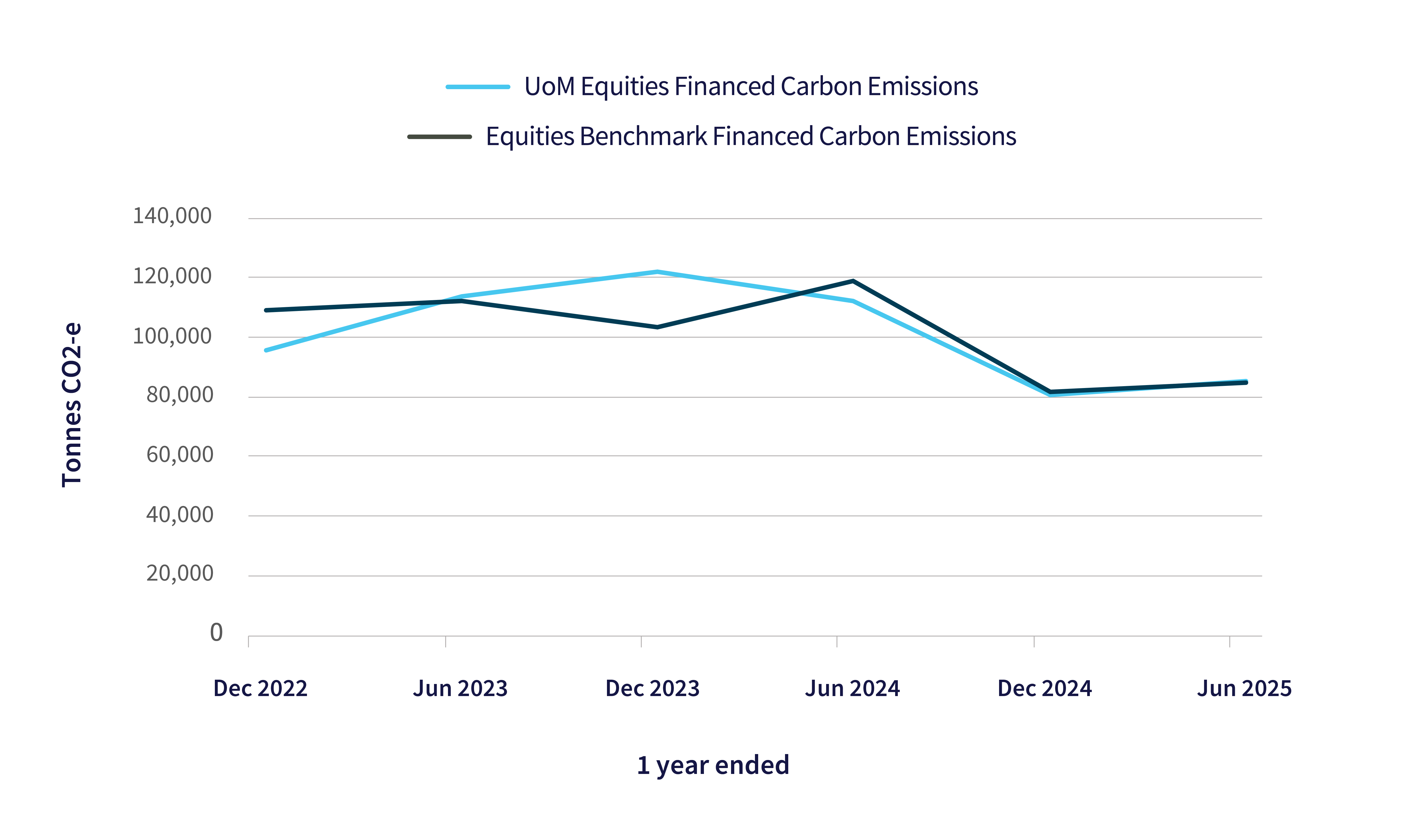
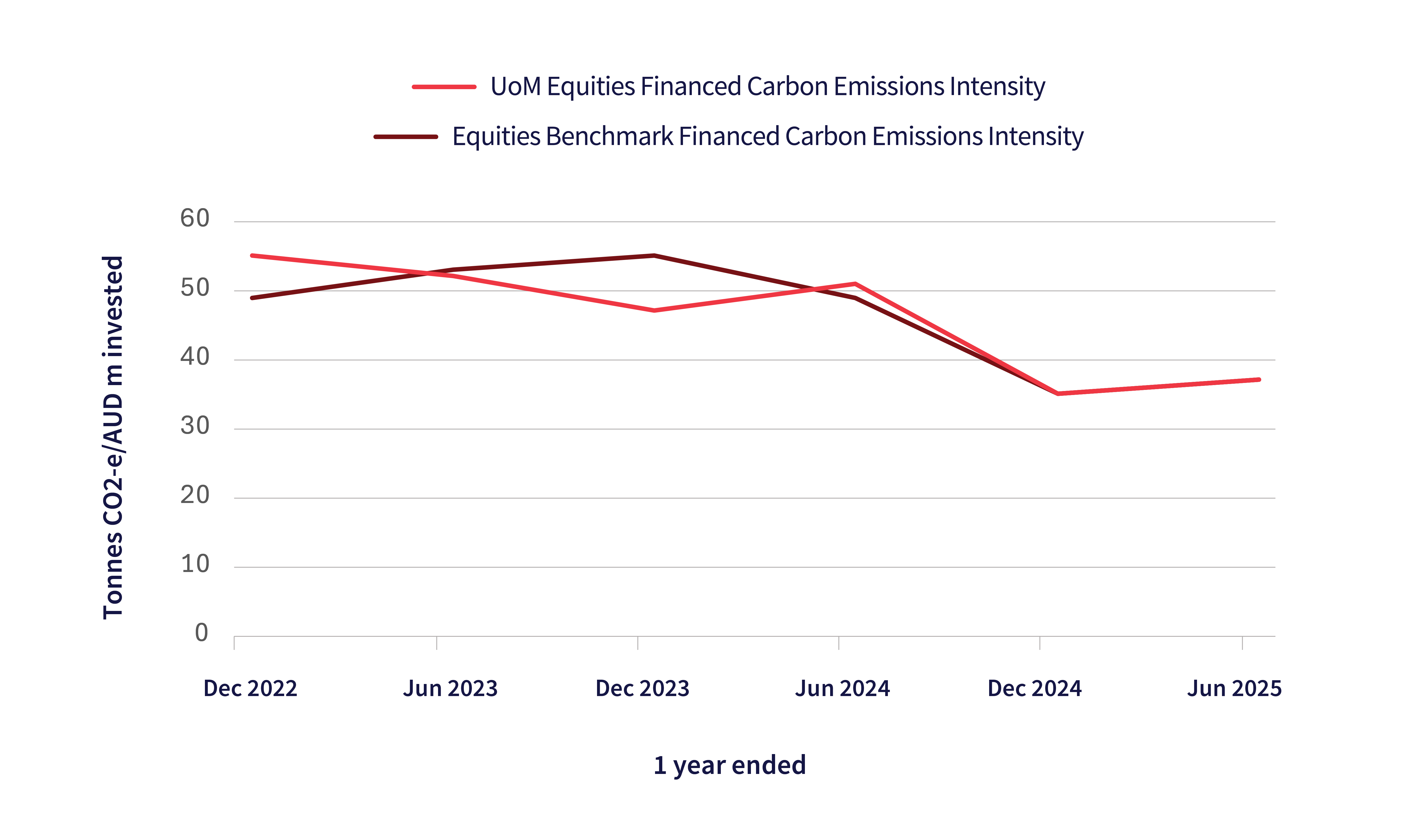
The following charts provide historical data on the absolute financed carbon emissions and financed carbon emissions intensity for the listed equities investments reported by the University.[13] Please note that these figures are best understood within the broader context of the University’s commitment to sustainability and the focus on longer-term trends, strategies and actions described above.
Estimated absolute financed carbon emissions from listed equities over time
Estimated financed carbon emissions intensity from listed equities over time
Top 20 listed equities holdings by value as of 30 June 2025
| No. | Stock Name | Sector | % of total listed equities (based on $ invested) |
|---|---|---|---|
1 | Commonwealth Bank of Australia | Financials | 3.7 |
2 | BHP Group Limited | Materials | 2.9 |
3 | Microsoft Corporation | Information Technology | 2.2 |
4 | CSL Limited | Healthcare | 2.1 |
5 | Macquarie Group Limited | Financials | 1.6 |
6 | National Australia Bank Limited Group | Financials | 1.6 |
7 | Goodman Group | Financials | 1.4 |
8 | Australia and New Zealand Banking Group Limited | Financials | 1.1 |
9 | Visa Inc. | Financials | 1.1 |
10 | Westpac Banking Corporation | Financials | 1.1 |
11 | Amazon.com. Inc. | Consumer Discretionary | 1.1 |
12 | Taiwan Semiconductor Manufacturing | Information Technology | 1.1 |
13 | Linde plc | Materials | 1 |
14 | Parker-Hannifin Corporation | Industrials | 0.9 |
15 | NVIDIA Corporation | Information Technology | 0.8 |
16 | American Express Company | Financials | 0.8 |
17 | Booking Holdings Inc. | Consumer Discretionary | 0.8 |
18 | Alphabet Inc. | Communications Services | 0.8 |
19 | Orica Limited | Materials | 0.8 |
20 | Wesfarmers Limited | Consumer Discretionary | 0.7 |
Top 20 | 27.7 | ||
The top 20 holdings by size comprise approximately 28 per cent of listed equities’ value and contribute approximately 10 per cent of listed equities’ absolute financed carbon emissions.
Listed equities sector exposures and estimated absolute financed carbon emissions
| Sector | % of total listed equities ($ invested) | Estimated UoM carbon exposure (tCO₂e) |
|---|---|---|
Financials | 22.3 | 180 |
Information Technology | 16.7 | 1,338 |
Materials | 11.8 | 38,761 |
Industrials | 10.7 | 7,774 |
Health Care | 10 | 782 |
Consumer Discretionary | 9.1 | 1,007 |
Consumer Staples | 4.7 | 1,909 |
Real Estate | 4 | 540 |
Communication Services | 2.7 | 261 |
Energy | 2.6 | 5,282 |
Utilities | 1.8 | 22,221 |
Reporting from JANA shows that the University’s holdings are distributed across a wide range of sectors. Some of these sectors are traditionally relatively low carbon emitters, for example the financials, healthcare and IT sectors. Others, such as the materials, energy and utilities sectors, are more carbon intensive. These are also sectors that are important to the energy transition and decarbonisation solutions.
Additional governance information
The University’s Responsible Investment Guide was drafted through consultation with Melbourne Climate Futures and developed in collaboration with the University’s Implemented Consultant. The Guide was subsequently updated in 2025.
The University became a signatory to the Principles for Responsible Investment (PRI) in 2020 and reports its responsible investment activities regularly to the PRI.
Green bond
The University’s Green Bond, issued in 2022 under our Sustainability Financing Framework, undergoes an annual independent review to ensure ongoing alignment with the Green Bond Principles, a set of voluntary, market-led guidelines issued by the International Capital Market Association (ICMA). For the period ending 31 December 2025, DNV Business Assurance Australia Pty Ltd completed their review and confirmed that nothing came to their attention that causes them to believe the University’s Green Bond does not meet the criteria established in the Eligibility Assessment Protocol and is therefore aligned with Green Bond Principles.
Footnotes
[7] This will include investments in the University’s Investment Portfolio for which the carbon footprint can be reasonably measured or estimated.
[8] Demonstrated carbon emissions reduction outcomes beyond the scope required for Climate Active Carbon Neutral certification.
[9] Principles for Responsible Investment.
[10] Absolute financed carbon emissions are measured using ‘Enterprise Value Including Cash’ (EVIC) allowing measurement of an investor’s share of emissions proportional to its exposure to the investee’s total value. EVIC is defined as the sum of the market capitalisation of ordinary shares and preferred shares at fiscal year-end, and the book values of total debt and minorities’ interests. No deductions of cash or cash equivalents are made to avoid the possibility of negative enterprise values.
[11] Notes:
The emissions data is limited to what the underlying companies report and what JANA’s data providers (MSCI and FactSet) estimate. Note that emissions data covers Scope 1 and Scope 2 emissions only.
The benchmarks used are listed below:
- Australian Equities: S&P/ASX 300 Index
- International Equities: MSCI All Country World Index
- Credit: 25% BofA ICE Global Corporate Index (Hedged into AUD), 50% BofA ICE Global High Yield Index (Hedged into AUD), 25% CS Leveraged Loan Index (Hedged into AUD)
- Fixed Interest: 50% Bloomberg Barclays Global Aggregate (Hedged into AUD), 50% Bloomberg
- AusBond Composite 0+Yr Index
The benchmark absolute financed carbon emissions figures assume an investment equivalent $ amount in the index. Note that the University does not have access to the benchmark financed carbon emissions for Credit. Accordingly, total benchmark financed emissions are the sum of emissions data for those asset classes where benchmark data is available.
The benchmark financed carbon emissions intensity is also not available for Credit and therefore, total benchmark financed carbon emissions intensity comprises only those asset classes where benchmark data is available.
Absolute financed carbon emissions are in metric tonnes of CO2 equivalent (tCO2e), which seeks to account for all seven greenhouse gas emissions under the Kyoto Protocol.
[12] 2024 and 2025 using MSCI reporting.
[13] Note: Fixed Interest and Credit reporting was only available from December 2024 onwards and are therefore not included in this historical chart.
Our sustainability strategy
At the University of Melbourne, our efforts in sustainability are guided by Sustainability Plan 2030 - a roadmap for sustainable delivery of the University's Strategy 2030: Resilience.
Read more about how we are advancing sustainability at the University:
