2025 Sustainability Report
Healthy water cycles
Domain: Walking the talk in our operations
Aspiration to 2030: The University has used water efficiently and contributed to healthy water cycles.
Progress against targets
| Target | Target status | Progress in 2025 |
|---|---|---|
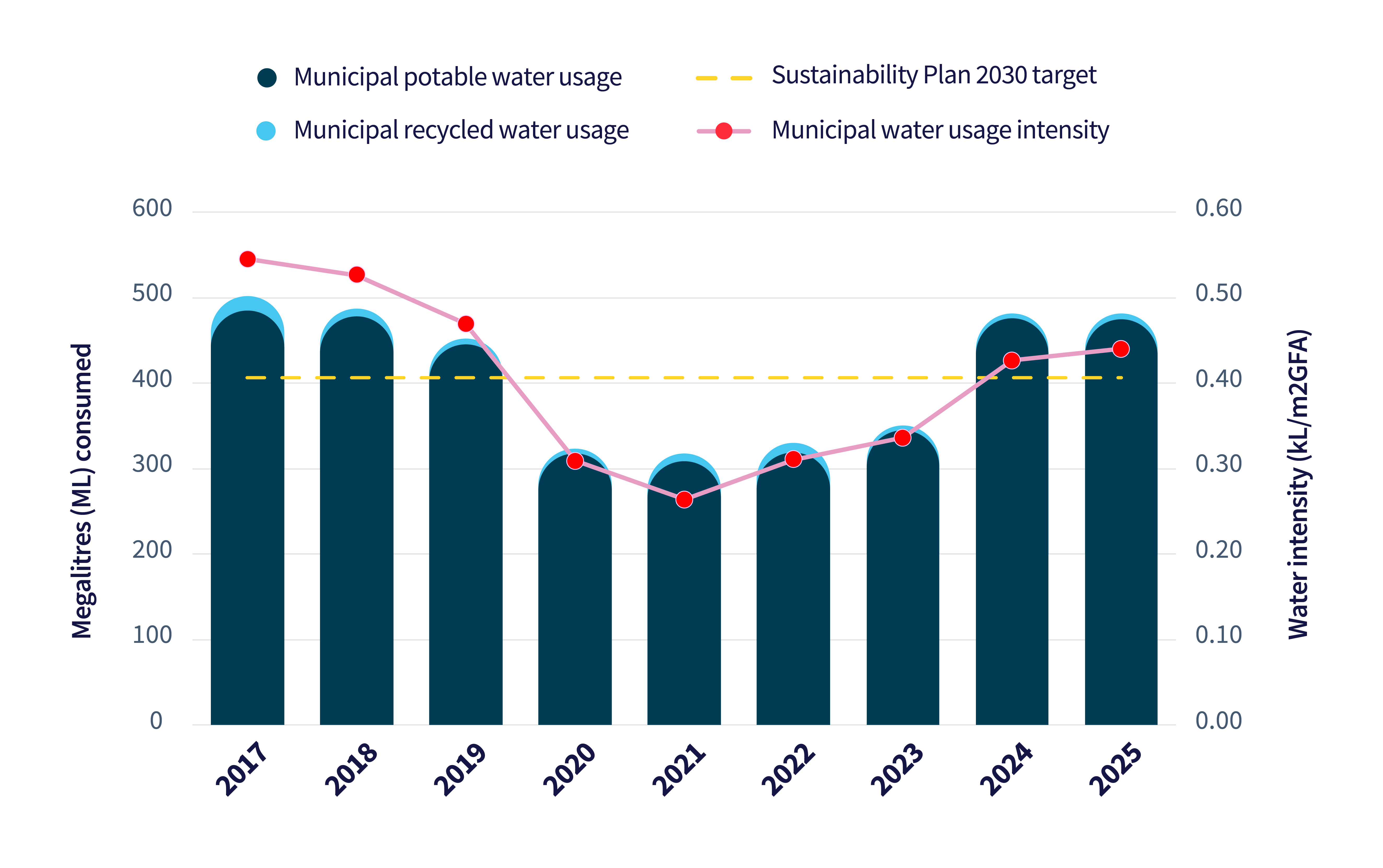
| The University has reduced total water consumption by 10 per cent relative to a 2019 baseline. |  | Total mains water consumption was approximately 474,430 KL[6] – exceeding the target. Based on a 2019 baseline of 452,020 KL, consumption in 2025 increased by 5 per cent on the baseline. |
| The University has significantly increased the proportion of water consumption from non-potable sources compared with a 2019 baseline. | | The University is unable to accurately determine the proportion of potable to non-potable water sources across its campuses. The University will continue to focus on improving its monitoring and visibility of water data. |
Our progress
Water consumption performance
Healthy water cycles is a key area in need of attention for the University. In 2025, total mains water consumption exceeded the 10 per cent reduction target and was 5 per cent over the 2019 baseline. The timeliness and accuracy of billing information remains a key challenge for the University. At the time of publication, some 2025 invoicing is delayed due to system billing and payment systems issues with the water authority and therefore some water data has been estimated.
Water-saving initiatives
In 2025, approximately $52,000 was invested in water-saving initiatives. Initiatives included upgrading irrigation infrastructure for all areas controlled by static battery-operated solenoid valves to enable them to be monitored and controlled by the University’s irrigation system. Following the completion of this project, scheduling of irrigation for the entire Parkville campus (except areas forecasted for development in the next five years) will be informed by weather forecasts. They will have the options of being controlled remotely and consumption will be accurately measured. Two new sites on the Parkville campus were connected to the South Lawn Harvested Water Storage, resulting in potential savings of up to 1.6 million litres annually on irrigation.
Harvested water use
The University is unable to calculate the total amount of harvested water (on-campus sources) consumed across all campuses. A lack of monitoring technology means the University is also unable to holistically calculate the amount of harvested water consumed as a percentage of total water consumption, despite having over 5.1 million litres of tank storage capacity. However, data is available for some campuses. Burnley campus used 677 KL of harvested water for irrigation and toilet flushing – 3.3 per cent of total campus water usage. At Dookie, 652,000 KL of water was extracted from the Broken River, with approximately 4 per cent treated in the onsite water treatment plant for potable water uses on campus. At the Werribee campus, approximately 1 to 3 per cent of mains water consumption came from the mains recycled water line.
The University is considering how it can improve monitoring and reduce its water consumption in the future. Improving data quality, system capability and efficiency remains a priority through business-as-usual operations to support more effective water management over time.
Total water use | 2017-2025
Footnotes
[6] Note: Total mains water consumption includes some estimated data.
Our sustainability strategy
At the University of Melbourne, our efforts in sustainability are guided by Sustainability Plan 2030 - a roadmap for sustainable delivery of our institutional strategy Advancing Melbourne.
Read more about how we are advancing sustainability at the University:
