2025 Sustainability Report
Indigenous knowledges
Domain: Mobilising knowledge for action
Aspiration to 2030: The University has respectfully integrated Indigenous knowledges and participation into our approach to sustainability.
Progress against targets
| Target | Target status | Progress in 2025 |
|---|---|---|
| The University has an increased understanding of sustainability from an Indigenous perspective through co-created or Indigenous-led reciprocal learning. |  | Although there have been various activities linking Indigenous knowledges and sustainability across the University from 2022-2025, these were brought about by other University priorities and strategies rather than Sustainability Plan 2030. |
Our progress
Integrating Indigenous knowledges and sustainability
The University is committed to respectfully integrating Indigenous knowledges and participation across its sustainability, teaching, research and partnership activities, guided by the Indigenous Strategy Murmuk Djerring and an institutional focus on reciprocal, Indigenous‑led learning. As at the end of 2025, the Sustainability Plan 2030 target to increase understanding of sustainability from an Indigenous perspective has not been met. However, there are many examples of projects, activities and outcomes that work at the intersection of Indigenous knowledges and sustainability across the University, some of which are illustrated below.
Going forward, the University commits to making more deliberate efforts to advance sustainability and Indigenous knowledges, including via stronger alignment between Sustainability Plan 2030 and Murmuk Djerring. There are many opportunities to build on progress, with significant potential to more intentionally align our work with Indigenous knowledge systems, strengthen reciprocal partnerships, and ensure Indigenous leadership plays a role in shaping the University’s approach to sustainability.
Our stories
Embedding Indigenous perspectives in sustainable engineering practice
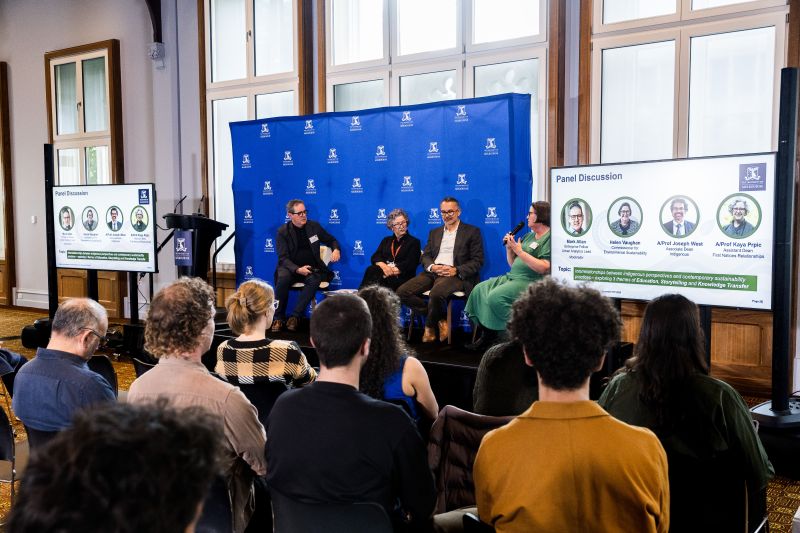
Indigenous Knowledge for a Sustainable Future was a flagship panel session delivered by the Faculty of Engineering and Information Technology as part of the 2025 National Indigenous Engineering Summit at the University. The session positioned Indigenous knowledge systems as a core sustainability asset, not an adjunct to technical practice, and demonstrated how engineering education and research can be strengthened through Indigenous-led perspectives. It brought together Indigenous engineering educators, senior sustainability practitioners and government leaders to explore how principles such as long-term stewardship, reciprocity and Caring for Country can inform contemporary engineering, land administration and infrastructure decision-making. Delivered as a hybrid event from the Parkville campus, it included both in-person and national online audiences, extending impact beyond the University.
The event aligned sustainability with education, storytelling and knowledge transfer, highlighting practical pathways for embedding Indigenous perspectives into engineering curricula, community partnerships and policy practice. It reinforced the Faculty’s commitment to place-based learning, Indigenous leadership and culturally grounded sustainability approaches, while providing staff and students with actionable insights for applying these principles within research, teaching and professional practice.
The Wilin Centre for Indigenous Arts and Cultural Development
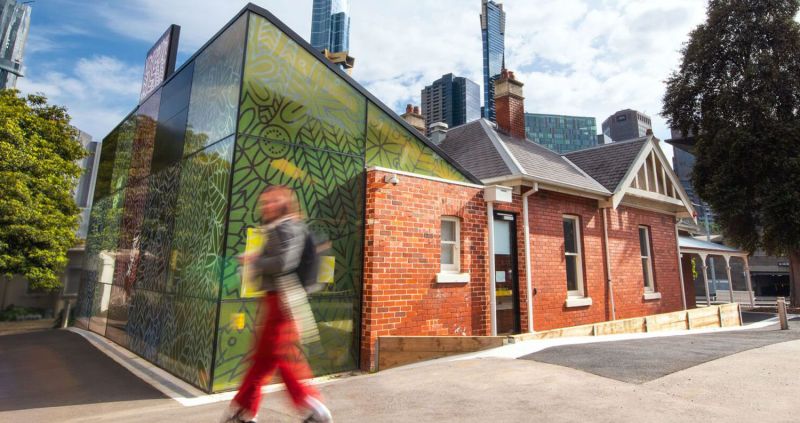
The Wilin Centre for Indigenous Arts and Cultural Development is situated within the Faculty of Fine Arts and Music, and fosters innovation in the research, development, advocacy and presentation of Indigenous arts and cultural practice. Staff work with Aboriginal and Torres Strait Islander communities to identify, recruit and support potential and practicing Indigenous artists to study and refine their academic and artistic skills at the University. Beyond student support, two-way learning and increased understanding of topics and methods related to Indigenous knowledges is central to the work that is done by Wilin across domains of academic pursuit and across the Faculty.
Wilin has an overarching focus on sustainability across all domains. The intersection of environmental sustainability and Indigenous knowledges, as enacted through Indigenous arts practices, is evident in Wilin’s teaching, research and engagement. For example, in the teaching space Wilin teaches students about how materials for the production of arts are sustainably harvested following intergenerational knowledges and practices. It also teaches the role of this harvesting in sustaining vegetation, environments, and, in turn, animal and human life over generations. Social sustainability is core to Wilin’s teaching, research and engagement practice. Key research focuses are: the role of Indigenous diplomacies in sustainability and the tertiary education sector; the role of intergenerational knowledge transmission in sustaining cultural heritage, arts and languages; and data sovereignty and sustainable access to archives.
Wilin maintains and builds partnerships across community-controlled organisations and community-based artists, as a strategy to support and sustainably grow participation of Indigenous future students in the Faculty and the University. The Faculty has a partnership with Ilbijerri and collaborations with many Indigenous artists and organisations centring and honouring Indigenous knowledges.
A place-based, Indigenous-led approach to sustainability – the With Country Camp
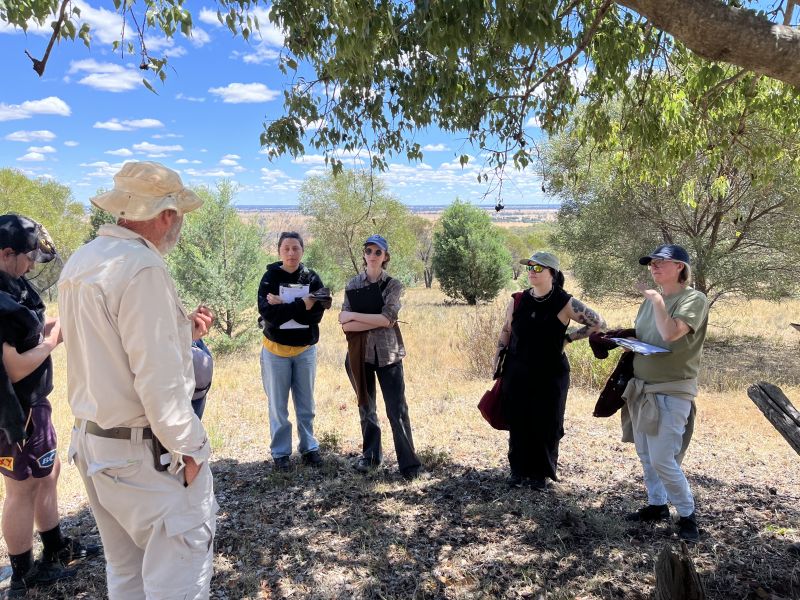
The With Country Camp, delivered in partnership with the Grimwade Centre for Cultural Materials Conservation at the University, represents a place-based, Indigenous-led approach to sustainability that integrates Caring for Country principles with conservation science, land management and intergenerational knowledge exchange. This builds on the decade long Gija-Elder led on Country Masters subject Ngarranggarni: Gija Art and Country , which has provided a strong framework for sustainable education at the University and fostered a desire for students for further programs of this kind.
Held on Country at The Rock in New South Wales and designed in collaboration with Traditional Owners and community partners, the camp created a reciprocal learning environment where Indigenous knowledge holders, University researchers, students and professional staff engaged directly with Country as teacher. The program centres Indigenous epistemologies, positioning cultural knowledge systems not as complementary to sustainability practice, but as foundational to long-term environmental stewardship.
Through immersive on-Country learning, participants explore sustainable land management practices, cultural material conservation, ecological restoration, and the interrelationship between cultural continuity and environmental health. The camp centres principles of reciprocity, custodianship, relational accountability and long-term responsibility to future generations. These principles are then translated into professional and academic contexts, particularly within conservation practice, museum and archive management, and environmental sustainability disciplines.
The With Country Camp demonstrates how sustainability education can move beyond classroom-based models to embodied, relational learning experiences grounded in Indigenous governance systems. It strengthens the University’s understanding of sustainability from an Indigenous perspective by:
- embedding Indigenous leadership in program design and delivery
- elevating Indigenous ecological and cultural knowledge as core sustainability frameworks
- creating structured opportunities for two-way learning
- building long-term partnerships with Traditional Owner groups
- connecting cultural materials conservation with broader environmental sustainability outcomes.
Importantly, the camp illustrates how Murmuk Djerring’s emphasis on reciprocal, Indigenous-led engagement can be more intentionally aligned with Sustainability Plan 2030. Subject to ongoing funding, it offers a scalable model for integrating Indigenous knowledge systems across teaching and research, particularly in disciplines concerned with land, materials, heritage and environmental management.
Supporting sustained engagement with Traditional Owners and Yolŋu communities in Northeast Arnhem Land
The University supported the purchase of housing and leasing of fit-for-purpose vehicles in Northeast Arnhem Land to ensure colleagues working in the region have reliable accommodation and safe, appropriate transport. The driver for this investment was operational need, risk mitigation and reducing environmental and community impact associated with short-term, fly-in engagement models which perpetuate transactional engagement that are not aligned to the expectations of Indigenous peoples.
Establishing an ongoing physical presence in the region enables more meaningful, sustained engagement with Traditional Owners and Yolŋu communities. Reliable accommodation allows staff and researchers to spend longer periods on Country, strengthening trust, continuity and relational accountability. Purpose-built vehicles reduce safety risks, support access to remote areas and minimise environmental impact compared with repeated short-term hire arrangements.
Importantly, this infrastructure creates the conditions for deeper engagement with Indigenous knowledge systems. Extended presence on Country supports:
- Indigenous leadership in shaping research priorities and methods
- stronger recognition of Yolŋu ecological, cultural and governance knowledges in research design
- more reciprocal knowledge exchange rather than transactional consultation
- greater alignment between research practice and caring for Country principles.
Yolŋu have expressed the need for a sustained approach utilising the community’s prescriptive method of working which is based on the Gurruthu or kinship system. This will support the community’s goal of self-determination and ensure a long-term balanced and reciprocal relationship with the University.
The investment contributes to the University’s broader commitment under Murmuk Djerring to Indigenous-led engagement and reciprocal learning. It demonstrates how University infrastructure can support more respectful, place-based sustainability practice grounded in long-term relationships and Indigenous governance.
Our sustainability strategy
At the University of Melbourne, our efforts in sustainability are guided by Sustainability Plan 2030 - a roadmap for sustainable delivery of the University's Strategy 2030: Resilience.
Read more about how we are advancing sustainability at the University:
