Beyond ChatGPT: Let’s get practical about assessment design
Introduction
This module guides you through reconsidering and redesigning your assessments in the context of generative Artificial Intelligence (GenAI). We explore practical strategies and ethical considerations for designing assessments that leverage these tools to enhance learning.
The materials and advice in this module are accurate as of Semester 2, 2026. Due to the evolving nature of GenAI, advice and associated materials may change quickly. We periodically update the module content to reflect the current landscape of GenAI.
Intended learning outcomes
By the end of this module, you should be able to:
- Apply the ‘Funnel Approach’ to assessment design
- Explore the Revisited Bloom’s Taxonomy in the context of GenAI
- Consider practical steps for redesigning your current assessments
Module requirements
- Estimated completion time: 20-40 minutes to review module materials.
- Access to the following GenAI tools:
- The University of Melbourne’s SparkAI (currently available to staff)
- Copilot (with University SSO) (currently available to staff and students)
How to get the best out of this module
We recommend completing the module from start to finish and taking time to reflect on each section. While the module introduces a variety of assessment design concepts, it is important that you consider how best to apply these concepts in your own teaching context. It is also beneficial to discuss your assessment design ideas with your colleagues after completing the module to gain different perspectives.
Principles of effective assessment design
Effective assessment design, regardless of the technological context, should adhere to several key principles:
- Alignment with learning outcomes
- Authenticity and relevance to real-world scenarios
- Clarity in instructions and expectations
- Opportunities for feedback and improvement
- Fairness and inclusivity
- Promotion of academic integrity
The ‘funnel approach’ to assessment design
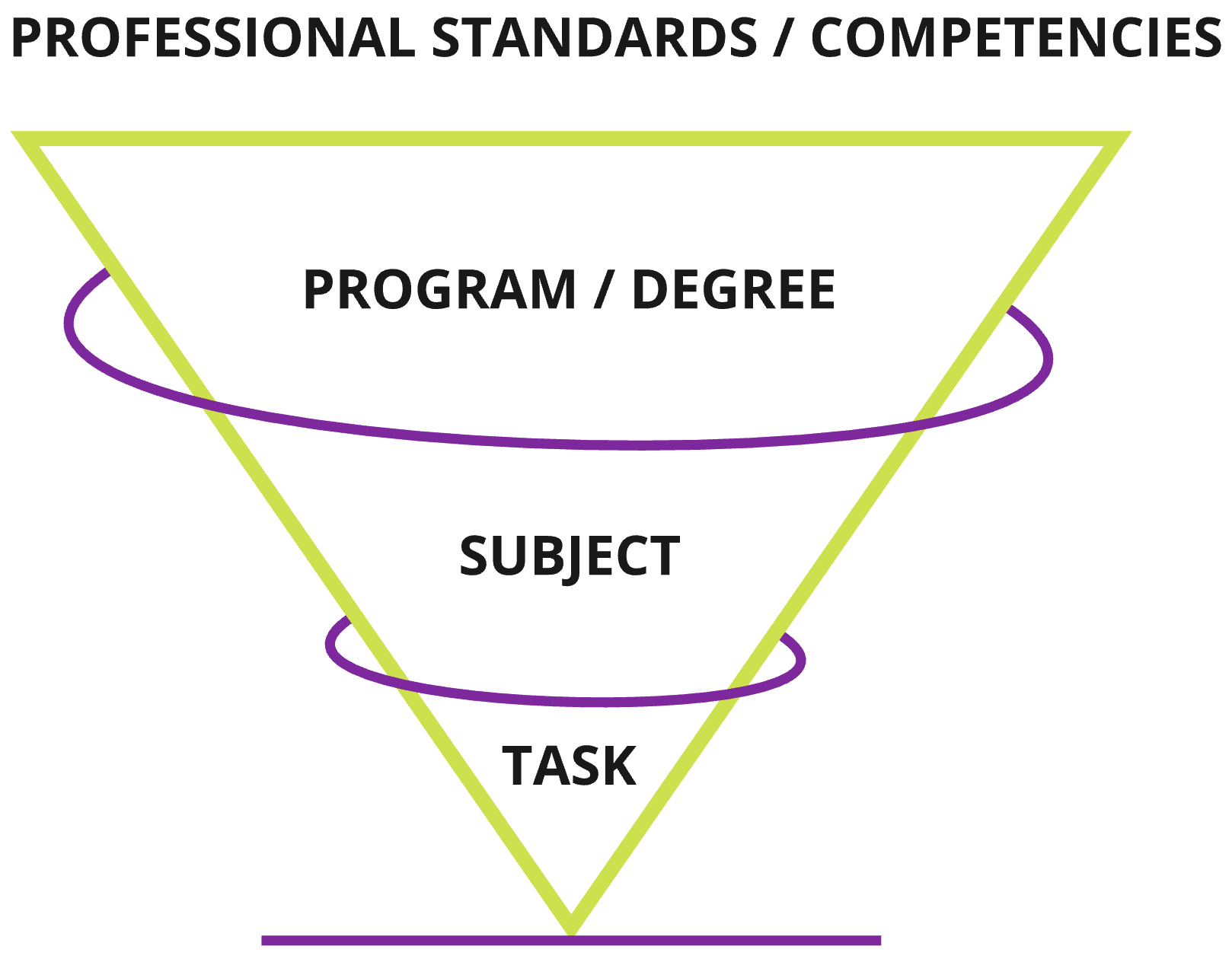
The funnel approach encourages you to start broad from the overarching concepts, then gradually narrow your focus to specific, targeted elements of the assessment. This approach consists of four key steps:
- Identify the professional skills and knowledge required in your discipline and profession, and how they may be reflected in the program-level learning outcomes.
- Consider the specific skills and knowledge taught in your subject.
- Identify the learning outcomes your assessment task aims to measure.
- Design the individual assessment components and the assessment criteria.
This approach ensures that your assessments are always grounded in the broader context of your discipline and effectively measure the intended learning outcomes.
Thinking prompts and examples
The following prompts are designed to help you identify the professional skills and knowledge essential in your discipline and profession, and how they are incorporated into subject-level teaching to prepare your students for these requirements. From here, you can determine how your assessment can be designed to evaluate these skills and knowledge alongside the subject’s intended learning outcomes.
-
Prompt
"As a [insert your discipline] professional, I need to perform [insert knowledge and skills, e.g. different kinds of research, use certain tools and platforms, perform analysis, synthesis, communicate my findings in these ways to...]"
Example
"As a marine biologist, I need to perform field research, use data analysis software, synthesise findings from multiple studies, and communicate my results through scientific papers and presentations to both academic and public audiences".
-
Prompt
"In my subject, the students are taught [insert professional skills and knowledge] in order to... [focus on what should be done in intended professions]."
Example
"In my Marine Ecosystems subject, students are taught data collection techniques, statistical analysis methods, and scientific writing skills in order to prepare them for conducting and communicating marine research in their future careers".
-
Prompt
“In [insert assessment task], students will [complete/demonstrate an artefact/process] and will be assessed on [insert skills/knowledge relevant to their intended profession].”
Example
“In the ‘Policy Brief’ assessment task, students will write a policy brief on one of the suggested marine conservation issues (for example, overfishing, microplastic pollution). Students will be assessed on their ability to synthesise scientific information, communicate complex ideas to a specific audience group, and propose evidence-based policy recommendations.”
In the next section, with the intended profession in mind, let’s consider how we can adapt our assessment design in the context of GenAI and explore an adapted version of the Bloom's Taxonomy to support your assessment design decisions.
Using the Revisited Bloom's Taxonomy with GenAI
The Revisited Bloom’s Taxonomy, developed by Oregon State University, explores how we may reconsider the different levels of learning in the presence of GenAI and support meaningful integration of student use of GenAI, particularly in assessments. For each level of learning (from Remember to Create), there are distinctive human skills that students can demonstrate, as well as specific capabilities that GenAI tools can offer to supplement students’ learning at the same level.
In the following image hotspot activity, based on an adapted version of the Revisited Bloom’s Taxonomy, we provide you with a range of assessment ideas corresponding to the learning levels of the Taxonomy. We consider how GenAI tools can be incorporated into the assessments while still challenging students to demonstrate the required knowledge and skills.
While working through the Taxonomy, it’s important that you determine which skills are deemed foundational for the students to master before they can meaningfully and productively engage with GenAI in their assessment.
You also need to consider the likelihood of learning opportunities being lost if GenAI was to be used to substitute components of the assessment.
Click on each skill level in the table below to reveal sample assessment briefs for each level of learning.
*Al capabilities derived with reference to an analysis of the MAGE framework, based on ChatGPT 4 as of October 2023. See Zaphir, L., Lodge, J. M., Lisec, J., McGrath, D., & Khosravi, H. (2024). How critically can an Al think? A framework for evaluating the quality of thinking of generative artificial intelligence. arXiv preprint arXiv:2406.14769.
Reflection questions
Consider these questions as you apply the Revisited Bloom’s Taxonomy in your assessment redesign process:
- In which areas of the assessment could GenAI be most useful? Why?
- Where should we avoid the use of GenAI?
- Does any educational technology or tool that you use in your teaching already have GenAI integration? How might this impact your decision to allow students to use GenAI in their assessments?
Redesigning assessments in the context of GenAI
The development of GenAI requires us to rethink the way we design our assessments. There are several ways in which we can adapt our assessments, as suggested in the following list:
- Prioritise higher-order skills and consider incorporating the use of GenAI into assessment tasks where applicable (see the Revised Bloom’s Taxonomy section for further information).
- Integrate a diverse range of open and secure assessment formats to support meaningful learning progression.
- Explore ways to embed personal reflection and contextual professional experience.
- Foster peer review and collaboration among students.
Heuristics: Redesigning assessment task
To help with the assessment redesign process, there are a series of heuristics (prompts) to help you with the brainstorming phase. Identify one of your assessment tasks you would like to redesign, then select a set of prompts in an area you would like to focus on and use these to guide your thinking.
Some prompts are related to GenAI, and some are related to broader considerations in assessment design, but each prompt offers you a lens/focus area to approach your redesign.
Download a full copy of the design card sets (DOCX 1.8 MB).
Set 1: Academic integrity
Academic integrity focuses on equipping learners with the capabilities and values necessary to conduct ethical scholarship. In contrast, assessment security focuses on strengthening assessment against cheating attempts and detecting any cheating that has occurred (Bearman et al., 2020). This set of cards encourages you to think about how you can design your assessment to support academic integrity and minimise opportunities for academic misconduct.
Consider the reliability and validity of your assessment task(s) - does it form part of a consistent approach to assessment (such as multiple time periods, cohorts, assessors), and does it assess what it is aimed to assess (For example, are there any irrelevant characteristics)? (Dawson, 2023).
Re-consider the weighting distribution of your assessment. Typically, cheating occurs more often with high-stakes assessments (French, Dickerson & Mulder, 2024).
Based on what is being assessed, which of the tasks could be made formative (non-graded) and which ones should be summative (graded)?
Which components can be completed synchronously (for example, in class) versus asynchronously (for example, using technologies outside of class time)?
In your discipline(s), what are the advantages/disadvantages of incorporating oral synchronous methods of assessment (for example, an oral exam)? Would this option suit your assessment structure?
Set 2: Focus on the process
A process-oriented approach to assessment focuses on evaluating the process students undertake to complete an assessment task. This assessment approach allows you to gain insight into how students' learning is evidenced throughout their work, rather than just in the final product or artefact. This set of cards encourages you to think about how you can design a process assessment that captures student learning effectively.
Incorporate a variety of ways for students to show their process of undertaking an assessment task, including cycles of revisions. An example could be a visual diary in design or architecture disciplines or a detailed research journal in science; incorporating iterative drafts.
Examine the visibility (for example, can you see what students are doing/completing) of different steps in an assessment task: where are the blind spots?
Examine each component of your assessment task and its purpose.
Can students show the progress or different stages of their work as they undertake the assessment task?
Could students show screenshots from their interactions with GenAl?
What guidelines are needed for the students to enable them to demonstrate the progress / stages of their work as they undertake the assessment task?
Set 3: Social and societal impact
Designing an assessment task with a strong collaborative focus can be a good way to enhance student engagement and create lasting social impact that extends beyond the learning context. This set of cards encourages you to consider ways to incorporate collaborative elements such as group work, peer review, or partnership with industry professionals to strengthen the learning experience within the assessment process.
Could the collaborative tasks consider social and societal impact and go beyond students' immediate context?
Could group work/peer review be introduced into an assessment task?
Could approaches such as working with local communities and industry partners be considered as part of your assessment design?
Set 4: Context and specificity
Assessments that are context-specific and applicable can minimise the reliance on GenAI tools, whilst providing students with an opportunity to engage in authentic experiences that replicate professional practice scenarios. This set of cards encourages you to consider ways to reframe and refine the assessment (including the marking criteria) to be more contextual, applicable and authentic.
Examine your assessment structure and reframe applicable assessment tasks to be more specific, contextual and situated (an authentic setting).
Consider project-based assessment task design: could student be asked to design and conduct an experiment, then present their findings and recommendations? Or could they analyse a detailed case study, identify relevant concepts and propose solutions to a problem?
Consider ways to scaffold knowledge generation in a series of steps in an assessment task. For example, what would be some of the ways to provide students with a structured framework that helps them gradually build and develop their understanding of a topic or concept? How can they progressively acquire and connect new information? Where would GenAl tools be useful?
Could the marking criteria in a rubric be made more explicit and situated on specific tasks? For example, how can the language be tailored further to the specific assessment task? Could concrete examples or samples of what constitutes different levels of performance for each criterion be used? Does the rubric criteria directly align with specific learning objectives?
Set 5: Accessibility and inclusion
Creating an accessible and inclusive assessment task that embraces the universal design for learning (UDL) framework. can reduce unnecessary barriers to students accessing and completing the task. This set of cards encourages you to think of ways to implement UDL principles to ensure learning is fairly and genuinely evaluated, making a better assessment experience for all students.
Reflect on your assessment task(s) through the lens of the universal design for learning (UDL) framework to reduce unnecessary barriers to access and inclusion.
Can more than one modality form part of the task submission (for example, a written report or a short video with a set of PPT slides)?
Could students have a choice of a topic of an assessment task (for example, they could analyse and synthesise findings from a report on Topic A or Topic B)?
In what ways does my team/School/Department/Faculty support assessment-related decisions around accessibility and inclusion? Can I collaborate with colleagues on exploring current challenges and recommending solutions?
Could the assessment task provide options for self-regulation, for example, scaffolded guidance for students to monitor their progress?
Set 6: Modelling of GenAI tools and disciplines
The use of general and discipline-specific GenAI tools may be beneficial in learning and assessment processes, as exposure to these tools can prepare students for their future careers. However, effective use requires thorough modelling to guide proper applications. This set of cards encourages you to think about how you may incorporate the modelling of GenAI tools within your subject and specific assessment tasks to ensure that students use these tools effectively and appropriately.
How could you model effective, critical and ethical use of GenAI within your discipline?
Is there a way to co-create an effective use of GenAl tools with the students? Can this be done iteratively, and refined as part of the assessment cycle?
How are GenAI tools currently being used in professional practice within your discipline? How could students critically evaluate those uses?
How could the modelling of GenAl tools be integrated into the assessment design, for example, synthesing information from multiple sources and fact-checking? Could GenAl tools be integrated into the peer review, where students can provide feedback on each other's work, and the GenAl tool can assist in identifying areas for improvement or offering alternative perspectives?
Checklist: Evaluating your assessment design process
Once you have completed the module, use the checklist below to evaluate and refine your assessment design.
Further resources and reading
- Teaching and Learning Innovation: GenAI Hub: A focused starting point with examples of classroom activities, practical workflows and case studies.
- Assuring learning at Melbourne: University’s guide to assessment principles and secure assessment types and tasks.
Need further support
- Teaching and Learning Innovation support centre: For further support with topics covered in this module as well as broader teaching and learning support.
References
- Bearman, M., Dawson, P., O’Donnell, M., Tai, J. and Jorre de St Jorre, T. (2020). Ensuring academic integrity and assessment security with redesigned online delivery. Deakin University, Melbourne.
- Heriot-Watt Learning and Teaching Academy. (2023, January 16). Heriot-Watt University “Inspiring Learning” New Year Lecture 2023 by Prof Phil Dawson [Video]. YouTube.
- French, S., Dickerson, A., & Mulder, R. A. (2024). A review of the benefits and drawbacks of high-stakes final examinations in higher education. Higher Education, 88(3), 893-918.
- Tai, J., Ajjawi, R., Boud, D., Dawson, P., & Panadero, E. (2018). Developing evaluative judgement: enabling students to make decisions about the quality of work. Higher education, 76(3), 467-481.