Transforming care for children with epilepsy
A $5 million gift is expanding vital research into the most severe group of epilepsies, the developmental and epileptic encephalopathies, to help families access precision diagnoses, improve management and to lead to better treatments.
When Gemma had her first seizure at just 10 months old, her parents began an unexpected journey in search of answers. Until then, she had been a happy, healthy baby.
“She was face down on the highchair table,” recalls Leah, Gemma’s mother. “I knew it was a seizure, but I’d never seen one before.”
A month later, Gemma had a second seizure that lasted almost 20 minutes. A third followed the next week. As the seizures continued and hospital visits became more frequent, her family found themselves searching desperately for answers.
A diagnosis eventually came: Dravet syndrome, a severe developmental and epileptic encephalopathy (DEE). While it provided answers, Gemma’s diagnosis was both devastating and life-changing for the family.
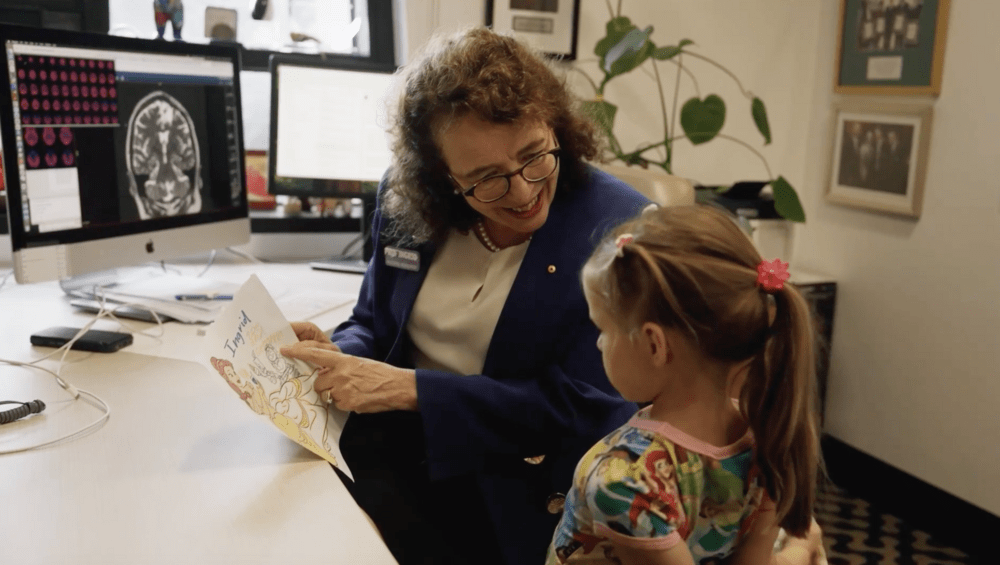
Laureate Professor Ingrid Scheffer AO (MBBS, Phd, HonLLD, FRACP, FAES, FAES, FAA, FAHMS, FRS) with Gemma.
Understanding DEEs
DEEs are among the most complex neurological conditions affecting children. They impact all aspects of life from seizures to development, motor skills, behaviour, sleep and they carry a high risk of death.
They are also more common than many people realise, affecting one in 590 children worldwide.
Finding effective treatments remains challenging because DEEs have an extraordinarily diverse range of causes, including more than 970 genes, with the number increasing steadily.
For Gemma's family, the diagnosis marked the beginning of a harrowing journey and Gemma was experiencing up to 100 absence seizures every day. It quickly became apparent that Leah would need to step away from work to care for Gemma and manage her seizures, in addition to navigating a relentless schedule of appointments, hospital visits and treatment decisions.
Turning uncertainty into hope
Today, families like Gemma's have reason to be hopeful thanks to the pioneering work of Laureate Professor Ingrid Scheffer AO and her team at Austin Health and the University of Melbourne.
Laureate Professor Scheffer leads a groundbreaking Natural History Study that tracks how DEEs develop over time. By following children and adults with DEEs over many years, they are building a deeper understanding of these devastating conditions to compare the effects of new precision therapies.
The study has now recruited 370 individuals, with individuals with DEEs undergoing regular assessments for seizures, development and all their associated conditions, including regular neuropsychology evaluations.
This major study has been significantly accelerated by a generous $5 million gift from a family whose lives were touched by Professor Scheffer's care.
The gift has enabled the University of Melbourne's Epilepsy Research Centre to expand the study around Australia, enrol more families and discover vital new knowledge that is helping transform the future of DEE care and research.
Building on three decades of innovation and discovery, Laureate Professor Scheffer’s research has transformed understanding of DEEs around the world.
“By discovering genes and through our vast amount of research, thanks to the support of donors, we are now perfectly positioned to take this Natural History Study forward to support the outcomes of therapeutic trials and new precision therapies.”
For families like Gemma’s, this progress is bringing hope for the future.
“We’re very lucky now that as Gemma has gotten older, we’ve had exposure to different treatments, different medications, and her seizures are relatively well controlled,” Leah says.
Being part of the Natural History Study has also helped Leah and her family better understand Gemma’s condition and prepare for the support she will need as she grows.
“The fact that we are so close to precision medicine and we’re even doing trials in gene therapy here in Melbourne is amazing to me,” Leah says.
“We are so thankful as a family to have so many services through the Austin and through the University of Melbourne.”
This research is doing so much to support our families.
“It’s changing the lives, not just for my child, but for all families and children and adults with DEEs.”
Learn more about giving
Delve into stories of donor impact or find public lectures, gallery openings and more.
-
Impact of giving
The generosity of our donor community can be felt across industries – and will continue to improve lives for generations to come. Learn more about how our supporters are building a brighter future.
-
Ways to give
Whether you’d like to make a one-off gift or explore other meaningful options like leaving a gift in your Will, there are plenty of ways you can give to the University for a brighter future.
-
News and events
Stay connected with your passionate University community through thought-provoking public lectures, events celebrating our donor community or expert commentary on global issues.
How can we help?
FAQs and contact details
Find helpful answers to common questions and specialised contact details.
Give to education and research
Learn how you can support students and researchers.
Ways to give
Explore the varied and meaningful ways you can give towards a brighter future for all.