Disability Inclusion Action Plan 2026-2029
DIAP 2026-2029
Introduction
Commitments
This Disability Inclusion Action Plan (DIAP) is both the University’s commitment to being an accessible and inclusive place and an outline of what we will do to achieve this in the next three years. We recognise that access and inclusion must underpin all strategic development, programs and initiatives. Achieving this will mean that everyone - including students, graduate researchers, staff and visitors with disability – can feel welcome and thrive.
We commit to having disability inclusion as a standing expectation. All teaching, learning support and research; leadership decisions; and systems and measures of success must reflect this expectation. This will support a diverse, resilient and successful University community. Lived experience expertise is central to this undertaking, and we have taken steps to embed lived experience voices in what we do to achieve it.
This is the University’s second comprehensive DIAP. It is one of a suite of six targeted action plans1 that support the implementation of the University’s Diversity and Inclusion Strategy 2030. Together, they drive an intersectional approach2 to achieving “a thriving, fair and diverse University community”. The DIAP is a critical enabler of the University’s Strategy 2030 goals to empower people and performance, improve student experience, partner for impact, and lead with a future focus.
Context
The University of Melbourne has legislated responsibilities to support access and inclusion under the Disability Discrimination Act 1992 (Cth), the Disability Standards for Education 2005, and the Equal Opportunity Act 2010 (Vic). In meeting these obligations, we subscribe to the United Nations Convention on the Rights of Persons with Disabilities (2006, Preamble E) definition of disability:
…disability is an evolving concept and disability results from the interaction between persons with impairments and attitudinal and environmental barriers3 that hinders their full and effective participation in society on an equal basis with others.
This definition is often described as being based on the ‘social model'4. Instead of seeing disability as a medical problem, the social model shifts responsibility to governments, institutions (like the University), businesses and communities. They have a responsibility to remove barriers that exist in society and to promote equal participation. The Convention notes that disability rights are human rights and thus calls us to action.
We aspire to best practice in accessibility and inclusion to ensure “full and effective participation” of students and staff and with disability “on an equal basis with others”. This DIAP brings together actions that support us to meet legislated responsibilities, and exceed them, informed by the human rights lens of the Convention. It does so by improving supports for students, staff, graduate researchers and visitors with disability and by embedding accessibility in everything we do. This is not just the right thing to do: we all benefit.
First Nations perspectives
First Nations understandings of disability are shaped by cultural perspectives. Disability is seen as a part of ‘the normal range of human diversity’ (Daniels-Mayes, 2023, p. 3) and the response to this diversity is typically holistic and situated within a community approach. As a result, ‘conventional constructions of disability – as a barrier to individual capacity and participation in society’ (Daniels-Mayes, 2023, p. 3) may not resonate with First Nations people. The University recognises the importance of cultural safety to Indigenous staff and students and, through our Murmuk Djerring strategy, aspires to excellence in Indigenous higher education and research. This includes prioritising listening, trust, and relational accountability. Over the life of the DIAP 2026-29, we will look to build practices that honour Indigenous ways of knowing, being, and doing into the way we go about implementing DIAP actions and to shape up an intersectional program of work.
Terminology
Disability describes a broad set of experiences, including experiences of physical, sensory or cognitive disability, and chronic health conditions, mental illness, and neurodivergence5. There are many ways to talk about disability, and preferences differ.
This plan uses person-first language (‘people with disability’) in line with Government language guides and general convention. We recognise that some disability communities prefer identity-first language. The plan also recognises the overlapping and distinct needs of unpaid carers of people with disability and refers to them as ‘people with caring responsibilities’. Where not specified, people with caring responsibilities are included within the scope of broader actions.
Next page: A snapshot of disability inclusion at the University
Footnotes
References
A snapshot of disability inclusion
The Neurodiversity Project
Supporting the University's neurodivergent community
Identifying the gap in supports for neurodivergent staff and students, the Neurodiversity Project have delivered over 87 professional development workshops, piloted curriculum co-design initiatives, designed a new neurodiversity-focused breadth subject, hosted the Celebrating Neurodiversity Research Symposium, and undertaken the largest neurodiversity needs analyses of staff and students at a single Australian university. Led by neurodivergent staff, the Neurodiversity Project has had impact across classrooms, policy and strategy, and research.
BlakAbility Project
Improving the lives of Aboriginal and Torres Strait Islander people with disability
Led by lived experience and funded by the Australian Research Council (ARC), BlakAbility’s research aims to identify better ways to support the success of Indigenous staff and students with disability. In investigating their lived experiences, the BlakAbility Project explores the intersection between disability and indigeneity, and incorporates Indigenous knowledge and practice of disability.
Student Equity and Disability Service (SEDS) review
Refreshing academic support for students with disability
An action in the previous Disability Inclusion Action Plan committed the University to reviewing its Student Equity and Disability Service. The review, completed in 2024, outlined over 70 recommendations. Plans quickly progressed for the implementation of the recommendations. So far, SEDS have renewed their website and student-facing information, refreshed their staff-facing information, increased their presence at student orientation, and reviewed their application processes. Work is ongoing, with next steps included in this plan.
The importance of lived experience
The voices of people with lived experience of disability must be centred in all initiatives to support disability inclusion. Guided by the principle, “Nothing about us without us,” the University has begun, and continues, to embed lived experience representation and consultation in the development and implementation of strategy and projects. The establishment of lived experience advisory groups was a key achievement under the DIAP 2023-2026:
- The Staff Disability Roundtable has been integral to the evaluation of the previous DIAP and the consultation on this DIAP. The Roundtable provides a lived experience voice to University executive on accessibility and inclusion and serves as a community for staff with disability at the University
- The Student Disability Projects Panel provides paid opportunities for students with disability to support the DIAP and other strategic initiatives related to accessibility and inclusion. Panel members consulted on the development of this plan.
Student Panel members were asked to reflect on their experience participating in the Student Disability Project Panel. They provided the following statement:
- We are a diverse group of students with lived experience of disability, chronic and mental health conditions, and neurodivergence. Each of us is shaped by our different backgrounds and intersections of identity. Our experiences give us firsthand knowledge of the barriers that impact learning, participation and wellbeing. They also inform our insights on what genuinely improves inclusion at the University and what enables us to thrive. Through the process of developing this plan, we valued the University’s openness to learning from our expertise. Our voices have helped to shape decisions that directly affect us, reflecting the principle of ‘nothing about us without us.’ As for all students, our experiences and our success at university will have immense impact on the rest of our lives. We deserve to continue to be heard, recognised as experts in our own experiences, and empowered to speak up openly and honestly.
Governance, reporting and implementation
The DIAP is overseen by University Executive via its Diversity, Equity, and Inclusion Sub-committee.
The DIAP Reference Group, made up of action implementation leads, lived-experience representatives (Staff Disability Roundtable and student representatives) and subject matter experts, has guided the development of this action plan. It will remain in place to drive and monitor the implementation of the DIAP, supporting and coordinating action-specific implementation plans and targets. Implementation plans will continue to seek lived experience and subject-matter expertise from across the University over the lifecycle of this plan.
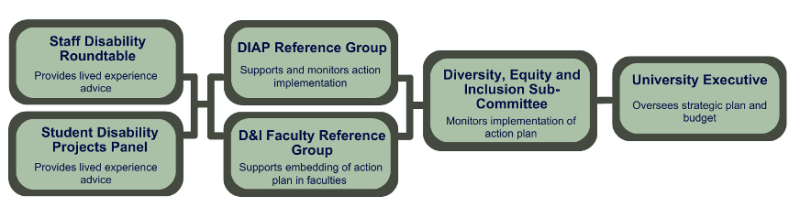
Each action has an executive lead who holds ultimate accountability for the action’s implementation and progress. Progress on the DIAP will be reported annually to the Diversity, Equity, and Inclusion Sub-committee via its action plan reporting cycle. Regular communication with the University community on the progress of the DIAP will be an implementation priority.
About this plan
Data and evaluation
The DIAP 2026-2029 has been developed with consideration of evaluation data from the DIAP 2023-2026, including:
- Annual reporting on progress against DIAP actions
- Student and staff surveys (staff and student experience surveys and DIAP-specific surveys)
- Internal stakeholder consultations (with staff with disability, DIAP action implementation leads, student representatives, faculty representatives, subject-matter experts)
The actions in the DIAP 2026-29 are grouped under five focus areas that capture the breadth of activities to be undertaken across the University. Each focus area has goals and a set of outcomes and measures related to the achievement of that goal. Where possible, we have included baseline data gathered from the evaluation of the DIAP 2023-2026. The measures identified in this plan highlight two key population groups: people with disability and people with caring responsibilities. Evaluation methods will break these groups down further to consider other intersectional inequities (e.g. gender, cultural background) that may further contextualise student and staff experiences. In the interests of maintaining consistency in evaluation, we have chosen to retain language from data sources in the measures included in this plan. This can be seen particularly in measures that reflect student and staff survey questions.
Targets
We can and should be proud of progress already made to achieving an accessible and inclusive University. There is still much room for improvement. Whether to include targets against specific actions in this DIAP has been a question over the course of the Plan’s development. On the one hand, targets hold us to account and help describe our aspirations. On the other, the ultimate use of targets depends on a mature framework for collecting and evaluating data. This is still evolving in step with, and supported by, actions in this DIAP. To proceed well, respectfully and ethically, we have therefore decided to include three overall targets to guide this work of the DIAP. Each has been designed to develop our data capacity, putting us in a stronger position for future monitoring and evaluation.
- By 2029, 100% of senior leadership1 have completed module one of the University’s Disability Awareness training
- By 2029, 5% of the University of Melbourne workforce have reported a disability through workforce data systems2
- By 2027, 40% of subjects are engaged with a University-wide program3 to encourage, develop and recognise best practice in approaches to inclusive teaching and learning, rising to 60% by 2029
Vision
The University of Melbourne is a place where accessibility and inclusion underpin our structures, practices and leadership, guided by the lived experience of people with disability.
Footnotes
3 To be established under this plan (action 3.3)
References
Focus Area 1: Organisational culture and attitudes
Goal: The University is a safe, welcoming, supportive place for people with disability, and demonstrates a commitment to becoming a leader in disability inclusion and accessibility
Outcome 1.a: People with disability are included, free from discrimination and safe to share their disability information when they need to
Indicator 1:
Increase safety from discrimination
Measures:
- Proportion of staff with disability or caring responsibilities who feel it is safe to speak up at the University
- Baseline: 36% of staff with disability (Staff Experience Pulse Survey 2024)
- Baseline: 50% of staff with caring responsibilities (Staff Experience Survey 2023)
- Proportion of staff with disability or caring responsibilities who agree that the University provides a working environment free from discrimination and harassment
- Baseline: 48% of staff with disability (Staff Experience Pulse Survey 2024)
- Baseline: 60% of staff with caring responsibilities (Staff Experience Survey 2023)
- Proportion of students with disability who agree that they are free from discrimination, harm or hatred at the University
- Baseline: 56.8% of students with disability (Quality Indicators for Learning and Teaching Student Experience Survey [QILT-SES] 2024)
Indicator 2:
Improve experience of inclusion and belonging for staff and students with disability
Measures:
- Proportion of staff with disability who see positive change in how the University provides an inclusive working experience for staff with disability
- Baseline: 21% of staff with disability (DIAP Staff Survey 2025)
- Proportion of students with disability who report they have a sense of belonging to the University
- Baseline: 31.5% (QILT-SES 2024)
Indicator 3:
Increase staff knowledge and understanding of disability
Measure:
- Proportion of staff who have completed Disability Awareness training
- Baseline: to be established in 2026 from TrainMe data
Indicator 4:
Increase lived experience representation at the University
Measures:
- Proportion of staff with disability or caring responsibilities who feel their lived experience, perspectives, and values are represented in University activities
- Baseline: 49% of staff with disability (Staff Experience Pulse Survey 2024)
- Baseline: 60% of staff with caring responsibilities (Staff Experience Survey 2023)
- Proportion of staff with disability in senior executive leadership roles
- Baseline: proportion not reported, less than ten responses (Staff Experience Survey 2023)
- Proportion of staff at the University who are people with disability or caring responsibilities
- Baseline: 8% of staff have disability (Staff Experience Pulse Survey 2024)
- Baseline: 25% of staff have caring responsibilities (Staff Experience Survey 2023)
- Proportion of students at the University with disability
- Baseline: 8.6% of students have disability (University of Melbourne student data 2025)
Outcome 1.b: The University demonstrates a commitment to being a leader in accessibility and inclusion
Indicator 1:
Increase senior leader knowledge and understanding of disability
Measure:
- Proportion of senior executive leaders who have completed Disability Awareness training
- Baseline: to be established in 2026 from TrainMe data
Indicator 2:
Improve perceptions of the University as a leader in disability inclusion and accessibility
Measures:
- Proportion of staff with disability who agree the University is committed to becoming a leader in disability inclusion
- Baseline: 21% of staff with disability (DIAP Staff Survey 2025)
- Proportion of students with disability who agree the University is committed to becoming a leader in disability inclusion
- Baseline: to be established in 2026 from DIAP Student Survey data
Actions for this focus area:
1.1: Launch and promote an online accessibility and inclusion resource hub
Indicative timeline to commence: 2026
Executive Lead: Director, Diversity & Inclusion
Link to outcomes: 1.a
1.2: Run an awareness campaign around the value of staff disclosing demographic data - including disability, cultural identity, and LGBTIQA+ information - on WorkDay and the confidentiality and privacy protections around doing so1
Indicative timeline to commence: 2026
Executive Lead: Director, Diversity & Inclusion
Link to outcomes: 1.a
1.3: Coordinate a University-wide approach to using data to support diversity and inclusion, drawing on expertise across University divisions and faculties as well as lived experience expertise voices2
Indicative timeline to commence: 2026
Executive Lead: Director, Diversity & Inclusion
Link to outcomes: 1.a
1.4: Pilot a rollout of Hidden Disabilities Sunflower across the University to better support staff and students with non-apparent disability
Indicative timeline to commence: 2026
Executive Lead: Director, Diversity & Inclusion
Link to outcomes: 1.a, 1.b
1.5: Pilot subscription to Convo Access to provide free, on-demand, online access to Auslan interpreters for staff, students, and visitors
Indicative timeline to commence: 2026
Executive Lead: Director, Diversity & Inclusion
Link to outcomes: 1.a, 1.b
1.6: Promote uptake and completion of the University's new Disability Awareness eLearn module
Indicative timeline to commence: 2026
Executive Lead: Director, Diversity & Inclusion
Link to outcomes: 1.a, 1.b
1.7: Build a suite of training opportunities around specific accessibility and inclusion related topics, including neurodiversity
Indicative timeline to commence: 2026
Executive Lead: Director, Diversity & Inclusion
Link to outcomes: 1.a, 1.b
1.8: Develop and implement a Disability Accessibility and Inclusion policy for the University
Indicative timeline to commence: 2026
Executive Lead: Director, Diversity & Inclusion
Link to outcomes: 1.a, 1.b
1.9: Update the Safer Community Program website and Speak Safely Portal to clearly communicate service scope for students and staff with disability, particularly those who may be experiencing harm or discrimination
Indicative timeline to commence: 2026
Executive Lead: Executive Director, Student & Scholarly Services and Academic Registrar
Link to outcomes: 1.a, 1.b
1.10: Repeat the Australian Disability Network Access and Inclusion index to measure progress since 2021 and over the life of the plan
Indicative timeline to commence: 2026
Executive Lead: Director, Diversity & Inclusion
Link to outcomes: 1.b
1.11: Continue the Critical Disability Studies seminar series to promote engagement with key issues in disability studies
Indicative timeline to commence: 2026
Executive Lead: Director, Diversity & Inclusion
Link to outcomes: 1.b
1.12: Partner with Indigenous communities, organisations, and leaders to build Indigenous ways of learning and doing and understandings of disability into accessibility and inclusion initiatives
Indicative timeline to commence: 2027
Executive Lead: Director, Diversity & Inclusion
Link to outcomes: 1.b
Footnotes
1This is a cross-cutting action across multiple D&I action plans
2This is a cross-cutting action across multiple D&I action plans
Focus Area 2: Digital and physical accessibility and inclusion
Goal: The University provides a physical and digital environment that is accessible and inclusive
Outcome 2.a: People with disability can navigate, work and study in the digital environment on an equal basis with others
Indicator:
Increase the accessibility of the digital environment
Measures:
- Proportion of staff with disability who always/often find navigating the University’s digital environment to be accessible and inclusive
- Baseline: 37% of staff with disability (DIAP Staff Survey 2025)
- Proportion of students with disability who always/often find navigating the University’s digital environment to be accessible and inclusive
- Baseline: to be established in 2026 from DIAP Student Survey data
Outcome 2.b: People with disability can navigate, work and study in the physical environment on an equal basis with others
Indicator:
Increase the accessibility of the physical environment
Measures:
- Proportion of staff with disability who always/often find navigating the University’s physical environment to be accessible and inclusive
- Baseline: 27% of staff with disability (DIAP Staff Survey 2025)
- Proportion of students with disability who always/ often find navigating the University’s physical environment to be accessible and inclusive
- Baseline: to be established in 2026 from DIAP Student Survey data
- Proportion of non-compliant building features that are uplifted to meet Disability Discrimination Act building compliance
- Baseline: to be established from University Disability Discrimination Act Compliance Program audit data
Actions for this focus area:
2.1: Mandate accessibility requirements as part of the procurement and implementation of all new digital solutions
Indicative timeline to commence: 2026
Executive Lead: Chief Information Officer
Link to outcomes: 2.a
2.2: Audit core digital services against the University's accessibility requirements and produce remediation recommendations to address non-conformance
Indicative timeline to commence: 2026
Executive Lead: Chief Information Officer
Link to outcomes: 2.a
2.3: Develop Alternate Access Plans for key digital goods and services (e.g. timetabling, ServiceNow, enrolment), to provide information on known issues, plans for remediation and alternative ways of accessing the service
Indicative timeline to commence: 2026
Executive Lead: Chief Information Officer
Link to outcomes: 2.a
2.4: Upskill IT staff who are responsible for the development, testing and delivery of digital goods and services on digital accessibility best practice
Indicative timeline to commence: 2026
Executive Lead: Chief Information Officer
Link to outcomes: 2.a
2.5: Strengthen information related to web accessibility practices in Digital Design System documentation to uplift the accessibility of University websites
Indicative timeline to commence: 2026
Executive Lead: Executive Director, Communications & Marketing
Link to outcomes: 2.a
2.6: Improve accessibility of library digital technologies for users with disability, including the library management system and integrated subject readings platform
Indicative timeline to commence: 2026
Executive Lead: Executive Director, Student & Scholarly Services and Academic Registrar
Link to outcomes: 2.a
2.7: Include accessibility assessment in the building design process that references lived experience
Indicative timeline to commence: 2026
Executive Lead: Director, Campus Management
Link to outcomes: 2.b
2.8: Develop and implement a five-year plan, informed by lived experience consultation, for monitoring, prioritising and rectifying campus accessibility issues to ensure that facilities, including internal and external features, furniture and technology, are accessible
Indicative timeline to commence: 2026
Executive Lead: Director, Campus Management
Link to outcomes: 2.b
2.9: Uplift physical spaces to make libraries accessible and inclusive for students with disability, e.g. wayfinding, wheelchair access, additional sensory spaces
Indicative timeline to commence: 2026
Executive Lead: Executive Director, Student & Scholarly Services and Academic Registrar
Link to outcomes: 2.b
Focus Area 3: Learning, teaching and research
Goal: The University provides an inclusive experience, demonstrates best practice disability inclusion and accessibility principles in teaching and research, and supports and promotes the success of researchers with disability
Outcome 3.a: Best practice in inclusive teaching and learning, including Universal Design for Learning, is embedded into academic programs across the University
Indicator:
Increase staff knowledge and understanding of implementing Universal Design for Learning practices
Measures:
- Proportion of teaching and learning staff who have completed training related to disability awareness and inclusive teaching practice
- Baseline: to be established in 2026 from TrainMe data
- Proportion of staff with disability who agree or strongly agree that the University demonstrates best practice disability inclusion principles in teaching and research
- Baseline: 12% of staff with disability (DIAP Staff Survey 2025)
- Proportion of students with disability who always/often feel included by the learning experience at the University
- Baseline: to be established in 2026 from DIAP Student Survey data
Outcome 3.b: The University provides an accessible and inclusive experience where researchers, including graduate researchers, with disability are supported to succeed
Indicator:
Improve support for researchers with disability
Measures:
- Proportion of academic staff with disability who agree that the University promotes the success of researchers with disability
- Baseline: 13% of staff with disability (DIAP Staff Survey 2025)
- Proportion of academic/graduate researcher supervisors who have completed training related to disability awareness and inclusive supervisory practice
- Baseline: to be established in 2026 from TrainMe data
- Proportion of Academic Adjustment Plans provided to graduate researchers
- Baseline: 3.35% of students registered for ongoing supports are graduate researchers, while 8.9% of all students are graduate researchers (Student Equity and Disability Services data 2025; University of Melbourne student data 2025)
Actions for this focus area:
3.1: Develop and launch a compulsory Accessible Learning and Teaching eLearn for learning and teaching staff
Indicative timeline to commence: 2026
Executive Lead: Director, Diversity & Inclusion
Link to outcomes: 3.a
3.2: Provide ongoing professional development on accessibility and universal design for learning
Indicative timeline to commence: 2026
Executive Lead: Executive Director, Student & Scholarly Services and Academic Registrar
Link to outcomes: 3.a
3.3: Introduce a mechanism for recognising subjects which demonstrate inclusive teaching practice
Indicative timeline to commence: 2026
Executive Lead: Deputy Vice-Chancellor (Education)
Link to outcomes: 3.a
3.4: Integrate ‘Inclusive Learning’ as a priority theme across Education at Melbourne initiatives and digital hub
Indicative timeline to commence: 2026
Executive Lead: Pro Vice-Chancellor (Students and Education)
Link to outcomes: 3.a
3.5: Strengthen the member-driven model of the Community of Inclusive Learning1 by:
- Reviewing member needs and engagement preferences
- Establishing opportunities and supports for community members to organise events, workshops, or other activities
Indicative timeline to commence: 2026
Executive Lead: Executive Director, Student & Scholarly Services and Academic Registrar
Link to outcomes: 3.a
3.6: Embed the Inherent Requirements Framework2 in policy and practice across the University
Indicative timeline to commence: 2026
Executive Lead: Deputy Vice-Chancellor (Education)
Link to outcomes: 3.a
3.7: Convene a working group to develop a University-wide approach to coordination of supports for graduate researchers with disability that includes principles for the provision of reasonable adjustments across study, academic development and employment contexts
Indicative timeline to commence: 2026
Executive Lead: Director, Diversity & Inclusion
Link to outcomes: 3.b
3.8: Develop and implement initiatives to support researchers with disability (including graduate researchers and academic staff) to engage in research on an equitable basis with their peers, including through:
- promotion of an inclusive research culture
- targeted research and grant application supports
- findable resources and information
Indicative timeline to commence: 2026
Executive Lead: Deputy Vice-Chancellor (Research)
Link to outcomes: 3.b
Footnotes
1 The Community of Inclusive Learning (COIL) is a community of practice for University of Melbourne staff
2 The Inherent Requirements Framework will establish a standardised University approach to identifying and communicating course inherent requirements
Focus Area 4: Student recruitment, support and employability
Goal: The University is an inclusive and accessible place where students with disability and/or caring responsibilities are believed, valued, and supported to thrive and succeed
Outcome 4.a: Students feel comfortable, safe, and supported throughout the process of applying for and implementing academic adjustments
Indicator:
Improve staff responsiveness to the needs of students with disability
Measures:
- Proportion of teaching and learning staff who have completed disability training
- Baseline: to be established in 2026 from TrainMe data
- Proportion of students with disability who feel lecturers, tutors and demonstrators in their course demonstrated concern for student learning
- Baseline: 52.3% of students with disability (QILT-SES 2024)
- Proportion of students with disability who report satisfaction with the process of implementing their Academic Adjustment Plans
- Baseline: to be established in 2026 from DIAP Student Survey data
Outcome 4.b: Students are supported to participate and succeed in meeting and completing their course requirements
Indicator 1:
Improve support services and learning and teaching practices to meet students’ learning and participation needs
Measure:
- Proportion of students with disability who report that their learning and participation needs have been met
- Baseline: to be established in 2026 from DIAP Student Survey data
Indicator 2:
Increase the proportion of students with disability who continue their studies year after year
Measure:
- Retention rate of students with disability
- Baseline: 88.17% for domestic students with disability (Department of Education Equity Performance data 2024)
Indicator 3:
Increase the proportion of students with disability who complete their course each year
Measure:
- Award course attainment rate of students with disability
- Baseline: of total domestic student completions, 10.33% were students with disability (Department of Education Equity Performance data 2024)
Indicator 4:
Increase the participation rate of students with disability
Measure:
- Participation rate of students with disability
- Baseline: 8.6% of students have a disability (University of Melbourne student data 2025)
Indicator 5:
Improve wellbeing of students with disability
Measure:
- Proportion of students with disability who report that their higher education experience is very or extremely stressful
- Baseline: 40.3% of students with disability (QILT-SES 2023)
Actions for this focus area:
4.1: Implement the new service model for Student Equity and Disability Services (SEDS) in line with SEDS Review recommendations:
- 1.1 – Create a larger SEDS team of staff who strive for excellence and promote equal opportunity
- 1.2 – Create a specialist and expert SEDS for students
- 1.3 – Improve the quality and delivery of Academic Adjustments Plans for registered students, including graduate researchers
- 1.4 – Improve the quality of tangible supports and the efficiency of their delivery
Indicative timeline to commence: 2026
Executive Lead: Executive Director, Student & Scholarly Services and Academic Registrar
Link to outcomes: 4.a
4.2: Establish a Reasonable Adjustment Framework1 to decrease the administrative load on students, SEDS staff and academic staff when implementing academic adjustments
Indicative timeline to commence: 2026
Executive Lead: Executive Director, Student & Scholarly Services and Academic Registrar
Link to outcomes: 4.a
4.3: Improve the measurement of outcomes of students with disability and Academic Adjustment Plans to guide the implementation of data-driven continuous improvement within SEDS
Indicative timeline to commence: 2026
Executive Lead: Executive Director, Student & Scholarly Services and Academic Registrar
Link to outcomes: 4.a
4.4: Increase accessibility of the Special Consideration application and implementation processes, including:
- Improving the user experience and readability of the Special Consideration website and application form
- Publishing dedicated guidance for students with Academic Adjustment Plans on applying for extensions
- Increasing the number of Special Consideration outcomes provided by Student and Scholarly Services through faculty delegations
Indicative timeline to commence: 2026
Executive Lead: Executive Director, Student & Scholarly Services and Academic Registrar
Link to outcomes: 4.a
4.5: Develop common text for use across internal student-facing initiatives to communicate the availability of adjustments and accommodations
Indicative timeline to commence: 2026
Executive Lead: Deputy Vice Chancellor, Education
Link to outcomes: 4.a
4.6: In partnership with faculties, launch and maintain local faculty disability champion (academic equity) roles
Indicative timeline to commence: 2026
Executive Lead: Deputy Vice-Chancellor (Education)
Link to outcomes: 4.a, 4.b
4.7: Strengthen support for students with disability to access and participate in internships, including:
- Providing training for internship supervisors and Careers & Employability staff
- Increasing the promotion of internship opportunities and resources about navigating internship processes
Indicative timeline to commence: 2026
Executive Lead: Executive Director, Student & Scholarly Services and Academic Registrar
Link to outcomes: 4.a, 4.b
4.8: Review and address Access Melbourne eligibility for students with disability, using subject-matter expertise, evidence and best practice
Indicative timeline to commence: 2026
Executive Lead: Deputy Vice-Chancellor (Education)
Link to outcomes: 4.b
4.9: Continuously review student entry pathways and implement process changes to reduce barriers to participation for students with disability
Indicative timeline to commence: 2026
Executive Lead: Executive Director, Student & Scholarly Services and Academic Registrar
Link to outcomes: 4.b
4.10: In consultation with students with lived experience, develop opportunities and/or resources to upskill the Widening Participation Outreach team in engaging with students with disability
Indicative timeline to commence: 2026
Executive Lead: Deputy Vice-Chancellor (Education)
Link to outcomes: 4.b
4.11: Raise awareness of the Naarm Scholarship and other scholarship opportunities for students with disability at both undergraduate and postgraduate levels
Indicative timeline to commence: 2026
Executive Lead: Executive Director, Student & Scholarly Services and Academic Registrar
Link to outcomes: 4.b
Footnotes
1 The Reasonable Adjustments Framework will establish, in agreement between faculties and SEDS, standard academic adjustments that can be offered without requiring additional consultation with academic staff
Focus Area 5: Staff recruitment, support and development
Goal: Prospective, new and current staff with disability and/or caring responsibilities feel confident, supported, and passionate about working at the University
Outcome 5.a: Staff feel comfortable, safe and supported throughout the process of requesting and implementing workplace adjustments
Indicator 1:
Improve staff experience of the workplace adjustments process
Measures:
- Proportion of staff with disability or caring responsibilities who report they are always/often provided easy access to workplace adjustments without challenges or delays
- Baseline: 31% of staff with disability (DIAP Staff Survey 2025)
- Baseline: 39% of staff with caring responsibilities (DIAP Staff Survey 2025)
- Proportion of staff with disability or caring responsibilities who report they are always/often provided with flexible work options when required
- Baseline: 55% of staff with disability (DIAP Staff Survey 2025)
- Baseline: 67% of staff with caring responsibilities (DIAP Staff Survey 2025)
- Proportion of staff with disability or caring responsibilities who report that the workplace adjustments they needed were made and the process was satisfactory
- Baseline: 44% of staff with disability (DIAP Staff Survey 2025)
- Baseline: 62% of staff with caring responsibilities (DIAP Staff Survey 2025)
Indicator 2:
Increase in people manager knowledge and understanding of disability inclusion
Measure:
- Proportion of people managers who have completed disability training
- Baseline: to be established in 2026 from TrainMe data
Outcome 5.b: Staff with disability are actively supported to succeed in their roles and progress their career
Indicator:
Improve career pathways for staff with disability and/or caring responsibilities
Measures:
- Proportion of staff with disability or caring responsibilities who feel that they have an equal opportunity to progress at the University
- Baseline: 46% of staff with disability (Staff Experience Survey 2023)
- Baseline: 54% of staff with caring responsibilities (Staff Experience Survey 2023)
- Proportion of staff with disability or caring responsibilities who agree that the University makes fair and equitable promotion decisions
- Baseline: 44% of staff with disability (DIAP Staff Survey 2025)
- Baseline: 33% of staff with disability (Staff Experience Pulse Survey 2024)
- Baseline: 41% of staff with caring responsibilities (Staff Experience Survey 2023)
Actions for this focus area:
5.1: Establish and implement a clearly defined Workplace Adjustments Policy that:
- Includes flexible work arrangements, or ensures flexible work arrangements as adjustments are adequately captured in the Flexible Work Arrangements policy
- Provides for a centralised budget for adjustments below a set dollar value, with Job Access to be used for more substantial requests
- Ensures casual staff, including graduate researchers, receive equitable access to adjustments
Indicative timeline to commence: 2026
Executive Lead: Director, Diversity & Inclusion
Link to outcomes: 5.a
5.2: Improve the workplace adjustments service by:
- Reducing instances where medical evidence is requested
- Considering a dedicated adjustments subject-matter expert role to act as advisor for both staff with disability and managers
- Delivering change and communications to the University community regarding the improved service feedback mechanisms to inform future service improvements
Indicative timeline to commence: 2026
Executive Lead: Executive Director, Enterprise Services Group
Link to outcomes: 5.a
5.3: Review and improve resources for managers and Human Resources to support conversations about, and provision of, workplace adjustments, including:
- Completing a current-state lifecycle review of employee, manager and HR touchpoints regarding the provision of adjustments
- Reviewing and updating HR communication templates to guide conversations regarding adjustments
- Engaging with the HR community, particularly HR Business Partners, to ensure the new resources are understood and applied consistently across the University
Indicative timeline to commence: 2026
Executive Lead: Executive Director, Enterprise Services Group
Link to outcomes: 5.a
5.4: Develop and launch an Inclusive Employment eLearn for people managers
Indicative timeline to commence: 2026
Executive Lead: Director, Diversity & Inclusion
Link to outcomes: 5.a, 5.b
5.5: Review and improve critical employment processes across the professional staff career life cycle to improve disability inclusion and access, including:
- Ensure equitable recruitment policy requirements are embedded in practice, including diverse shortlists, D&I principles in selection criteria, and mandatory bias-aware training for hiring managers and panel members
- Enhance the performance review framework to support consistent and equitable outcomes for professional staff with disability, including through the application of Performance Relative to Opportunity (PRO) and bias mitigation
- Build a shared understanding of Performance Relative to Opportunity through targeted training and resources for professional staff and their People Managers
- Implement initiatives to support professional staff with disability’s skill development and ensure equitable access to leadership, development and progression opportunities
Indicative timeline to commence: 2026
Executive Lead: Chief People Officer
Link to outcomes: 5.b
5.6: Review and improve critical employment processes across the academic career life cycle to improve disability inclusion and access, including:
- Building robust and evidence-based recruitment practices that enable the University to attract, proactively support and successfully appoint candidates with disability to academic roles at all levels and in all work focus categories
- Connecting staff with disability into the University community and proactively setting workplans, workloads and flexible work arrangements that enable high performance and rewarding career pathways
- Designing and implementing a new academic performance and career development policy, system and process that enables proactive support for the performance and career development of staff with disability
- Building the capability of our Academic People Managers, performance review panels and promotions committees to undertake holistic, evidence-based assessments of academic performance relative to opportunity at all stages of an academic career
- Elevating and improving the University’s professional support and development offerings, ensuring access for staff with disability to relevant support at all stages of a career
Indicative timeline to commence: 2026
Executive Lead: Executive Director, Office of the Provost
Link to outcomes: 5.b
Faculty initiatives and plans
Faculty of Architecture, Building and Planning
At the time of development of the DIAP 2026-2029, the Faculty was in the process of finalising its new Diversity and Inclusion Plan. A dedicated web page captures the range of diversity and inclusion related activities underway in the Faculty. The annual Festival of Diversity and Inclusion held by the Faculty includes a strong focus on accessibility and design, including in 2025 a sensory mapping project identifying specific accessibility and sensory environment issues within and around the Glyn Davis Building that will inform future improvements. The Faculty also hosts the annual Ableist Cities Symposium, which showcases innovation and research in accessible and inclusive design.
Faculty of Arts
Diversity and Inclusion is embedded in the Faculty of Arts’ broader strategy. A dedicated Deputy Associate Dean Diversity and Inclusion (Disability) role has been established to help drive disability specific initiatives in the Faculty including establishing a Faculty network of staff with disability, Disability at Work Network (DAWN). The next phase of the Disability at Work Network will include establishing an Ally Network. The Faculty has had a strong focus on digital accessibility, including promoting tools and modules to support teaching staff to ensure that the LMS is accessible for all students.
Faculty of Business and Economics
Diversity and inclusion is one of five strategic priority areas for the Faculty, supported by a disability inclusion subgroup of the Faculty’s Diversity and Inclusion committee. The Faculty has established a Disability Inclusion Network which has informed a range of Faculty initiatives, including the establishment of a sensory room and a quiet zone guide, and supporting the pilot of the Hidden Disabilities Sunflower program in partnership with the Faculty of Education.
Planned future initiatives include new accessibility audits of Faculty buildings; expanding the Faculty’s Internship Access Stream Program for students with disability; establishing a mentoring program; delivering inclusive teaching training for staff; promoting the availability of a support service toolkit for students with disability; and delivering targeted events for students with disability to enhance employability skills and foster a sense of inclusion and belonging within the Faculty.
Faculty of Education
Diversity and inclusion in the Faculty is overseen by a dedicated Faculty committee. Disability related initiatives have included the implementation of mandatory Universal Design for Learning training for learning and teaching staff, a Disability Research Collaboration in partnership with the Melbourne Disability Institute, and pilot of the Hidden Disabilities Sunflower program in partnership with the Faculty of Business and Economics. The Faculty’s Diversity and Inclusion Podcast series includes podcasts on Universal Design for Learning. The Faculty has also developed its own Inclusive Language Guide.
Faculty of Engineering and Information Technology
Diversity and inclusion is one of six values under the Faculty’s 2035 Strategy. The Faculty has had a particular focus on neurodiversity, holding a neurodiversity forum for Faculty staff and students in 2024 and exploring opportunities to build sensory rooms in its Melbourne Connect building. In 2026, the Faculty will hold its first Accessibility Hackathon, bringing together Faculty students, staff, and professional teams to identify barriers to physical and digital accessibility and co-design solutions.
Faculty of Fine Arts and Music
The Faculty’s Diversity, Equity, and Inclusion Action Plan 2024-2030 includes several aims, objectives, and actions in relation to accessibility. The Faculty is home to several significant initiatives in relation to the participation of people with disability in the Arts, including its partnership with the Melbourne Youth Orchestra on the Adaptive Music Bridging Program and its research program around making higher education in music more accessible.
Faculty of Medicine, Dentistry and Health Sciences
Diversity and inclusion in the Faculty is overseen by a dedicated Faculty committee. Initiatives include a Diversity and Inclusion Grants program, a Faculty Staff Disability Inclusion Network, and a Carer Network. Momentum Fellowships are available to support the research momentum and retention of Level B and C academic whose extraordinary personal circumstances, including disability, have impacted their career progression. The Faculty also offers Career Continuity Grants for early career researchers to support research momentum following career disruption before, during, and following a period of parental leave and is exploring opportunities to further strengthen this support to recognise a broader range of circumstances, including disability.
Faculty of Science
The Faculty has a Diversity and Inclusion Action Plan overseen by a dedicated Faculty committee. A key area of focus for the committee is continually improving access and support for Faculty staff and students with disability. This includes a commitment to building capacity within the Faculty around neurodiversity.
Melbourne Law School
The School has dedicated Equal Opportunity Liaison Officers for students, including a Liaison Officer for students with disability. The School’s Student Equality and Wellbeing Committee provides a forum for staff and students to discuss issues related to equality and wellbeing and acts as a conduit to provide advice, assistance, and recommendations to the School. In 2025, the School launched a Disability Inclusive Law and Policy Hub.
Community actions
Responsibility for the changes and innovations needed to make the University an accessible and inclusive place rests with University leadership. The DIAP describes and supports how University leaders will meet this responsibility.
Inclusion is everyone's business, though: everyone benefits when everyone thrives. We invite the University community to support the work of this DIAP by taking advantage of University resources to inform inclusive and accessible practices:
- Disability Awareness Training (for University of Melbourne staff, login required)
- Diversity & Inclusion
- Disability Information & Resource Hub
- Accessibility in Teaching, Learning and Assessment
- Community of Inclusive Learning (for University of Melbourne staff, login required)
- Student Equity and Disability Services
- Student Health and Wellbeing Hub