Dr Jacob Haimson is accustomed to being at the cutting edge of things.
The University of Melbourne alum was among the first to design and install clinical linear accelerator machines across Europe, Australia and the United States, revolutionising cancer treatment for countless patients.
Through his company, Haimson Research Corporation, he has helped the US government develop its particle accelerator program, allowing scientists to unlock secrets from the quantum world.
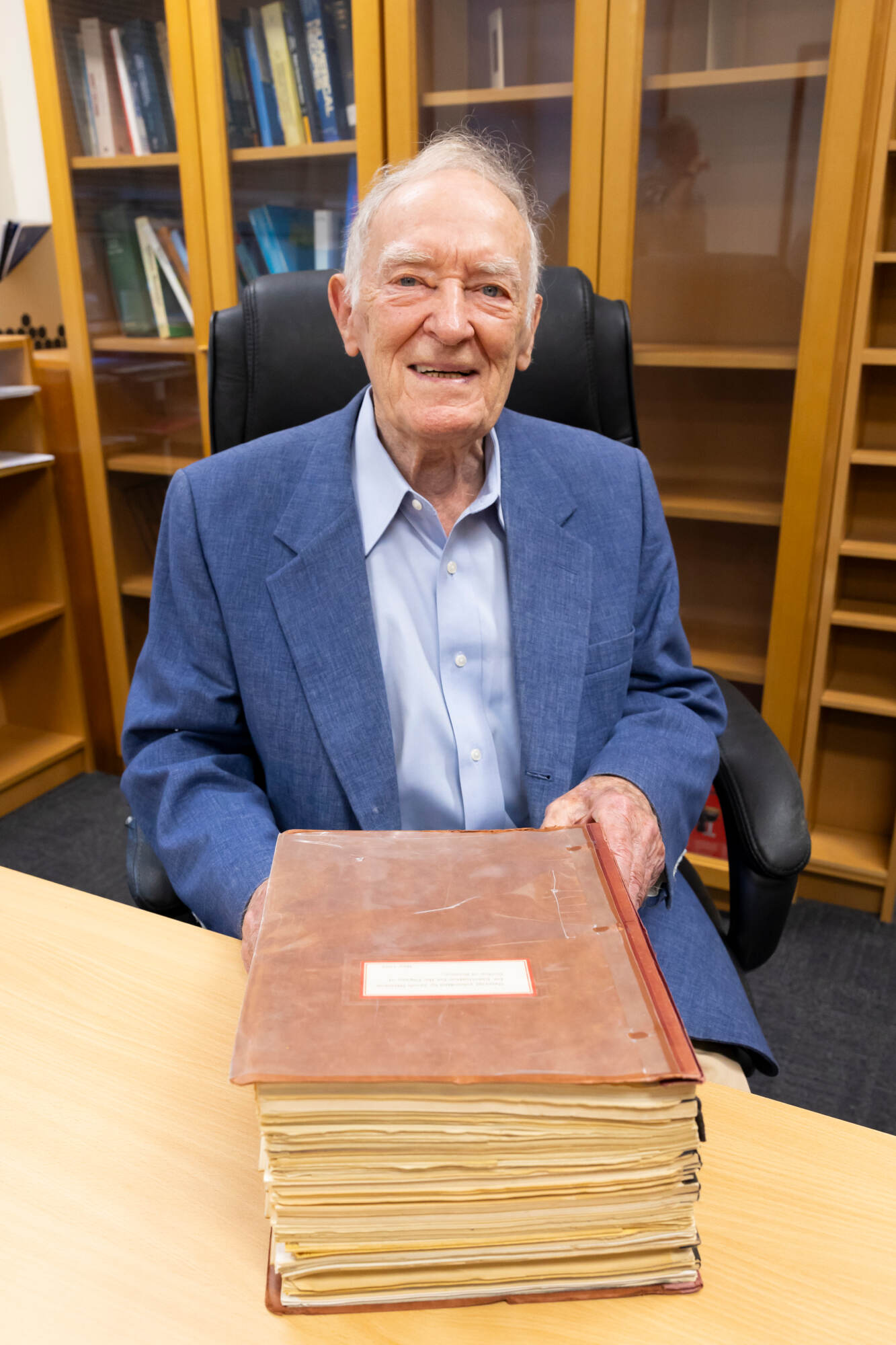
Even now, at the age of 96, Jake is often asked to assist with groundbreaking projects like CERN’s Large Hadron Collider – the world’s largest and highest-energy particle collider.
But ask the sought-after physicist what it’s like to be a pioneer in this impressive field, and he will likely bat away the praise.
“I don’t even think about that,” Jake responded while sitting at University House during his most recent trip to the University of Melbourne – an institution he continues to support through generous giving to the Faculty of Science.
“[Building linear accelerators] was very exciting work, but I couldn’t care less about much else going on.”
It would be a mistake, though, to confuse this modesty for a lack of ambition. Jake is motivated by an intense desire to take on challenges, to fix things no one else can. It’s a sort of “problem solving to the extreme” as his partner Dr Sarah Donaldson put it.
She recalls how national laboratories around the world would often get in touch with Jake throughout his career, bringing with them frustrating problems that no amount of money nor resources could resolve.
“And Jake would say, ‘let me think about it’, and then he would start scratching out some little equations, maybe on the back of a napkin,” Sarah said. Those scrawls would eventually become just the breakthroughs the laboratories needed.
“I was a risk-taker plus I loved the challenge of it,” Jake simply said of this remarkable talent.
It’s this unusual mix of risk-taking, dogged perseverance and a sheer love of problem solving that has guided many of Jake’s life decisions – including his more recent one, to invest in the future of physics research through the University of Melbourne.
Reaching the pinnacle of science
A self-confessed “nuisance” when growing up, Jake said he was competitive in all aspects of his life.
At the University of Melbourne, a Bachelor of Science didn’t satisfy Jake – he aimed for an Honours degree. But in 1948, his final year, he decided he’d “had enough of school”, and left to get a job at Australian General Electric.
From there, he set his sights abroad – jumping on a freighter ship bound for Italy at the age of 22 before starting work at Metropolitan Vickers (allied with International General Electric) in Manchester, north-west England.

Dr Sarah Donaldson and Dr Jacob Haimson spent two days travelling around the University, meeting with young scientists and hearing about their work.
It was here Jake began working for the first time with linear accelerators – machines that charged electrons up to ultra- high energies, creating powerful beams capable of radiating cancerous tissues.
The technology would come to define Jake’s life, leading to illustrious appointments at Varian Medical Systems, a US company specialising in oncology treatment, and at Massachusetts Institute of Technology.
But, Jake said his career highlight took place where it all began: at the University of Melbourne, where he completed his Doctor of Science. Jake earned the advanced degree at the young age of 38 (most DSc recipients have a “grey beard” when they receive the prestigious honour, Jake explained).
Only scientists who have made original, substantial and distinguished contributions to a field are eligible – and the degree marks out Jake as an acclaimed authority in linear accelerator development. “I wanted to get to the farthest point I could make. And, that was it,” he said.
Having reached this pinnacle of his career, Jake is now focused on ensuring other Australian scientists can do the same.
His connection to the University of Melbourne continues through his philanthropic giving, where he’s ensuring a new cohort of young Australian scientists can work to revolutionise their fields, just as he did.
Empowering future innovators
Jake is deeply invested in the future of physics and medical research. He said retirement “never made sense”, and he longs to be back in his laboratory, pulling apart the latest problem he’s been asked to solve.
That longing has led to a new passion: to equip young researchers with resources to make their own breakthroughs in the field.
The prestigious Jacob Haimson and Beverly Mecklenburg Lectureship – honouring both Jake and his mathematician business partner Beverly – has opened pathways for ambitious scientists to pursue cutting-edge research at the University of Melbourne.
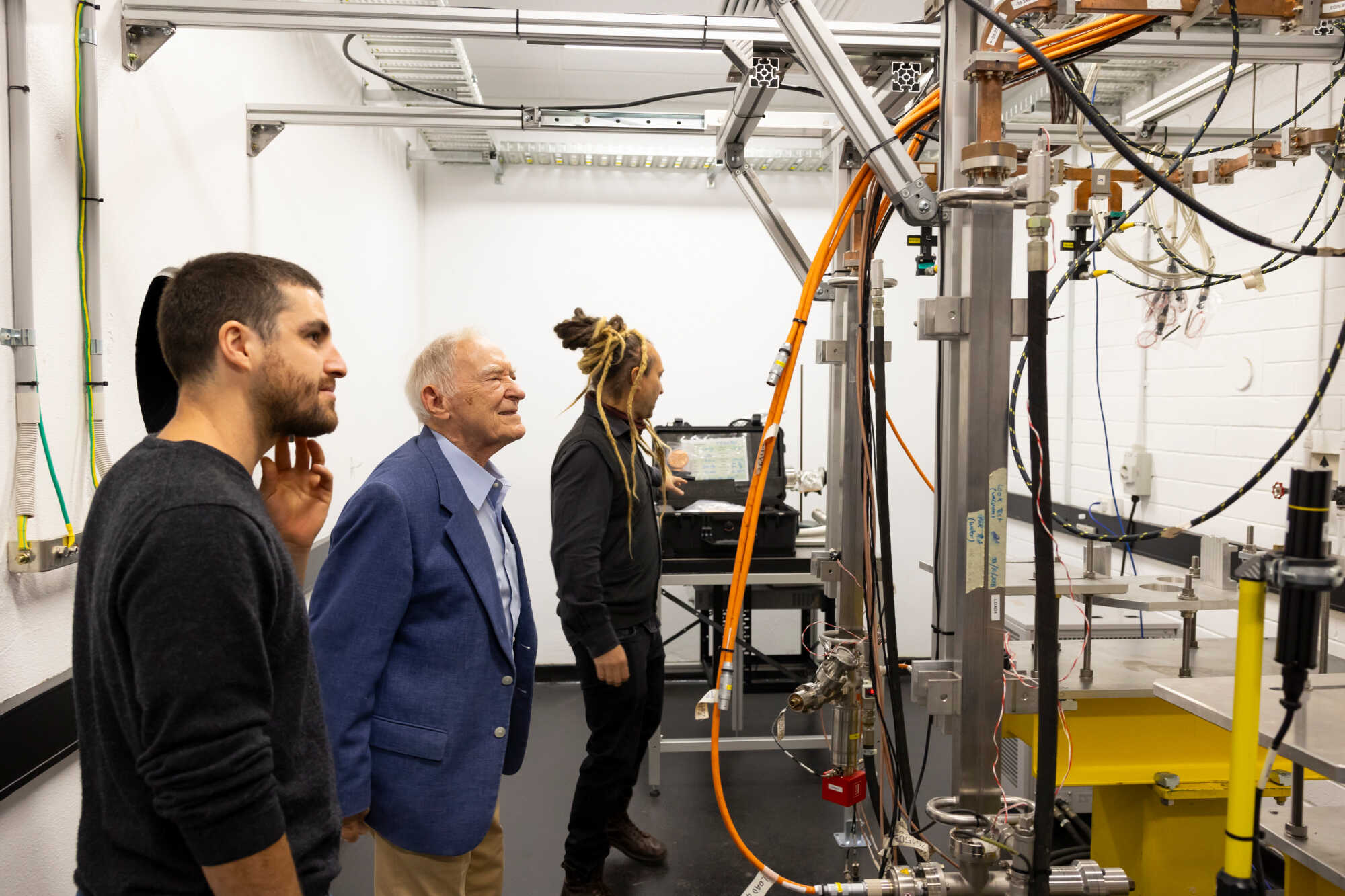
(L-R) Dr Paul Giansiracusa, Dr Jacob Haimson and Dr Matteo Volpi at the X-band Laboratory for Accelerators and Beams (X-LAB).
Much like Jake’s pioneering work, their discoveries have been beneficial to the global scientific and medical community.
Associate Professor David Simpson, who was awarded the Lectureship in 2021, has been working with a team to develop new applications for quantum biotechnology, particularly investigating how quantum sensors can be applied to detect signals from the brain and heart.
“The support has enabled us to secure additional funding, which has driven our applied research program, we are now focused on seeing this technology translated into the field to solve real world problems,” David said.
“The support has also helped grow the team of talented researchers with the group doubling in size over the past three years.”
Associate Professor Liz Hinde, who was the inaugural recipient of the Lectureship, has been investigating the mechanisms through which proteins navigate the human genome to target their relevant DNA sequence.
Her lab has been using a special confocal microscope to investigate these miniscule DNA structures within a cell – the very building blocks of life.
“The stability provided through the appointment allowed me to apply for further funding, to purchase equipment, to employ postdoctoral researchers and engage in undergraduate teaching, which led to the recruitment of Masters and PhD students,” Liz said.
Unsurprisingly, a love of competition and problem-solving underpins Jake’s intent to invest in scientific progress. He hopes his generosity will help Australian researchers compete on the global stage.
But, there’s an even more elementary reason that motivates Jake to support the next generation of scientific breakthrough.
“Because I can’t do it,” Jake said. “But I don’t want to prevent younger, bright people from carrying on in the field of physics.”
Stay connected
Your diverse alumni network offers unique opportunities for you to grow personally and professionally. Explore events, lectures, inspiring stories, global groups, and so much more.
-
Find an alumni event
From public lectures to alumni events that keep your community connected across the globe, see what’s on at the University of Melbourne.
-
Find a group
Join a vibrant alumni network in your local area to boost your career, build friendships, or connect with like-minded individuals.
-
Alumni Council
The Alumni Council champions your community worldwide, shaping events, student experience and more. Learn how to get involved.
How can we help?
FAQs and contact details
Find helpful answers to common questions or contact the alumni office.
Stay in the know
Learn how to set up your UniMelb account to access perks and discounts.
UniMelb account log in
Access your account to update your personal details and access benefits.