This article was first published on Pursuit on 1 November 2023. Professor Sean Grimmond holds the position of Bertalli Chair in Cancer Medicine, generously established by Neville and Diana Bertalli to lead the University’s cancer research strategy and support teaching, learning and engagement.
Current priorities of the strategy include increasing access to precision cancer care and establishing a new centre with the Peter MacCallum Cancer Centre to transform how genomics and precision oncology is delivered in Australia.
On this planet of more than 7.8 billion people, there’s no one quite like you. Genetically speaking, that is.
That’s why the future of cancer care is personal – tailored to fit the distinct variations in your genetic blueprint.
Until now, cancer treatments have been largely reliant on surgery, or chemotherapy and radiation, designed to shrink and kill cancerous cells.
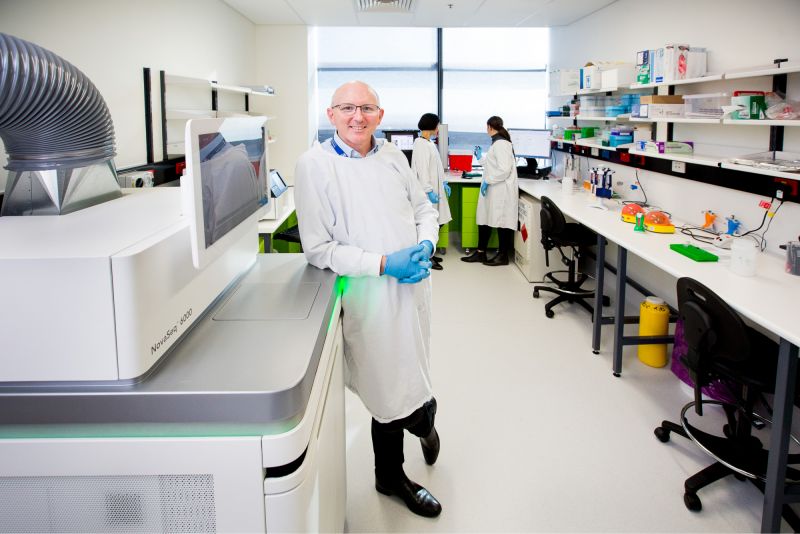
Professor Sean Grimmond in his lab at the University of Melbourne Centre for Cancer Research.
In the age of ‘precision medicine’, we’re moving towards a more targeted approach, adopting drugs and therapies designed to seek out and shut down the changed or mutated proteins that cause cancer cells to grow, divide, and spread.
To understand what is causing a tumour and target its Achilles heel, we need to create a detailed map of a patient’s DNA – much like completing a complex jigsaw puzzle with more than six billion pieces.
We simply haven’t had the technology to put the pieces of the puzzle together until recently.
Cracking the genome code
When I sequenced the genome of an Australian cancer patient for the first time back in 2010, it took 50 people more than seven months, at a cost of more than $1 million.
We needed 16 machines to generate the data in 12 batches that took two and a half weeks each to complete.
Fast-forward to now and the rapid advances in machine learning, nanotechnology and big data mean a single machine like the Illumina NovaSeq 6000 can decode the genome of 48 cancer patients in less than two days, each at the price of an MRI scan.
Just like silicon chips transformed the way we use computers, new-generation sequencing technology is about to completely revolutionise how we research and design cancer treatments.
The ability to read genetic code can help with everything from tracking infectious disease outbreaks to prevent the next pandemic, to developing sustainable food crops to reduce world hunger.
The promise of precision
My research at the University of Melbourne Centre for Cancer Research focuses on sequencing genomes in real-time for patients with some of the rarest and most challenging types of cancer.
The results of these genetic tests are analysed through a series of round-table discussions between genetic data curators, scientists, expert pathologists and clinicians, who use the information to form specialised treatment plans and build a robust evidence base to help patients access clinical trials.
We are also pioneering a new way to collect tumour information from a simple blood test called a ‘liquid biopsy’. This method deciphers small amounts of cancer-specific genetic mutations in the bloodstream known as circulating tumour DNA (or ctDNA).
While a tissue biopsy requires specialised equipment and trained radiologists, a blood sample can be taken at most clinics by a nurse or phlebotomist, meaning people living in remote communities don’t have to travel long distances to access advanced imaging and surgical biopsies to diagnose, treat and monitor their cancer.
Playing matchmaker
Once we map a patient’s genetic code, the information can help us figure out what type of cancer they have, where it originated in the body and what might have caused it to grow.
Then the matchmaking process begins.
We take everything we have learned about a person’s cancer profile and compare it to available drugs, looking for treatments that exploit genetic vulnerabilities in their tumour cells.
The information embedded in a person’s DNA can also tell us if there is something in their metabolism that could cause them to have an adverse reaction to a medication, or whether a drug that works on one person will have little to no effect on someone else.
It can help us find the safest and most effective drugs for each patient, saving valuable time in their treatment and sparing them the side effects of trialling things that might not work.
Using genomic profiling to match patients with accurate treatments could also save the Australian healthcare system billions of dollars on ineffective prescriptions every year – creating a more sustainable and affordable system.
What we need to get right, right now
For precision medicine to live up to its potential, we need to build strong foundations. That means ensuring the data we collect is equitable and representative, for example, the current model is deeply skewed towards Caucasian samples.
While teams like the National Centre for Indigenous Genomics – led by Professor Alex Brown at the Australian National University (ANU) – are trying to correct this, not enough has been done to ensure Indigenous Australians are adequately represented in the data used as the building blocks of the precision medicine movement.
With Aboriginal Victorians twice as likely to be diagnosed with cancer than other Victorians and three times as likely to die from the disease, all researchers and institutions need to do more to ensure they don’t miss out on access to genomic medicine.
If we get it right, precision medicine is an incredible opportunity.
It can lead to better patient outcomes and a more efficient and effective healthcare system. While huge advances in technology mean our capacity to provide genomic-informed personalised cancer care is rapidly expanding, we have work to do to ensure all Australians can reap the benefits.
This research is part of The Advanced Genomics Collaboration (TAGC), a partnership between Illumina and the University of Melbourne to increase genomics innovation, its translation and adoption into the healthcare system and improve patient outcomes.
By Professor Sean Grimmond
Director, University of Melbourne Centre for Cancer Research
Stay connected
Your diverse alumni network offers unique opportunities for you to grow personally and professionally. Explore events, lectures, inspiring stories, global groups, and so much more.
-
Find an alumni event
From public lectures to alumni events that keep your community connected across the globe, see what’s on at the University of Melbourne.
-
Find a group
Join a vibrant alumni network in your local area to boost your career, build friendships, or connect with like-minded individuals.
-
Alumni Council
The Alumni Council champions your community worldwide, shaping events, student experience and more. Learn how to get involved.
How can we help?
FAQs and contact details
Find helpful answers to common questions or contact the alumni office.
Stay in the know
Learn how to set up your UniMelb account to access perks and discounts.
UniMelb account log in
Access your account to update your personal details and access benefits.