The homecoming of a global tech entrepreneur to University of Melbourne
Meet Andrew J. Nash, global tech entrepreneur who returns to University of Melbourne as mentor and advisor.
Melbourne native Andrew J. Nash is a tech entrepreneur with over 40 years' experience working all over the world, including Silicon Valley and the East Coast of the States, where he founded a number of successful startups as well as heading up multinational tech companies. After 28 years in the US, he has now returned to the University of Melbourne in his role as Entrepreneur-at-Large for Translating Research at Melbourne (TRAM) and Operating Partner for University of Melbourne Commercialisation.
We sat down with him in Melbourne Connect to find out more about his colourful career and how he feels about returning to his roots at the University of Melbourne, where he acts as a mentor and senior advisor in the thriving innovation ecosystem.
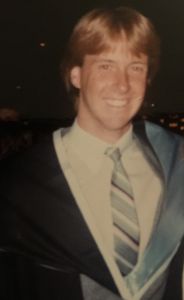
You were a student at the University of Melbourne in the ‘80s - what was student life like back then?
The University of Melbourne was somewhere you caught a tram, a train or a bus to - and then went home and worked my part-time job at a supermarket. I was here for no more than 8 to 12 hours a week - plus the four hours I had to spend in the library to find reading materials and photocopy pages and pages of documents.
I had to get all my five-cent coins, rolls and rolls of them, and to go to the library and then stand in a line at the photocopy machine to get the readings for the lectures.
The entire student body was less than 12,000 back then. It's at least four times larger now. We had a very small cohort of international students as well as boarders who were at colleges, but that was it – it’s completely different now.
What did you study and how relevant is it to what you do today?
I first wrote code 48 years ago in high school. My math teacher said, “You're actually pretty good at math. Would you like access to a computer mainframe?” Having access to a computer and writing code back then (which everybody takes for granted today) was completely novel, so of course I said, “I'd love to.”
Coding at the time was all punch cards and sense cards; you wrote code, but you had to give a deck of cards over and wait for a week for it to come back. If you write code today, you can experiment, and it doesn't matter; you can simply recompile. Back then you had to learn and know the code inside out. You had to put the time and effort in and really think it all through because making a single, simple mistake would cost you time.
Then I came here to The University for my undergraduate Bachelor of Commerce in what is now the Faculty of Business and Economics. In my first year, which was in 1981, they introduced computer programming (COBOL) as part of the Accounting major because the belief was business systems were going to become important for business. I was ecstatic. Back then, I surfed a lot. I figured if I could get the coding done quickly, I could spend more time at the beach. I completed the assignments very, very quickly!
Then I did Computer Science at Monash afterwards and when I started work, everyone was like, “Well, hang on, you’re an accountant and you can write code?”
So, what I studied did end up being very relevant for my career; going from studying and working in the embryonic stage of computers hitting business to, frankly, sitting front-row-centre and watching tech and entrepreneurship over the past 40 plus years; it literally was right place, right time.
What was your first entrepreneurial pursuit after university?
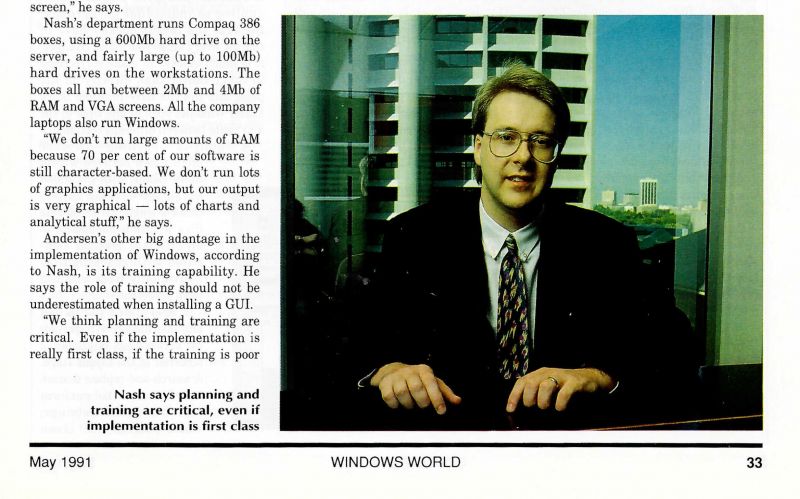
I went on a very traditional path. I became a Chartered Accountant. I worked at Arthur Andersen. But I after that I decided I wanted to be an entrepreneur.
I just felt, how can I be advising businesses if I've never sat in the chair? So, I joked that my first startup was going to be my burner startup, where I would just try figure out what being an entrepreneur is like.
It was in systems consulting. At the time, very few people knew how to bring that discipline of business and technology together. I loved it. It was so cool.
What did you like about becoming an entrepreneur?
Every day was a new day where I had to learn something, I had to get on top of something. And you're on your own; you're entirely dependent on yourself. There are incredible ecosystems now. But back then, there was limited support.
There was literally no Internet, no Google either. We we're like, “Okay, we’ve got to build a business from a blank sheet of paper”. And I did. I built it and we sold it two years later.
And if you've started a business once, and it was even semi-successful, you want to do that again. It's like if you get on a roller coaster and love it- you just want to do it again. It's pure insanity because it's 99% negativity with all the challenges. The high highs are just euphoric though.
What would you say was your proudest entrepreneurial project?
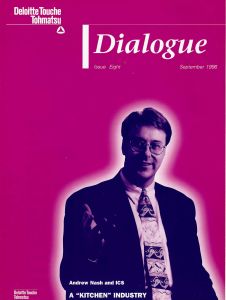
That would probably be International Consulting Solutions that was acquired by Deloitte Consulting. In 1994 and 1995, I kept hearing about this piece of software called SAP.
The more I researched, I thought, there's a huge opportunity here. If all these big corporations are going to put in SAP, why don't we build an SAP consulting and advisory firm? Which is what we did.
We became the market leader almost overnight - we were competing against Accenture, PWC and Ernst & Young, and we were beating them on a regular basis.
Within two years, we'd set up five offices in Australia and an office in New Zealand. We also started to work in Asia Pacific and added over 200 people in two years.
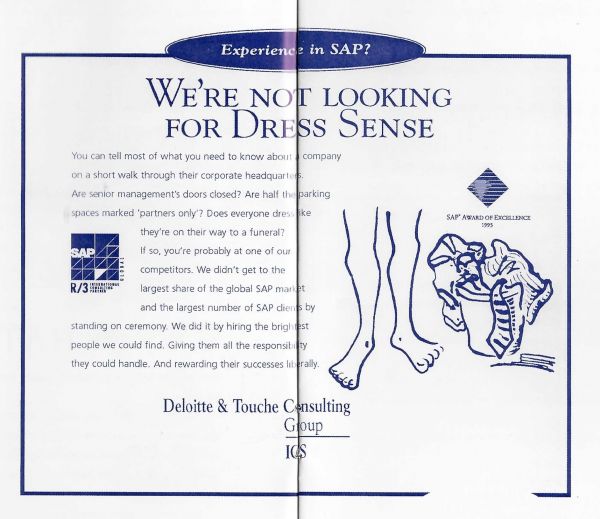
At ICS, because we were really the front end of the tech boom, we had to be quite aggressive about how we were going to build these companies differently to these big professional firms; we had to pioneer early cultural techniques.
We would come out openly and make bold claims for the time such as “Our employees are more important than our customers.” The customers would say, “What do you mean by that?!”
We just knew if we didn't have great people, we weren’t going to have great customers. And in the office, it was all about lunch ‘n’ learns. It was working collaboratively. It was the hot desking because we were out on projects. There were no suits.
When did you go to the Silicon Valley and what brought you there?
Deloitte acquired ICS and asked me to come to the US and step into a global role for them, which I did, so I initially moved to Silicon Valley.
It was an eye-opener. It was just a big, bold software world; you could see this was the centre of the universe.
Hardcore folks will tell you about the '70s and '80s, but to me Silicon Valley really took off like a rocket in the '90s.

What was Silicon Valley like in the 90s?
It was a different way of working, and these massive new buildings were being built everywhere. People had ideas - and suddenly - they had money.
If you love software, which I did - I've been playing with it since I was young - I was like, “Oh, wow. I'm here.” There was a casualness about it. If you go to New York, you know you're on Wall Street; there are suits, you have a preconceived notion of what the Financial District is like.
In Silicon Valley, the experience was just a bunch of entrepreneurs who went to university in places like Stanford, doing tech in a coffee shop. It was a culture of people trying to figure out what everybody else was doing; people with big ideas who wanted to talk to each other.
And tech was (and still is) a fascinating industry because there is no bottom in depth. It's an ever-expanding industry. It was just so hard not to be addicted to it; I just arrived front-row-centre, why would I ever leave? I thought, it's about time I do another startup. I had the bug.
Your experience even brought you to Hollywood, where you worked as a technical advisor for HBO’s TV show Silicon Valley...
Mike Judge, who did the movie Office Space, wanted to create a comedy TV show about Silicon Valley. He is a software developer and engineer, so he was adamant that the tech had to be as accurate as the chemistry in Breaking Bad. So, they needed technical advisors.
I would work with the writers and tell them, “We wouldn’t do that, or say that.” We would also have to construct, for example, how the software would fail in the show.
We would create diagrams, fake artifacts based on real tech that would then be woven into the actual script.
If you looked at some of the scenes, we knew that real technologists would freeze the screen and literally look at a diagram or a design on the wall to examine it and see if it was real. That legitimacy was appreciated by them and that was what we wanted. It was really well-researched. It was truly the most fun I've ever had with “work”.
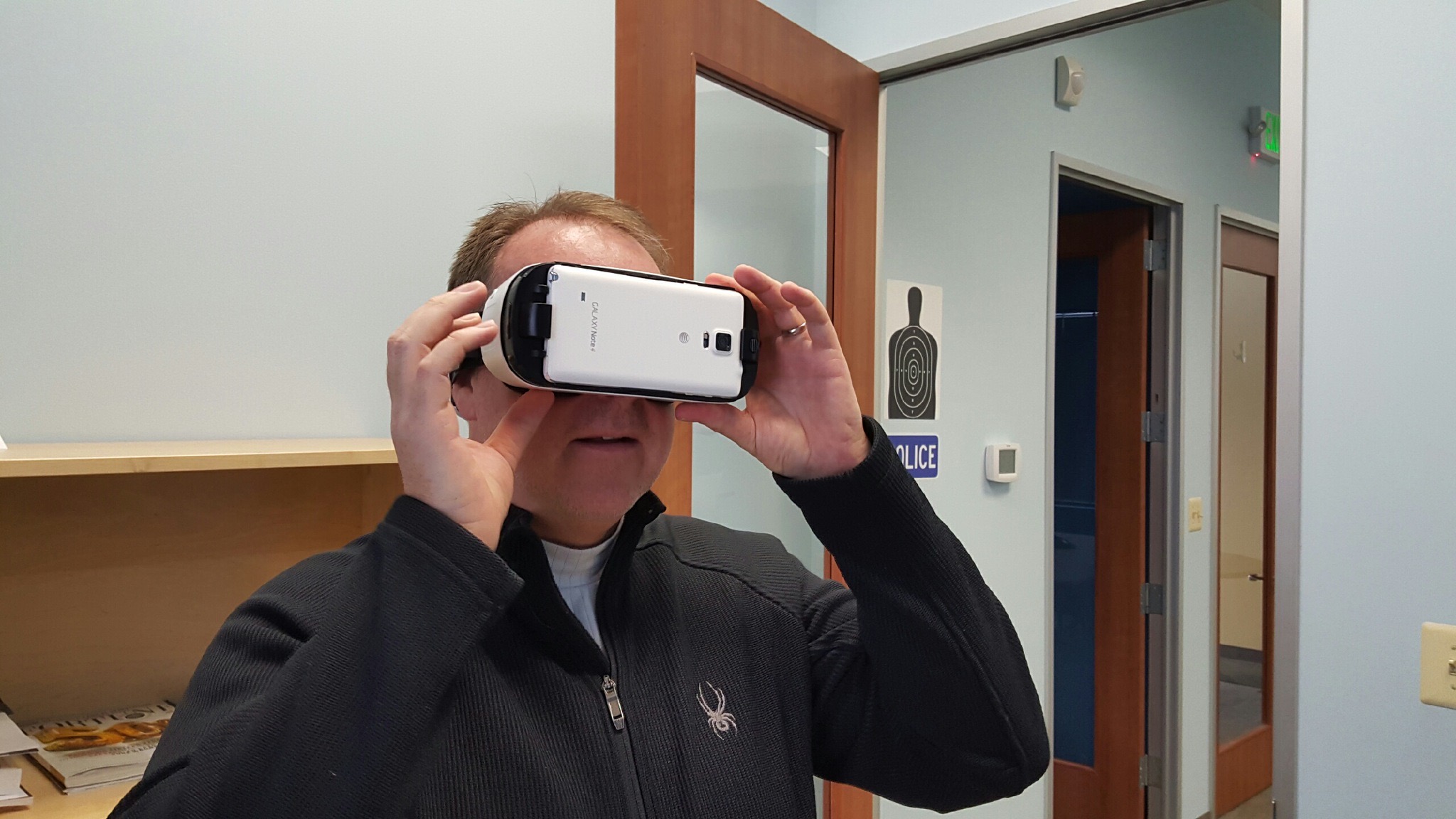
Andrew trialing VR in the Metaverse in 2015
What would you say your career highlights have been?
After 40 years to be able to say that I have exited (directly or indirectly) over a dozen companies over a diverse range of technologies including eCommerce, SaaS applications, data science, data & data infrastructure, cybersecurity, ESG/carbon models, digital marketing.
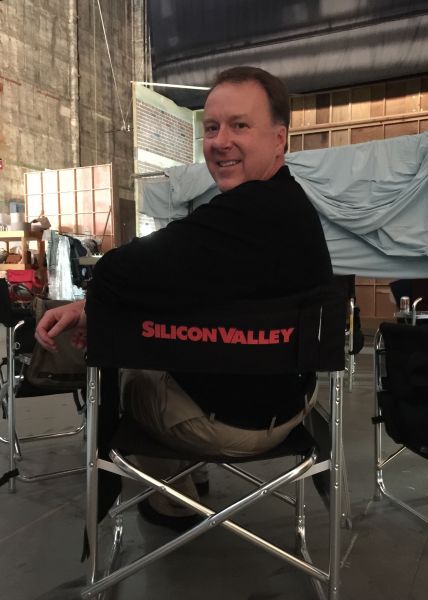
Aside from ICS and Silicon Valley [TV show], I also did a public company turnaround for BroadVision post-internet bubble in the 90s that was both a challenge and rewarding experience. But truly a big one was when I reconnected with The University.
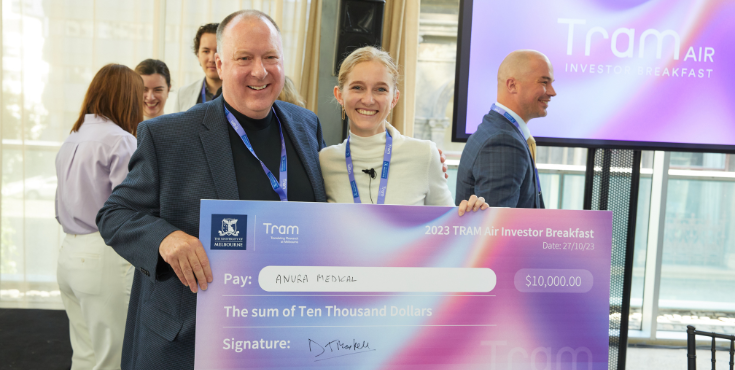
About six years ago, I became actively involved in the TRAM programs and it cemented my love of working with early-stage companies. It’s just so gratifying to work with them.
For example, I can see Mahdi, the co-founder of Porous Lane over there [in the Melbourne Connect Café] - I've worked with him for four years. I'm now an investor and on the board; we're building a company together. We're wonderful friends, it’s energizing.
What do you like about mentoring entrepreneurs?
I like to mentor because I see more potential in them than they see in themselves - every single time. It's because they have the same fear and trepidation I had when I did it. That takes over the brain rather than truly looking at the opportunity. If I can help them through that part of the journey, they can get there. They just need someone to provide some confidence, support and guidance.
What advice would you give to an aspiring entrepreneur?
I joke with them all that they need to get used to ‘a wall of no’, but it is the reality.
Just get used to the word ‘no’, brush it off.
I tell them not to leave a meeting until they've got at least two new connections so it’s never a waste of time. You never know how they might help you in the future.
What excites you about the University of Melbourne and wider Melbourne startup ecosystem right now?
The hard thing about deep tech, like a lot of the University startups, is not the idea. It's the gestation and duration of the idea because in certain industries, it's highly regulated, and you can only go as fast as the regulation. But now there's been enough capital raised and made in other areas, venture capital firms can now diversify it out into these other areas. You can have more patient capital and a more patient approach. But it's good to see that the universities, both here and overseas, have recognised that deep tech is a large opportunity. To see that now, it's awesome because now hundreds more ideas are going to survive rather than sit on the shelf or in the libraries of these amazing institutions.
And for me, this is the purest joy of being back at University of Melbourne is sitting here in this café in Melbourne Connect and saying;
What else can we do to accelerate, invest and support and create ecosystems around these companies?
Email Ecosystem-Community@unimelb.edu.au to get in touch with Andrew.
Learn more about the Andrew J Nash First in Family Scholarship.
Featured content
Stay connected
Your diverse alumni network offers unique opportunities for you to grow personally and professionally. Explore events, lectures, inspiring stories, global groups, and so much more.
-
Find an alumni event
From public lectures to alumni events that keep your community connected across the globe, see what’s on at the University of Melbourne.
-
Find a group
Join a vibrant alumni network in your local area to boost your career, build friendships, or connect with like-minded individuals.
-
Alumni Council
The Alumni Council champions your community worldwide, shaping events, student experience and more. Learn how to get involved.
How can we help?
FAQs and contact details
Find helpful answers to common questions or contact the alumni office.
Stay in the know
Learn how to set up your UniMelb account to access perks and discounts.
UniMelb account log in
Access your account to update your personal details and access benefits.