From interns to hosts: alumni creating opportunities
Internships can open doors for students and help organisations find their next generation of talent. These Faculty of Arts alumni share how their own internship experiences have come full circle.
It’s clear from a simple glance at Grace Corcoran’s bio that she’s blazing a trail in international relations.
With work spanning geopolitics, security, women’s empowerment and Australia’s relationships across Asia, Grace is at the centre of some of the region’s biggest policy conversations.
But if not for an internship undertaken during her university days, she wonders if she would ever have found a foothold in her dream career.
In 2022, she interned for three months at Asialink while studying a Master of Development Studies, gaining valuable diplomacy experience and working closely with the CEO.
She knew how competitive international relations was, so seized the opportunity to prove herself.
“It’s difficult to get into the international relations space in Melbourne, because there’s very few jobs,” said the policy expert.
“I was thrown into the deep end but that’s definitely the environment that I thrive in. It was my first office role after working in COVID-19 vaccination clinics across Melbourne, and it was incredible to see what it’s like to work in such a fast-paced and exciting area.”
Spotting an opportunity
Asialink, Australia’s leading national centre for creative engagement with Asia, is based at the University of Melbourne, giving her the flexibility to attend classes between work while gaining academic credit. It didn’t just look good on her CV – it led to Grace’s first role in the field.
During her internship at Asialink, Grace noticed a glaring gap: there was no dedicated staff member working in the diplomacy program, so she devised a new role and pitched herself.
“The program was being run by the communications team, and my mentor at the organisation really guided me on how to pitch myself,” she said.
“I learned how to show how my skills would benefit the organisation. I approached my supervisor, who was the CEO at the time, and then she offered me the job of Project Coordinator.”
Grace was promoted to program lead in 2023 and has since forged a successful career, being named as one of Australia’s Young Women to Watch in International Affairs in the same year.
Now with the Australia India Institute as a Research Fellow and Senior Policy and Projects Manager in the security and geopolitics team, her work focuses on Australian foreign and defence policy in Asia, Indian Ocean security, as well as minilateral cooperation (small countries working together), and penning regular articles on important policy topics.
“I wouldn’t be in the role I’m in now if it wasn’t for that internship,” she said.
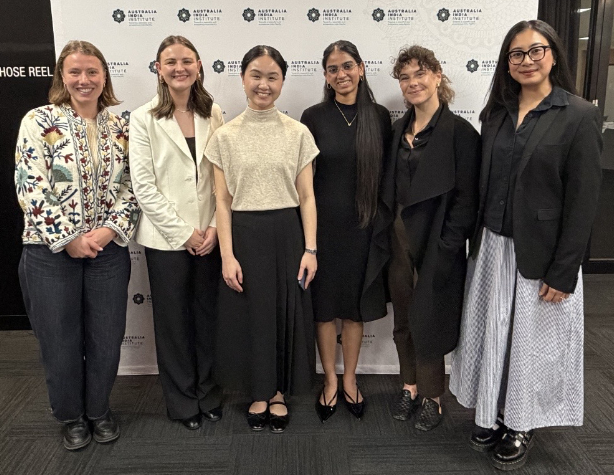

Giving back: 6 interns a year … and counting
Grace is passionate about “paying it forward” by hosting as many as 6 interns across the Australia India Institute in a year. And at Asialink she hosted up to 10 interns annually.
“They add such value to our work, such as contributing to deep thought, deep analysis and business development … they often have great ideas we can incorporate into our projects,” she said.
Her own internship was far removed from the stereotype of fetching coffees and printing, with tasks as broad as event management, supporting CEO briefings and diary management, business development and writing communications materials.
“Asialink was such a fantastic place to do an internship because they got you involved in all sorts of things and they got you to connect with people all across the organisation.”
She aims to give her interns the same experience.
They do everything from helping with speaking notes for meetings with diplomats or government ministers, report writing, business proposals and accompanying her to events.
Learning workplace-ready skills
At university, fellow alum Emma Nugent was largely learning about Australia’s family violence crisis response with her head buried in books.
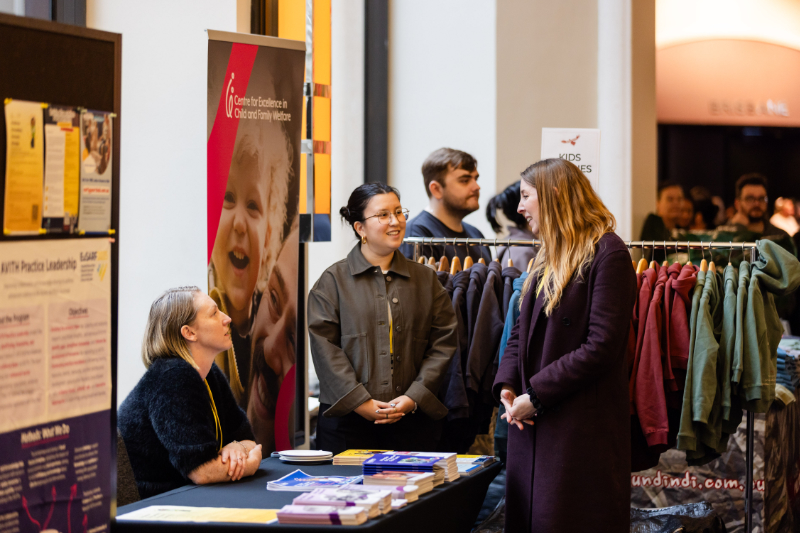
However, the realities of how policy worked in practice were brought to life when she started an internship in 2021 at the Centre for Excellence in Child and Family Welfare.
She was quickly set to work with practitioners dealing with real-life cases on a project helping services assess family violence risk, called MARAM (Multi-Agency Risk Assessment and Management).
“It was very interesting to learn what that practice looked like on the ground because it was so different from what I was reading,” she said.
Given the choice between writing a thesis or an internship, she opted for hands-on experiences to complement her studies.
One of the most valuable skills she learned was how to turn academic research into information people could actually use in their day-to-day work.
“I think it really did help me with that broader understanding of how to write for different audiences,” she said.
“The first feedback I got from my internship supervisor was that [my writing] was very theoretical and academic. Practitioners don’t have a lot of capacity to be reading pages and pages of research, so I needed to make things easy for them to access.”
How interns can be an asset
Like Grace, the internship proved to be a pivotal gateway to a job.
Two weeks after graduating, Emma received a call from her former supervisor asking if she could work a short-term contract on the MARAM project.
A one-month consultancy turned into a full-time role as a Project Support Officer, and she has since risen through the ranks to become a Senior Policy and Research Officer.
She’s now helping open doors for others, and this year supervised three University of Melbourne interns as they helped build the centre’s AI policy. They opened the team’s eyes to the breadth of AI platforms they could use, including skills associated with writing effective prompts.
“They have so many different perspectives that people working in an organisation might not necessarily have,” she said.
“They’re able to give that out-of-the-box thinking, which is really valuable.”
Support through a structured placement
Having been on both sides of the intern desk, Emma said the University’s structured model was helpful in setting expectations for both the organisation and students.
“From day one, the uni staff are very supportive, and it’s really wonderful to have a middleman helping you all communicate, and set out the terms of reference,” she said.
She said she would always be grateful for the confidence she gained from the experience.
“I’m just really pleased that I had the opportunity to be an intern here at the Centre but also to pay it forward and be able to supervise interns.”
Learn more about hosting Faculty of Arts students at your organisation.
Stay connected
Your diverse alumni network offers unique opportunities for you to grow personally and professionally. Explore events, lectures, inspiring stories, global groups, and so much more.
-
Find an alumni event
From public lectures to alumni events that keep your community connected across the globe, see what’s on at the University of Melbourne.
-
Find a group
Join a vibrant alumni network in your local area to boost your career, build friendships, or connect with like-minded individuals.
-
Alumni Council
The Alumni Council champions your community worldwide, shaping events, student experience and more. Learn how to get involved.
How can we help?
FAQs and contact details
Find helpful answers to common questions or contact the alumni office.
Stay in the know
Learn how to set up your UniMelb account to access perks and discounts.
UniMelb account log in
Access your account to update your personal details and access benefits.