Exams
This guide outlines key design principles and practical recommendations to help subject coordinators and teaching teams develop a valid, reliable and meaningful exam.
Exams are often the most significant assessment in a subject (some exams account for 50% or more of the total weighting). Although students sometimes receive their exam results and feedback from the teaching team, this is not always guaranteed, leaving them with little understanding of how they performed in the most important assessment of the subject. While good exams should adhere to general assessment design principles, particular attention should be paid to alignment with the intended learning outcomes, exam structure, conditions, and quality assurance.
Alignment
Before you begin writing the exam, you need to work out which intended learning outcomes you want to assess in the exam. The action verbs in those outcomes, such as explain, analyse or apply, indicate the level of cognitive skill or learning students must demonstrate.
The exam should target the subject mastery expected of students at their year level. The exam should be appropriately challenging and should not assess proficiency below or beyond the targeted learning outcomes. For example, if the learning outcome requires students to apply their understanding of theories in various contexts, the exam should assess students' ability to apply those theories, not simply their ability to recall them nor skills that go beyond application.
Exam structure
Whole exam structure
Exams are often divided into parts, which may represent the learning topics, the level of learning being assessed, or question types. When exam questions are grouped logically according to one of these patterns, students understand the structure of the exam more quickly and can use more of their time to plan their approach. While it is not compulsory, it is recommended that you design exams to progress gradually in complexity and difficulty, moving from lower-order tasks towards higher-order tasks.
To design an exam that is balanced in both length and difficulty, consider the number of questions included in the exam, as well as the number of marks and recommended time allocated to each exam question. Excessive workload can create unnecessary time pressure, whereas an underloaded exam may not provide adequate opportunities for students to demonstrate the intended learning outcomes.
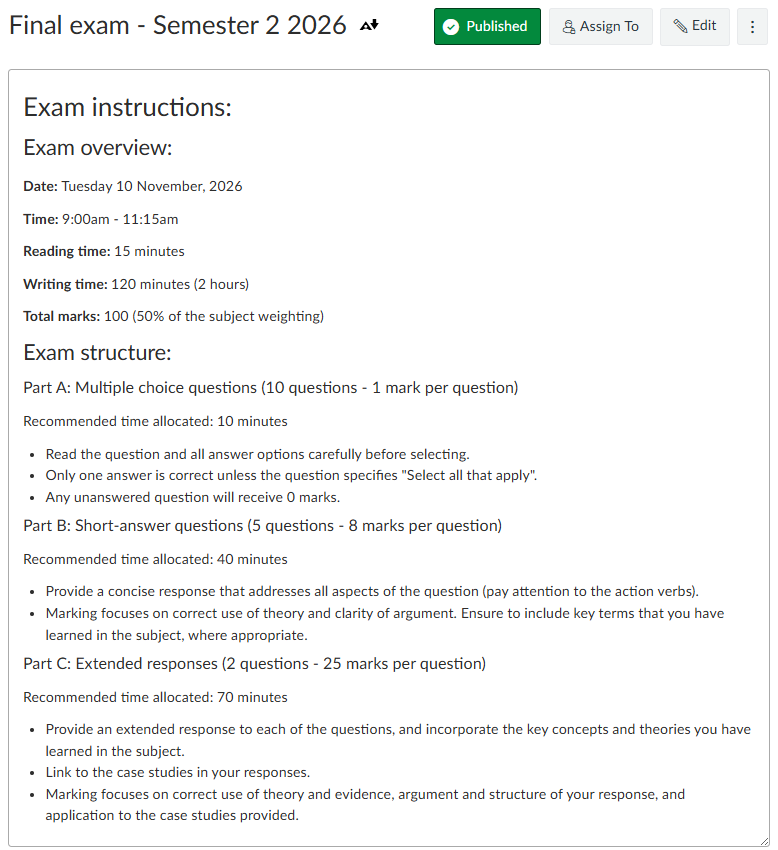
An exam that is well-structured and properly presented should include:
- Clear signposting for each section. For example, Part A: Multiple choice questions (10 questions - 1 mark per question); or Part A: Leadership theories (10 MCQs - 1 mark per question)
- Detailed instructions for how students should complete each section
- Number of questions, marks and time (when appropriate) allocation for each section
- A balance of question formats to ensure evaluation of both breadth and depth of learning. Avoid using too many different question types or having no variation at all.
Question structure
Once you have a rough overall outline for your exam, the next step is to formulate the exam questions.
Question types fall broadly into two types:
- Direct, basic question, for example: What is the basic purpose of SWOT analysis?
- Contextualised, application questions, for example: Explain why conducting a SWOT analysis would be relevant to a chosen business’s strategic position.
These questions may be delivered as multiple choice, short answer, extended response items and so on, or may form part of a case study. Regardless of question type and format, each question should contain specific action verbs that match the intended learning outcome, indicate the expected word limit where possible, and should be written in clear, unambiguous language so students know exactly what is required. Avoid using unnecessary complex language, idioms or culturally specific references.
Multiple choice questions (MCQs) are commonly used in exams as they can measure a range of cognitive levels and are efficient to mark. However, it is not always an easy task to design valid, reliable and effective MCQs. The Centre for the Study of Higher Education provides a detailed guide on how to write MCQs which also includes examples of different MCQ types.
Exam conditions
Some exam conditions can increase cognitive load, leading to stress and time management issues. Too many additional resources or print materials require students to spend more time reading and interpreting information which shifts their attention away from demonstrating the targeted knowledge and skills. Many students may run out of time due to this added process, and those with slower reading speeds may be disadvantaged. It is important that you limit additional materials to what is essential and consider including the extra information directly in the exam questions instead, so that students do not have to navigate multiple documents.
Exam conditions also encompass the digital platform or tool students must use to complete their exam. Digital tools can introduce additional demands on students, so it is important to select the tool carefully based its capabilities and whether it suits the nature, complexity and marking workflow of the exam. Our digital exams website provides detailed user guides to help you compare different assessment tools and configure them for use; however, we strongly advise that you preview the exam under realistic conditions before making it available to students.
Our preparing your students for exams guide explains how you can support students' preparation for their exams.
Quality assurance
Before finalising the exam, you should work with your teaching team or colleagues in your department to review the exam content and where possible, arrange for other teaching staff to take the exam under comparable exam conditions. This practice is to ensure that any unclear question wording, misalignment with the intended learning outcomes, or technical issues (for digital exams) are identified and rectified promptly.
If multiple markers are involved in the marking process, consider how marking will be moderated to support consistency across the teaching team.
After the exam has been delivered, you should utilise any available exam analytics, for example, Canvas Quiz analysis reports, to evaluate overall student performance and the effectiveness of the exam. Consider any questions with unexpected response patterns or exceptional levels of difficulty, and use these insights to inform future iterations of the exam.
Support and resources
The digital exams website provides all guides and resources relevant to centrally-managed exams.
For assessment design support, please book a consultation with our Learning Design and Assessment team.
For assistance with our university-supported teaching and learning technologies, please submit a support request.