Professor Graeme Clark awarded Japan’s Honda Prize
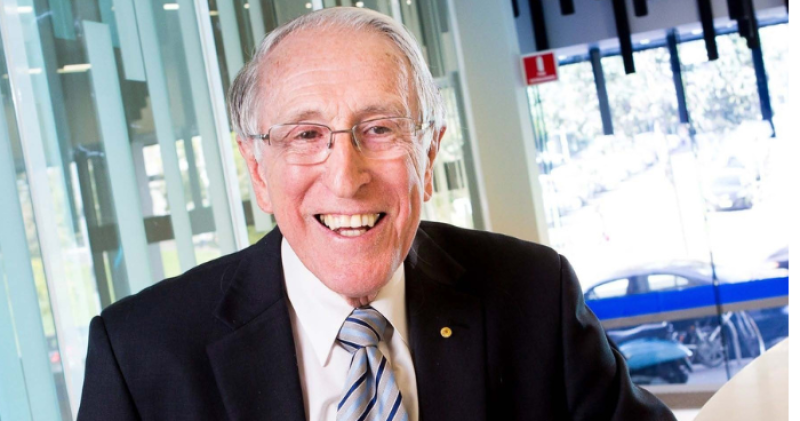
University of Melbourne Emeritus Professor Graeme Clark AC – whose breakthroughs have brought the gift of hearing to over 650,000 people globally – has been awarded the 2026 Honda Prize.
The Prize has been awarded jointly to surgeon and scientist Professor Clark and Austrian electrical engineer Dr Ingeborg Hochmair. Working independently, both spearheaded the research and development, clinical application and worldwide adoption of the multichannel cochlear implant, commonly known as the bionic ear.
Professor Clark and his team invented the world's first multichannel cochlear implant, which was commercialised with Australian medical device company Cochlear Limited. Dr Hochmair co-founded MED-EL, an Austrian-based company specialising in hearing implants and devices.
The cochlear implant helps people with severe to profound hearing loss, who have difficulty understanding speech, even with hearing aids. It transmits sound to the brain by converting it into electrical signals and directly stimulating the auditory nerve through electrodes inserted into the cochlea – the sensory organ for hearing in the inner ear.
Professor Clark is the second Australian to receive the Honda Prize since its establishment in 1980, with Professor Ian Frazer receiving the Prize in 2009 for his work on cervical cancer vaccines.
University of Melbourne Interim Vice-Chancellor Professor Glyn Davis AC congratulated Professor Clark.
“We are enormously proud of Professor Clark, who worked tirelessly for decades to develop and refine the multichannel cochlear implant, achieving major advances in scientific understanding along the way,” Professor Davis said.
“He is an inspiration to generations of scientists and clinicians in Australia and globally, demonstrating what can be achieved through innovation, collaboration, rigorous medical and scientific research, and persistence.”
In 1978, working in collaboration with The Royal Victorian Eye and Ear Hospital, Professor Clark and his team performed the first multichannel cochlear implant surgery. His legacy lives on at the hospital through the world’s first public Cochlear Implant Clinic that was founded 40 years ago.
He then worked with his research team at the University of Melbourne to discover a code to give speech understanding to his profoundly deaf patients without even the need to lipread. He then collaborated with industry to launch what is now Cochlear Limited. Together with Cochlear, Professor Clark further improved the device and its clinical application. Through approvals in various countries and the training of healthcare professionals, the resulting device saw adoption worldwide.
Professor Clark said he was motivated as a child to develop the solution after watching his father struggle with severe hearing loss. He was appointed foundation Professor of Otolaryngology at the University of Melbourne in 1970, leading a team of medical and engineering experts, carrying out multifaceted research on issues such as electrode design, auditory nerve stimulation, sound processing and safety.
“It is a great honour to be a co-recipient of the Honda Prize as it highlights the importance of using technology for human welfare and, in my case, giving hearing to severely deaf people,” Professor Clark said.
“This was my dream as a five-year-old as I knew how difficult life was for my deaf father. I felt driven not only to restore hearing, but to understand how our brains function and result in human consciousness.
“When I started my research in 1967, I could not have imagined the benefits for adults and children. While clinical application was initially for adults, later improvements saw the first cochlear implant designed specifically for children implanted in 1985.
“Thus, it has become the first means of restoring a human sense and paves the way for restoring brain function through neural engineering.”
Professor Clark has received many honours, including Australia’s highest civil honour, a Companion of the Order of Australia for services to medicine in 2004, the 2026 Queen Elizabeth Prize for Engineering, the 2026 Richard N Merkin Prize in Biomedical Technology, the 2004 Prime Minister's Prize for Science, 2001 Senior Australian of the Year, the 2013 Lasker Award, and many more.
The Honda Prize ceremony will be held in Tokyo on November 16 and includes a total prize of 10 million yen (AUD90,000). The Prize was established by The Honda Foundation in 1980 to acknowledge research achievements that contribute to “the creation of a truly humane civilization”.