Statement by Laureate Professor Marcia Langton AO on the repatriation of Ancestral remains from The Donald Thomson Collection to the Dhaḷwaŋu, Maḏarrpa, Djapu, Dhuḏi-Djapu, Maŋgalili and Marrakulu Clans
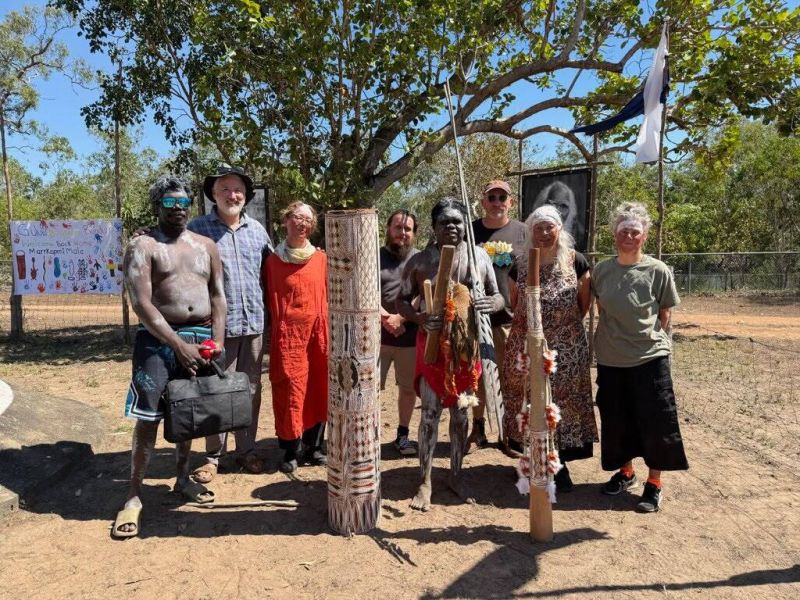
A Message to the clans and their leaders from Professor Marcia Langton
To the leaders, Elders, families and members of the Dhaḷwaŋu, Maḏarrpa, Djapu, Dhuḏi-Djapu, Maŋgalili and Marrakulu Clans, I want to express my profound sorrow as your Ancestors are returned to their homelands. Your Ancestors are coming home. After so many years away from their Country and their people, they will be returned to you at Gäṉgaṉ and Bäniyala under your law, your ceremony and your care, as it should always have been.
I am sorry for what was taken, with respect for your law and your leadership, and with hope for all that lies ahead between your communities and The University of Melbourne. At the same time, it will be an honour to stand with you at Gäṉgaṉ and Bäniyala, and be with you during the ceremonies.
For many years, I have been involved in the efforts to bring them home to their families and clans. I am deeply aware of the great injustice and wrongdoing that Donald Thomson caused in taking them from you, and of the grief and sadness that their absence has brought to your families across the generations. No words are adequate. Nothing that I, or the University, can say will undo what was done. What we can do is tell the truth about what happened and honour the obligation to return your Ancestors to you and to their homelands.
It is my deepest hope that their homecoming brings some relief to the families and clan members who have carried this grief for so long, and that the ceremonies at Gäṉgaṉ and Bäniyala, led by your leaders and conducted in accordance with your protocols, will be a time of healing and renewal for your communities. I honour the Clan leaders and Cultural Authorities whose strength and patience have guided your Ancestors on their journey home.
The Donald Thomson Collection is a collection of Aboriginal art and material culture of national and international distinction, exceptional by any standard for the complexity and quality of the material it contains. Assembled by Professor Donald Thomson (1901–1970) of the University of Melbourne between 1928 and 1965, it comprises more than ten thousand objects, together with photographs, films, audio recordings, field notes, journals, maps, and natural science specimens.[i] It represents the cultural, economic and social life of Aboriginal peoples of Arnhem Land, Cape York and the Great Sandy and Gibson Deserts, and includes material collected from Papua, West Papua and the Solomon Islands during Thomson’s wartime service. It stands as a testament to the rich cultural and economic lives of the Indigenous peoples of these regions.
Thomson’s approach set him apart from his contemporaries. Where the founders of modern anthropology in Australia described, from the observer’s point of view, the formal features of social organisation, Thomson was interested in how life looked to Aboriginal people, and in comprehensive documentation. He recorded each element of the world he encountered in several cross-referenced formats — an object linked to photographs, to fieldnotes or a journal entry, to a specimen or a drawing — identifying objects in Aboriginal languages as well as in English. The archaeologist John Mulvaney observed that no other anthropologist documented and cross-referenced objects, fieldnotes and photographs in this way, and that Thomson appraised the complex society of the people he worked among with sympathy and affection.
Thomson was also a public advocate for Aboriginal people: trained in journalism, he published articles that exposed the cruelty of their treatment and argued for the recognition of Aboriginal rights to their tribal lands. It is this depth of documentation, made with the knowledge and collaboration of the communities in which he worked, that gives the collection its paramount value to Aboriginal people today — a living archive of intergenerational knowledge that is, at last, after fifty years, of immense value in your efforts to renew and strengthen your culture.
Thomson also collected ancestral remains, and the offence this caused to Aboriginal people requires an honest explanation. Unlike some of his contemporaries at the University of Melbourne, Thomson had no interest in eugenics, nor in the study of remains exhumed from graves for scientific research or comparative anatomy. Indeed, he was angered by an official request, made before his 1935 expedition to Arnhem Land, to collect Aboriginal skulls for the Australian Institute of Anatomy, and he refused it.
His collecting of ancestral remains and sacred material was instead consistent with his holistic drive to document every dimension of the ceremonial life he witnessed, including funerary practice, of which he wrote that a person who could follow all that takes place at the death of an important man ‘would understand almost all of the culture of these people’. Whatever his purposes, the removal of Ancestors from their Country caused deep and lasting offence and grief to the communities of origin. Their return is part of the University’s acknowledged commitment to truth-telling and to its legal and ethical responsibilities.
At Thomson’s death in 1970, no agreement had been reached on the future of the collection: both Thomson and the University had separately claimed ownership, and it passed to his widow, Dorita Thomson. Remember, at this time, as you well know, there were no Aboriginal rights in our cultural heritage. Under a 1973 agreement, the cultural objects were donated to the University of Melbourne and placed in the custody of the museum now known as Museums Victoria, while the fieldnotes, journals, photographs and films — the literary collection — remained in the ownership of the Thomson family. For five decades, the collection was divided. The Indigenous communities of origin were never represented or involved in its governance and management, and, with few exceptions, only a small number of Aboriginal people from those communities ever saw it.
Change came in stages. Following the 2016 amendments to the Aboriginal Heritage Act 2006 (Vic), the University transferred all known Aboriginal Ancestors in its care, including the ancestral remains collected by Thomson, to the Victorian Aboriginal Heritage Council in 2018, for care, management and repatriation. In 2017, prompted by the University’s senior Indigenous academics, Professors Ian Anderson and I, the University Council established the Donald Thomson Collection Review, chaired by Judge Ian L. Gray. Judge Gray consulted more than 250 people, and its principal finding of the Report was clear: the collection’s ‘greatest significance resides in its importance to communities of origin, and their descendant families’. Applying Article 31 of the United Nations Declaration on the Rights of Indigenous Peoples, it recommended a new model of governance and management that would, for the first time, make communities of origin central to decisions over access to their cultural heritage material and knowledge. It also warned that this work is time-critical: few elders remain who can interpret the knowledge and language held within these materials, and once this generation has passed, that knowledge and language will be lost.
In 2024, an agreement between the University and representatives of the Thomson family united the literary and object collections under University ownership for the first time in more than five decades, so that detailed information about the people and places Thomson visited, and what he collected, could be studied to correctly identify the Ancestors and other materials, so that these could be made available to the communities of origin.
The repatriation ceremonies taking place at Gäṉgaṉ and Bäniyala in northeast Arnhem Land in 2026 are the direct continuation of this history. In February 2026, the Cultural Authorities of the Clans wrote to the Victorian Aboriginal Heritage Council seeking the return of their Ancestors, and this was formally approved in March. Across multiple days of ceremony and song, led by the Clan leaders under their own cultural protocols, fourteen Ancestors are being returned to the Dhaḷwaŋu, Maḏarrpa, Djapu, Dhuḏi-Djapu, Maŋgalili and Marrakulu clans. For these communities of origin and for the University, the return of the Ancestors marks both an act of truth-telling about the past and a commitment to a future in which the Donald Thomson Collection is governed with and for the peoples whose knowledge it holds. Please accept my condolences.
With my deepest respect,
Laureate Professor Marcia Langton AO
Associate Provost, The University of Melbourne
[i] This part of my statement is a summary of the chapter by myself and Louise Murray, published as ‘Gifts and Legacies’ in Dhoombak Goobgoowana: A History of Indigenous Australia and the University of Melbourne, Volume 2: Voice (Melbourne University Publishing, 2025).