Immersive immunology
Advances in technology that allow us to see inside the human body have significantly advanced our understanding of its inner workings. However, some processes, such as the functioning of the immune system remain challenging to visualise.
As a result, we struggle to comprehend the full complexity of the cellular immune system, and the way it controls infections, responds to vaccines, responds to cancer or causes immunological diseases.
The research team has already developed spatial transcriptomics (ST) to construct the first detailed catalogue of every immune cell-type within the spleen, including the genes used by each cell, their locations and interactions with neighbouring cells.
The team has also published novel cellular maps of the adult spleen both before and during an immune response. These maps represent both an opportunity – generating new biological understanding, and a challenge – making sense of massive amounts of spatially-resolved, high-dimension data.
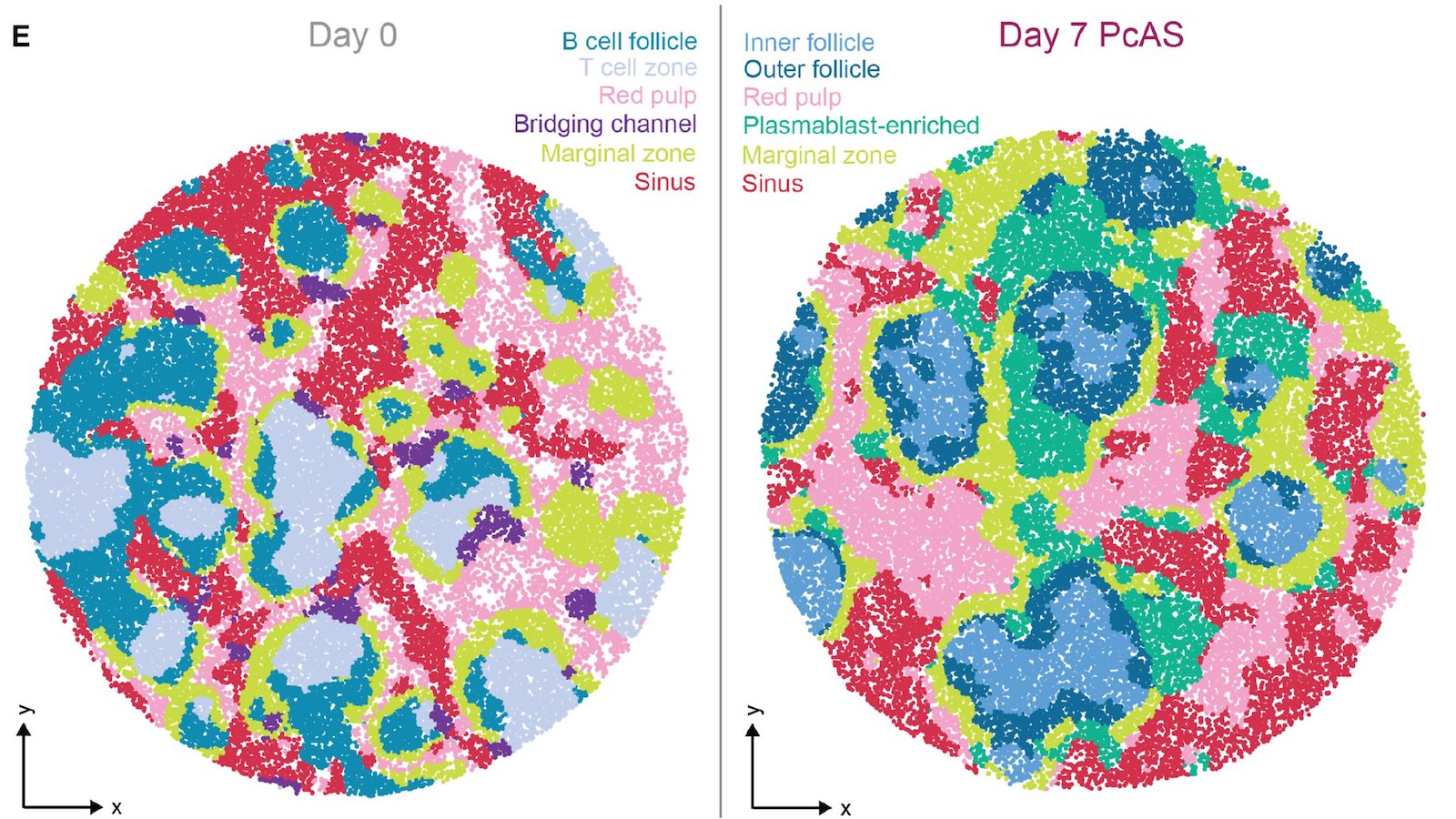
Spatial transcriptomics at near single-cell resolution maps changes in splenic microarchitecture. Source: Plasmodium infection induces phenotypic, clonal, and spatial diversity among differentiating CD4+ T cells.
This project aims to leverage our existing three-dimensional high-resolution spatial cellular genomic data from the spleen to create a virtual reality (VR)-based immersive and interactive experience of the immune system at work.
MDAP's expertise in data analytics, visualisation and VR environments – particularly in neuroscience and cell biology applications – allows us to build on our research. Our data examines genes in individual cells, producing massively high-dimensional datasets with up to 20,000 genes examined within a single tissue slice.
This collaboration will allow us to convert and present this data in VR environments applicable to multiple purposes, such as:
- Training medical professionals and biology students on immune system structure and function
- Allowing researchers to find new ways to harness the immune system to improve human and animal health
- Providing communities with accurate information to make informed decisions around their own immune health.
The resulting VR platforms will be an invaluable teaching and research tool for the University, with the aim to make the platforms open source for global academic partners, as well as accessible for medical and pharmaceutical applications where appropriate.