Counter Mapping: Australian Wars and Resistance
with Dr Bill Pascoe
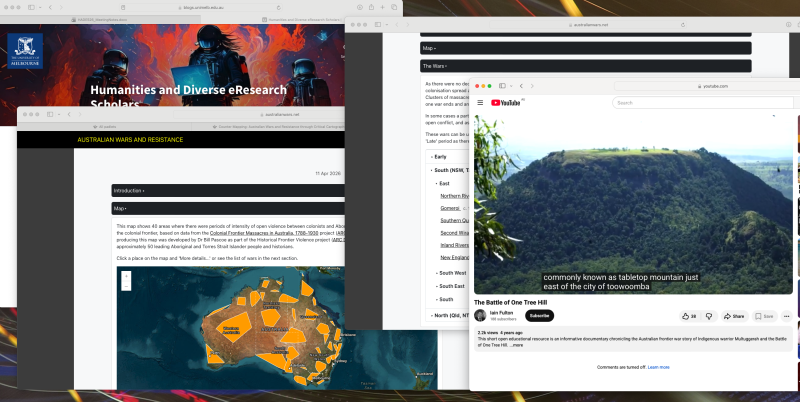
Australia’s colonial history has involved periods of war and resistance, mortal conflicts between colonists and Aboriginal and Torres Straight Islander people. These undeclared guerilla wars are the subject of a collective mapping project, “Australian Wars and Resistance”.
In June, Dr Bill Pascoe led the HADES community through an open discussion of digital mapping, with a specific focus on how and why digital maps are especially useful for truth telling about colonial history. The work of counter-mapping the historical conflict events that formed the Australia of today, builds on the prior work of the Colonial Frontier Massacres in Australia, 1788-1930 project (Ryan et al, 2025) which provides a dataset indicating the intensity of violence across Australia, enabling further research.
The rich conversation at the seminar led to the following responses from Bill to community discussion.
What does it mean to publish knowledge that is incomplete?
In the context of this research it is necessary to be provisional - we are only beginning. This is the work of generations, and like any other field of research, it will never be finished. Even if it becomes well known in this generation, each generation has to learn anew. So we need to make work available as we go.
More immediately, it's a topic where information can be hard to find, and where local knowledge goes a long way. Ethically, it's important to allow time for people to respond, as well as time for us to respond to that feedback. We need to be able to update it as information improves and new findings emerge.
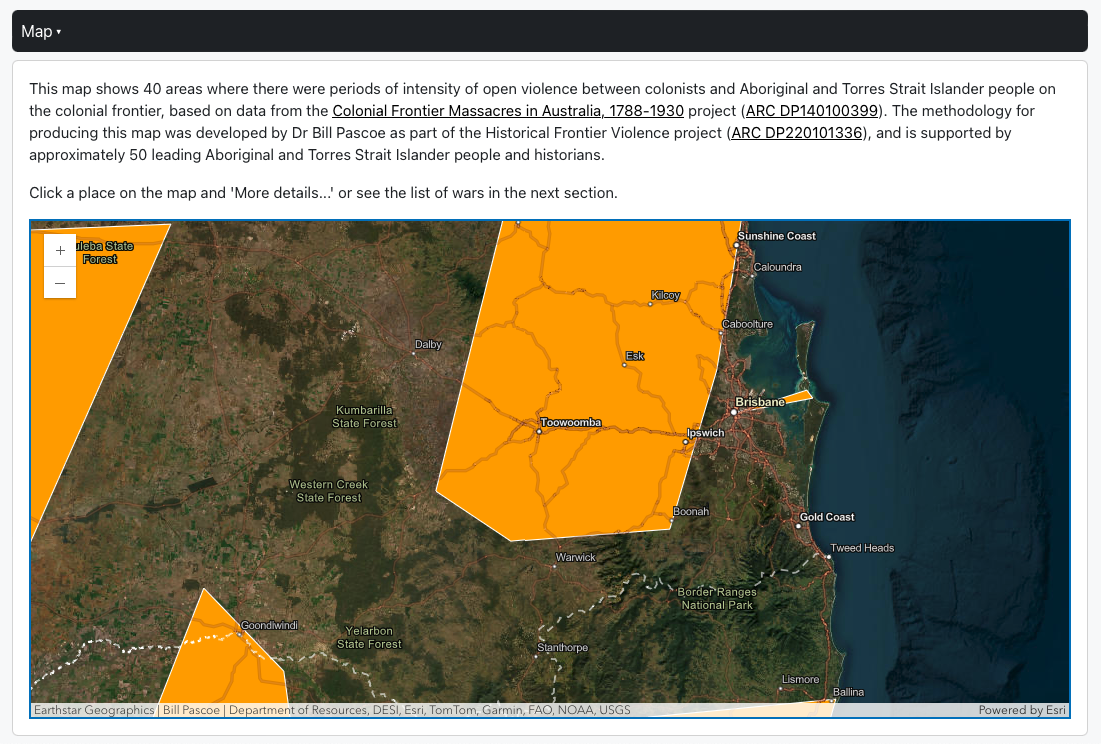
Even now, eight years later, people still notice things about the Colonial Frontier Massacre map that helps us improve the accuracy of the information it shows. It hasn’t been supported with funding for years now, the rate at which we find out more has slowed, so it’s quite stable and officially it’s closed, but there’s still a few sites that I’m reviewing to make some important changes in a new version. This open public updating is contrary to the usual approach of keeping things secret and releasing findings when the project is over but this approach to knowledge and information is important for methodology in this field.
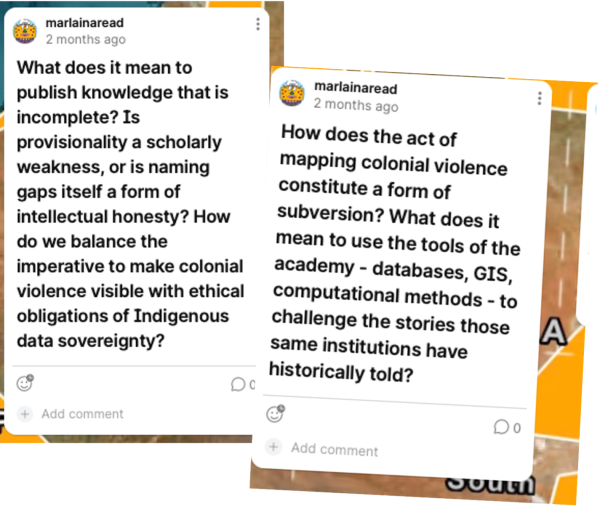
Is provisionality a scholarly weakness, or is naming gaps itself a form of intellectual honesty? How do we balance the imperative to make colonial violence visible with ethical oblications of Indigenous data sovereignty?
Academic research is inherently provisional. Even the hardest science is provisional - and scientists go to great pains to say, 'only according to our study under these specific conditions'. For example, Newtonian physics has been updated by relativity theory. I'd go so far as to say that this provisionality is the most fundamental point on which all academia is built. The academy was founded by Plato in ancient Athens, based on Socratic method. Socratic dialogue emerges from oral culture. The fundamental point of this method is that we suspend our confidence in what we think we know and welcome debate to get closer to the truth. The most important thing to remember in a world of post truth and denialism, is that this doesn't mean all criticism is valid or warranted. Socrates made it very clear that 'sophistry', arguing to win regardless of the truth, is opposite, and contrary to this kind of dialogue.
Ironically though, it was sophistical denialism that led to the demand for more evidence which in turn led to the massacre map, which brought us all closer to the truth.
Some of the old attacks on Professor Ryan have very erudite and convincing rhetoric but are riddled with fallacious arguments, but no rhetoric can argue against the weight of all the evidence presented clearly through the map. Thankfully we can now put the ‘history wars’ behind us and the massacre map has had a lot to do with that. A few people try to resurrect those bitter old grievances, but it doesn’t work because if people don’t trust academics or opinion columnists or radio shock jocks, they can just go and see the evidence themselves and the intention and reasoning, and balanced and thorough methods behind it. People can use the map to set each other straight, because it’s so easy to access online.
When studying some denialist attacks on some of the massacre sites in detail, I found that looking past the nonsense, rhetoric and abuse; they do have a keen attention to detail that can provide helpful information. The problem is that instead of letting us know this information that would be useful to truth telling, they try to use a few bits of information to try to discredit and shut down years of painstaking work. Although the intention is counter-productive, working through that level of detail expanded my understanding of those events and the historical context. I can’t spend much of my time on that, because I owe it to the overwhelming majority of reasonable people to get on with the job, but when I do I try to turn these attacks into help. When we first released the map, an analysis of responses showed that only 3% of people had this kind of negative or denialist attitude, so it’s unfair and disproportionate to let that distract from valuable work, or to think of invalid arguments as the ‘other side’ of a ‘balanced’ view. It's important, if difficult, to retain the professional academic attitude of remaining open to debate to learn from it - even when the other person isn't arguing in good faith.
Balancing the need to do truth telling about this history, which mostly comes from colonial records, with ethical obligations and Indigenous data sovereignty is difficult. It has to be a personal commitment, because that’s what’s expected. There is a long history of institutional abuse, so there is, understandably very little trust. Organisational ethics procedures are important as double checks, but you can’t hide behind them and it’s really up to us to take it on. Many of the structures of a Uni don’t help, it’s hard to build and sustain relationships juggling short term contracts on short term projects. People always complain about ‘fly in fly out’ research and 'blanket solutions', but the system is set up that way, so we have to personally take responsibility to work around the flaws in the system.
One of the main things is to ask first. On the other hand, be aware that people get ‘consultation fatigue'. There are always difficulties like this where it seems you can’t do one thing without doing the other, but if you just change the way you word it from ‘I can’t do this because of that.’ to ‘How can I do this without doing that?’ it might still be hard, but it gives you way through.
One of the difficulties is that most ethical guidance assumes working closely with a specific community on detailed cultural information, but this work is at a continental scale and there are more that 200 language groups in Australia. It’s not possible for anyone, Indigenous or non-Indigenous, to work closely with that many peoples. But that is not an excuse not to do it. It means you have to figure out how to do it, and we have been figuring out ways. These ways are at various levels - from holding formal organised consultation sessions, to hearing feedback at academic conferences, to messages sent to us online, having chats and yarning, going to workshops about data sovereignty, employing Indigenous people on the work, talking with close advisors, reading Indigenous academics, listening to speeches, watching Youtube, podcasts - in short, listening at every opportunity in any way we can.
For the Australian Wars and Resistance work, it can only be feasible, pragmatically and ethically, if it is done in a distributed way – with local involvement both of Indigenous communities, and researchers who know that area well. The idea that ‘no one group or grant or project can do this for the whole of Australia’ is not a reason not to do it. If you phrase it differently the problem becomes the explanation of the way it can be done - ‘it must involve many groups/grants/projects across Australia’. At the same time, there are some aspects and methods that are useful in all areas, such as finding and organising historical sources on events and IT systems for organising the basic framework of information. It’s a coherent whole of autonomous parts.
How does the act of mapping colonial violence constitute a form of subversion? What does it mean to use the tools of the academy – databases, GIS, computational methods – to challenge the stories those same institutions have historically told?
Honest debate towards the truth is a vital role that academia should provide in society. Cicero sums it up in 'The Nature of the Gods' and ‘Academica’: we can never be completely certain, yet we must act, so it's wise to act on what is most likely, or what we are most sure of. Knowledge of the truth is not absolute, it's always a degree of certainty. This is especially relevant for the massacre data, because it is often hard to be certain of details, when they were covered up, and reported or remembered vaguely. The massacre data has a 3 level rating system for 'confidence'. We are confident that all the massacres on the map happened, but this rating gives detail on the level of confidence based on available evidence. It transparently gives an indication of the level of detail and who was recording it. Our estimates are conservative to increase the degree of certainty to make it as inarguable as possible.
This difference between academic debate and provisional truth and sophistry is a one reason why politicians should not decide what is true. The imperative of political debate is to win, while the academic imperative is to get closer to the truth. The role of political leadership should be to figure out what action to take in response to the truth. Thankfully, Australian culture has a healthy scepticism towards politicians.
These problems of uncertainty and bias are normal in history; the sources for the massacre at Lindisfarne in British history are very scant, and much is hearsay and re-reporting. And yet that is regarded as a historical 'truth', marking the beginning of the Viking age in England.
If you want to convince someone of something it helps to try to talk their own language. What I’m saying is that on one hand, this is well within the tradition of Academia, coming from Europe. In that sense it’s not subversive. It would only be subversive to people who don’t want to acknowledge the truth, who want to deceive themselves or others. This might be due to vested interests, the age old motives of money and power, or simply because these are very difficult and hard truths to face. Having spent a long time with this I know that sometimes the brutality of an event is too much to contemplate, and when multiplied again and again it is overwhelming. But from the amount of people, Indigenous and non-Indigenous, who have told me personally how much this means to them, and being Australian, I’m confident most of us would agree with what one elder said to me, when I asked how I should represent what happened on his country – he said, ‘I just want the bald faced truth’.
Most people’s reaction when they first learn this history is just like mine was - “Why weren’t we taught this in school?” In this sense it is subversive in that it reveals something that remained hidden for a long time, that was not acknowledged within our societal systems, like the school curriculum, nor generally discussed. It’s also subversive in the way that it uses mapping technology, much of which, like longitude, was developed for building colonial empires, to do this. But it’s subversive in a good way because it stops us living a lie. It ends the hypocrisy of hiding an injustice we can’t ignore: the massacre of more than 10,000 people, in more than 438 massacres, in conflicts across the continent, over 150 years, with many decades in which at least one massacre occurred every single year – a mortal conflict between peoples over land, water, resources and the ability to exist. Not every colonist was a killer, or thought that Indigenous people should be eradicated – Neil Black for example took up land where people had already been killed so that he would not have to do it himself, and many who came after probably did not know, or did not want to know the extent of it - but on the frontier, far from prying eyes, it was a common enough attitude. Because there was a sustained attempt to erase people from existence, there must be a sustained attempt to remember them. We aren’t personally responsible for what happened before we were born but we are responsible for how we respond to it. It’s not a subversion that is meant to destroy - it is meant to deal with a difficult past to make a better future.
Aboriginal and Torres Strait Islander people have been calling for recognition at least since the Day of Mourning in 1938. The historian Stanner famously called it ‘The Great Australian Silence’. I couldn’t be doing this without the work of Lyndall and other historians who went before, and truth tellers like Rachel Perkins, and the people I’m collaborating with now. Researching this history is not a conspiracy or a concoction – it's just how historical research works – the aim is to learn something we didn’t know about the past. Recently we noticed that for just one of these 40 wars or resistance movements, the Gomeroi Resistance, there was about 140,000 words of newspaper reporting at the time it occurred, not including government and police reports or private letters and journals. That’s a lot of reporting and shows the conflict was of great concern to people at the time, and is a fundamental part of our history.
Who is telling this truth about our history? I’m just finding it and putting it together so people can access it and make up their own minds, and so that discussion, decisions and recognition can be reliably informed. At the end of the day, it is the government and police, it is the squatters and workers, and the descendants of people this happened to who tell us these truths.
Statement on AI use: No AI was used in writing of this post or creating visuals