A gift from philanthropist and former social worker Krystyna Campbell-Pretty AM is enabling many students to take part in a horizon-widening experience, opening their eyes to the wonder and beauty of human achievement as well as humanity’s greatest challenges.
The culturally rich Florence, Italy was explored by 18 students during a nine-day intensive subject named Leaders, Business and Culture in Florence as part of their Executive Master of Arts (EMA) course.
It’s the first postgraduate course of its kind in the world that marries culture, business and leadership, with a focus on the humanities.
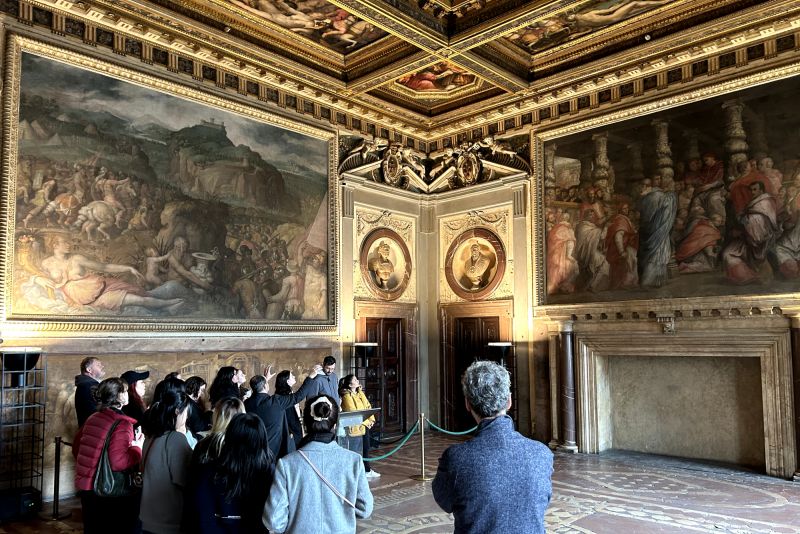
Students immersing themselves in Florence’s cultural history during the Leaders, Business and Culture intensive subject.
The intensive subject is at the vanguard of the University’s acknowledgement of the humanities as being fundamental in how we address societal problems, an understanding writ large in its recent establishment of the Melbourne Public Humanities Initiative.
The Initiative aims to inspire people through informed debate, creating “opportunities for thought, conversation and training with the aim of transforming communities, organisations, business and government, providing inventive and applicable solutions for navigating our complex world”.
“Studying the humanities is extremely valuable in a world beyond the University,” said Professor Sara Wills, the EMA coordinator and Director of the Initiative. “And especially where we might be looking at forms of social enterprise.”
Distilling insights from history
The Florence intensive represents an opportunity for students to visit the birthplace of the Renaissance, which provides a model of development that can be drawn on today to inform understandings of contemporary crafts and artisanal skills, finance, marketing and customer service – insights that gripped student Olivia Hally.

Olivia marvelled at the rich cultural heritage of the city, a source of inspiration for successive generations of creative leaders stretching back to the Medici family of the 15th century.
“An amazingly rich history was alive all around us,” she reflected with gratitude. “This deep heritage provides an essential backdrop to the business of art and culture and the role that leadership and enterprise play in the cultural sector.”
While in Florence, students learned how, under the influence of the Medicis and through the development of new social and cultural networks, the city underwent an economic and political transformation.
As well as having lecturers drawn from a selection of expert academics in the fields of humanities and entrepreneurship, the students come to understand historic economic clusters in Florence that have collaborated across generations to make products through the procurement of raw materials – such as wool, coffee or leather – and then crafting them into quality goods for retail.
For this emerging generation of young thinkers, messages inherent in the success of Florence-based enterprises are clear, including that businesses of the future must be sustainable in order to thrive.
“The experience was life-changing,” said Olivia, who was a touring musician before enrolling in the EMA. “It crystallised my thinking about values-based businesses. They were all relationship-based and produced the highest quality craftsmanship.”
During their stay in Italy, students get to see how the whole supply chain works and the important connections between makers and suppliers, said Professor Wills of the subject.
“We see the ethical, social and financial issues at play. We go to schools where employees are trained. We sample products. We understand how they handle quality control and how they market, and the students get to put lots of questions directly to the owners and producers.”
In a nutshell, the purpose of Leaders, Business and Culture in Florence is to focus on the city as a successful global case study, added Wills.
“It’s about discovering how people think creatively about their place, how networks create the conditions for innovation to happen, about culture and relationships, as well as the advantages of having a place-based connection to like-minded people.”
How giving enriches student experience
The elective subject was a key moment for Olivia and the other 17 domestic and international students, selected from over 50 applicants.
“Hearing how these businesses had evolved over generations was eye-opening and not something you would ever experience in the classroom,” she said.
“We were able to speak with the founders who shared challenges they have overcome and opportunities they have embraced to sustain what are often family-run businesses.”
16 of the 18 students received a travel grant, made possible by Krystyna, that helped cover flights, accommodation and living expenses.
Olivia is grateful to Krystyna for underpinning the unique opportunity. “I got to meet Krystyna in person,” she said warmly. “I was able to talk with her about the value of the arts and the humanities and see how passionate she is about these fields and the way she takes action to support them.
“Krystyna helped support what’s important to us as people. I just felt incredibly lucky to have been a recipient of her support.”
The students’ final task was to take their learnings from the trip and apply them to a proposed business in their own city.
“It could be Shanghai, Melbourne or Brisbane, and, for many of them, it’s the first time they have written a business plan,” said Professor Wills.
“So, it’s a big learning curve, making the most of the environment they’re in and creating something culturally relevant and productive for their city.”
During their time abroad, the students learnt a lot from each other and their lecturers, considering they spent nine days living and working together closely, said Olivia. “We all shared meals together and bounced ideas off each other, having so many in- depth discussions about everything we were experiencing. It was a really beautiful bonding experience to connect with our peers.”
As the intensive subject came at the end of her studies, Olivia said it proved a fitting finale, leading her to think more about how creatives could be better supported, culminating in a thesis on basic income for the arts in Australia.
“I took everything I learned on the intensive and in the entire EMA and funnelled it into my thesis,” she said.
Learn more about giving
Delve into stories of donor impact or find public lectures, gallery openings and more.
-
Impact of giving
The generosity of our donor community can be felt across industries – and will continue to improve lives for generations to come. Learn more about how our supporters are building a brighter future.
-
Ways to give
Whether you’d like to make a one-off gift or explore other meaningful options like leaving a gift in your Will, there are plenty of ways you can give to the University for a brighter future.
-
News and events
Stay connected with your passionate University community through thought-provoking public lectures, events celebrating our donor community or expert commentary on global issues.
How can we help?
FAQs and contact details
Find helpful answers to common questions and specialised contact details.
Give to education and research
Learn how you can support students and researchers.
Ways to give
Explore the varied and meaningful ways you can give towards a brighter future for all.