New hope in the quest for HIV cure
Generous support from donors has led to an exciting discovery in the search for a cure for HIV.
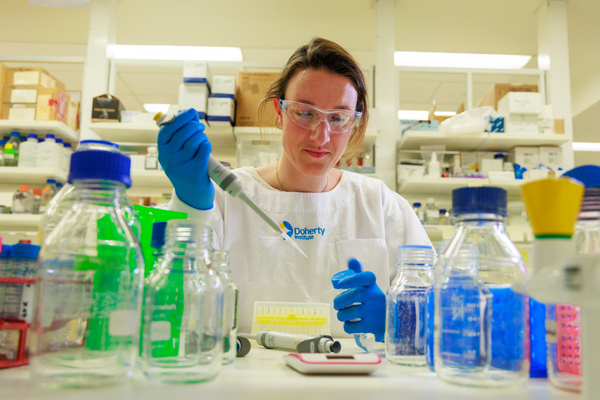
A new chapter in HIV research is beginning, now that Dr Paula Cevaal and her team at the Peter Doherty Institute for Infection and Immunity (Doherty Institute) – a joint venture between the University of Melbourne and Royal Melbourne Hospital – have uncovered a new approach to overcome HIV latency. This term refers to when the virus ‘goes to sleep’ in specific immune cells called resting T‐cells, ready to re-emerge if virus-suppressing HIV treatment is stopped.
“As HIV cure researchers, our goal has been to reach the virus where it hides,” Dr Cevaal, a Research Fellow in Professor Sharon Lewin’s laboratory explains. “We programmed mRNA to tell infected cells to ‘give up’ the virus and make it visible. But getting the mRNA into those cells was the challenge.”
HIV latency has been the main barrier to finding a cure – but in an important discovery, Dr Cevaal and her colleagues have found a way to expose the virus using mRNA technology. They developed a novel lipid nanoparticle – a microscopic fat-like bubble – as a delivery vehicle for the mRNA. They were excited to discover that it could successfully carry the mRNA into HIV-infected cells.
It forced the virus out of hiding, which is exactly what we need to start clearing it from the body.
Researchers can now begin to target the exposed virus, and Dr Cevaal’s hope is that this new nanoparticle design could become a cornerstone in future HIV cure strategies.
The potential impact
Finding a cure for HIV could be life-changing for the 40 million people worldwide who live with the virus. The development of antiretroviral treatments has saved many lives and enabled people to live with and manage HIV for many years, but these drugs are not a standalone solution.
Costs are increasing and access to these vital medications remains limited in some lower-resourced countries, particularly those with higher infection rates. Despite medical advancements, the stigma associated with an HIV diagnosis continues to negatively impact quality of life for many.
A cure could save millions of lives, reduce rates of virus transmission, and end the lifelong financial and personal toll of taking daily treatment.
The power of partnership
Donors to the University of Melbourne have played a vital role in reaching this milestone. Generous support from the J and M Wright Foundation helped drive the research that made it possible, while the Michael Hirshorn Medical Research Commercialisation Fund is paving the way for future innovations.
"I am sincerely grateful for their generous support, which enables our vital work for people living with HIV globally. Their contribution has been instrumental in advancing our research to develop a new generation of therapeutics that have the potential to cure HIV. Their support is helping us make a real difference."
With philanthropic support, researchers can push scientific boundaries and bring life-changing solutions closer to reality.
Read more about Dr Cevaal's research: World-first discovery harnesses mRNA in the search for an HIV cure.
Learn more about giving
Delve into stories of donor impact or find public lectures, gallery openings and more.
-
Impact of giving
The generosity of our donor community can be felt across industries – and will continue to improve lives for generations to come. Learn more about how our supporters are building a brighter future.
-
Ways to give
Whether you’d like to make a one-off gift or explore other meaningful options like leaving a gift in your Will, there are plenty of ways you can give to the University for a brighter future.
-
News and events
Stay connected with your passionate University community through thought-provoking public lectures, events celebrating our donor community or expert commentary on global issues.
How can we help?
FAQs and contact details
Find helpful answers to common questions and specialised contact details.
Give to education and research
Learn how you can support students and researchers.
Ways to give
Explore the varied and meaningful ways you can give towards a brighter future for all.