CAIDE Art, AI and Digital Ethics
Art, AI and Digital Ethics is a research collective for academics, artists and art professionals
Collaboration between arts and STEM disciplines is increasingly making a powerful contribution to knowledge about digital ethics. Meanwhile, contemporary artists are responding to technology not just as a material or subject matter, but as something that structures every aspect of our lived experience. Art, AI and Digital Ethics might therefore be understood as a rapidly expanding mode of academic and artistic production, where artworks are evolved to encourage reflection on the ethics embodied in human-technology relationships.
About Art, AI and Digital Ethics
The problem with rapid technological expansion is that it affords little space for analysis and care. While Art, AI and Digital Ethics promotes the value of artistic practice as research, there is little discussion about the tensions and value judgments that emerge when art is adopted as a method alongside—or in addition to—writing a journal article or book. Issues of democracy and engagement are often cited on the grounds that an artwork ‘makes people think’. But the aesthetic expertise required to encourage this ethical feeling and deliberation is often treated as secondary. Amid the scramble to frame Art, AI and Digital Ethics as ‘new’ and ‘innovative,’ we forget that artists have been exploring relationships between aesthetics and ethics, art and technology, and art and science for centuries.
Our collective calls for a decentered ethics – an ethics that builds on decolonial attitudes, eco-criticism, and the more-than-human – to understand how to live and collaborate with technology. Our research initiative explores the contribution of art to enquiry about a decentered ethics of Artificial Intelligence and digital innovation, with an emphasis on how artists and curators produce aesthetic encounters and emotional engagements that support ethical feeling and deliberation.
The Art, AI and Digital Ethics program is guided by two overarching research questions:
What, specifically, do artists and curators bring to the conversation about AI and digital ethics?
The value of aesthetic experience is notoriously difficult to articulate. How do artists and curators allow the ethical dimensions of technological innovation to be experienced and felt, in ways that escape the grasp of other disciplines? How can technology and engineering specialists work with these insights to forge genuinely new directions in digital ethics research?
How do we practice in ethical ways?
Art often invites critique by estranging technologies from their ordinary context and re-presenting them to be understood anew. Is it possible to appropriate data sets and hardware without reproducing their inbuilt ethical dilemmas? How can we sustain critical and creative engagement with technology amid the hype of technological innovation?
Past Activities
For information about our previous research activities, please see below:
-
Funded by CAIDE and the Hansen Little Public Humanities Grants Download Transcript of the Book Launch Video
This book argues that artists and cultural institutions are a vital force in the construction of a relational, collectively held ethics of human-machine assemblages. Technological change always out-paces ethical governance, producing an uncertain zone between what machines can do, and what is upheld as ethical by diverse publics. Working quickly and often provocatively, artists trace ethical tensions as they are emerging in public consciousness, providing a vital speculative approach to AI futures.
AI ethics developed by big tech has been critiqued for its performativity and lack of equity. Artists have proposed more radical visions for who or what requires ethical protection, pushing past regulation toward ethics as a way of being in the world. To date, there has been no single volume that explicitly explores art as a way of doing AI ethics with complex human-machine entanglements. Taking AI art as a method, rather than an autonomous generative output, this edited collection explores the relationship between artistic practices, ethics and AI.
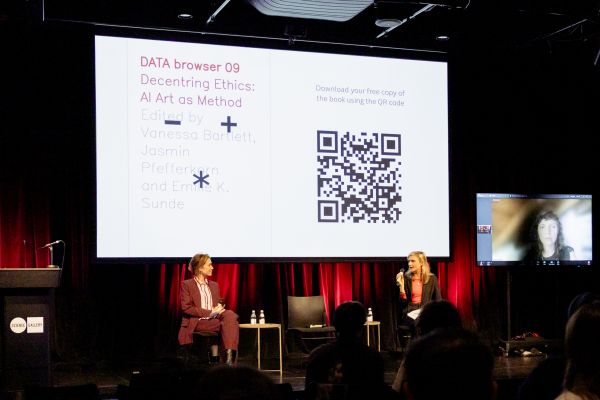
Decentring Ethics: AI Art as Method, book launch at Science Gallery Melbourne, 2025. Photo credit: Michaela Dutkova.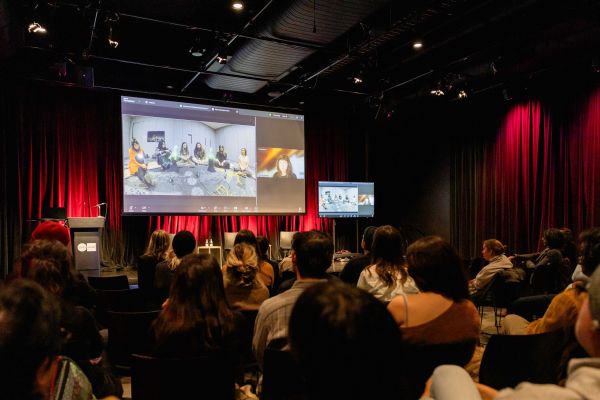
Decentring Ethics: AI Art as Method, book launch at Science Gallery Melbourne, 2025. Photo credit: Michaela Dutkova.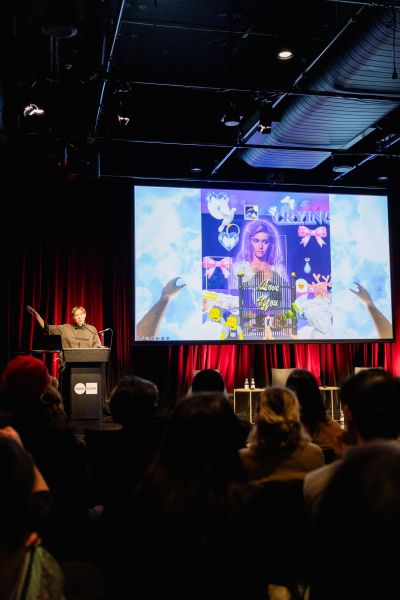
Decentring Ethics: AI Art as Method, book launch at Science Gallery Melbourne, 2025. Photo credit: Michaela Dutkova.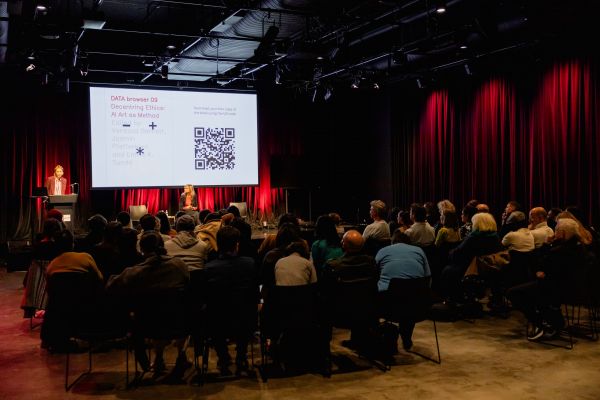
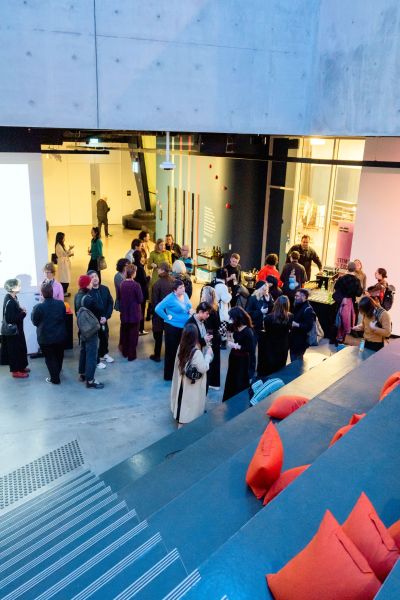
Decentring Ethics: AI Art as Method, book launch at Science Gallery Melbourne, 2025. Photo credit: Michaela Dutkova.
Decentring Ethics: AI Art as Method, book launch at Science Gallery Melbourne, 2025. Photo credit: Josh Broadhurst.
Decentring Ethics: AI Art as Method, book launch at Science Gallery Melbourne, 2025. Photo credit: Josh Broadhurst. -
Our seed fund was a yearly initiative designed to foster networking and critical thinking across Art, AI and Digital Ethics at University of Melbourne and beyond. It is for academics (including graduate researchers), industry professionals and practicing artists of all disciplines. We fund projects that specifically explore what art practice brings to consideration of digital ethics.
The seed fund was launched in 2021 with a blog post and a workshop attended by 25 artists, curators, industry professionals and academics from multiple disciplines.The workshop provided an opportunity for participants to discuss Art, AI and Digital Ethics prior to forming research teams who could apply for the fund.
We funded two projects in 2021:
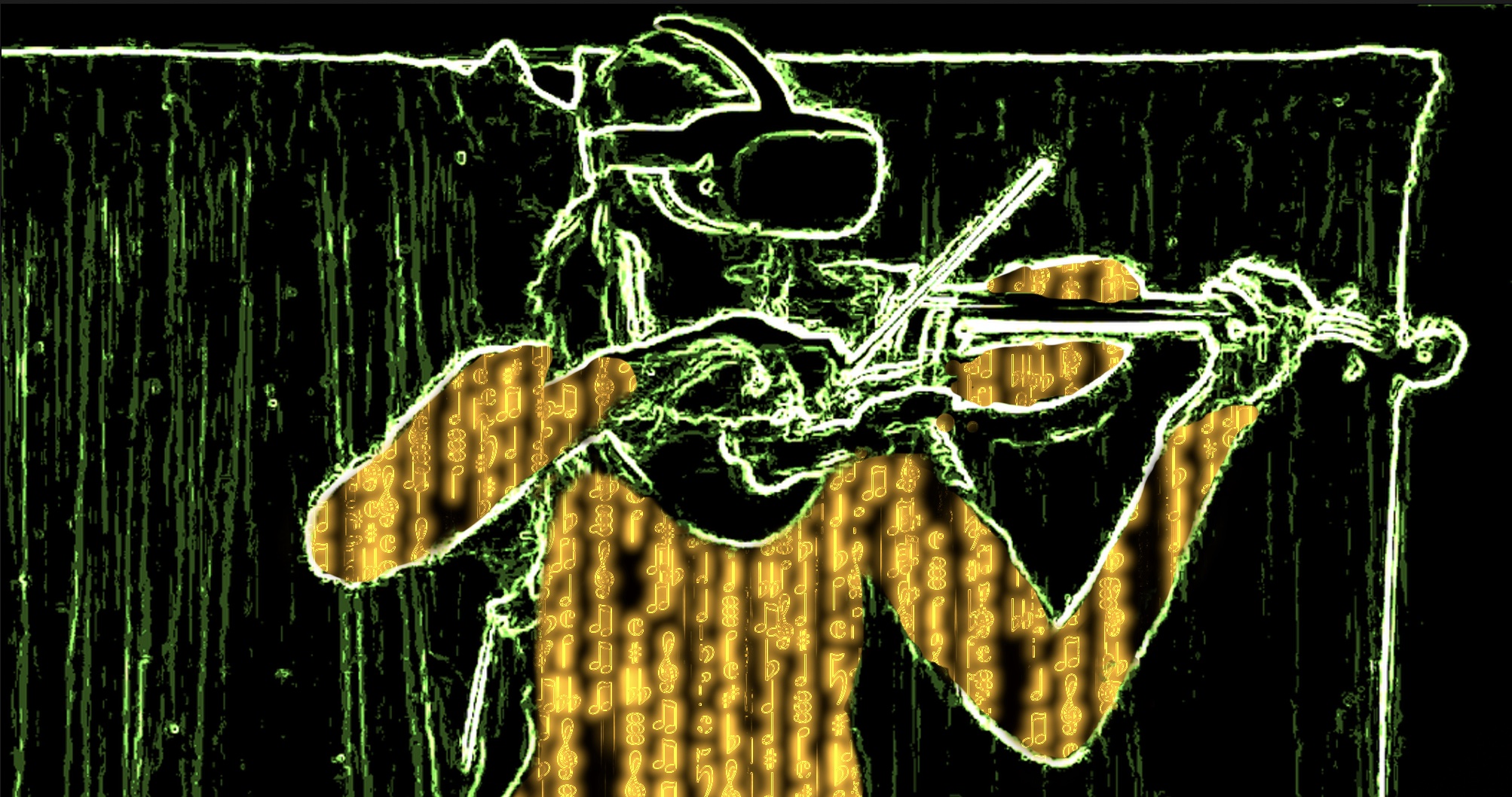
- Interrogating the Ethics of Biometric Capture in Immersive Musical Performance
Ryan Kelly, Solange Glasser, Margaret Osbourne and Ben Loveridge. - SACRIFICE: Can you trust a stone? Rehearing human and robot swarms via ancient standing stones
Robert Walton, Aleks Michalewicz, Airlie Chapman, Goran Duric, Daniel Williams, Elena Vella and Justin Green.
- Interrogating the Ethics of Biometric Capture in Immersive Musical Performance
-
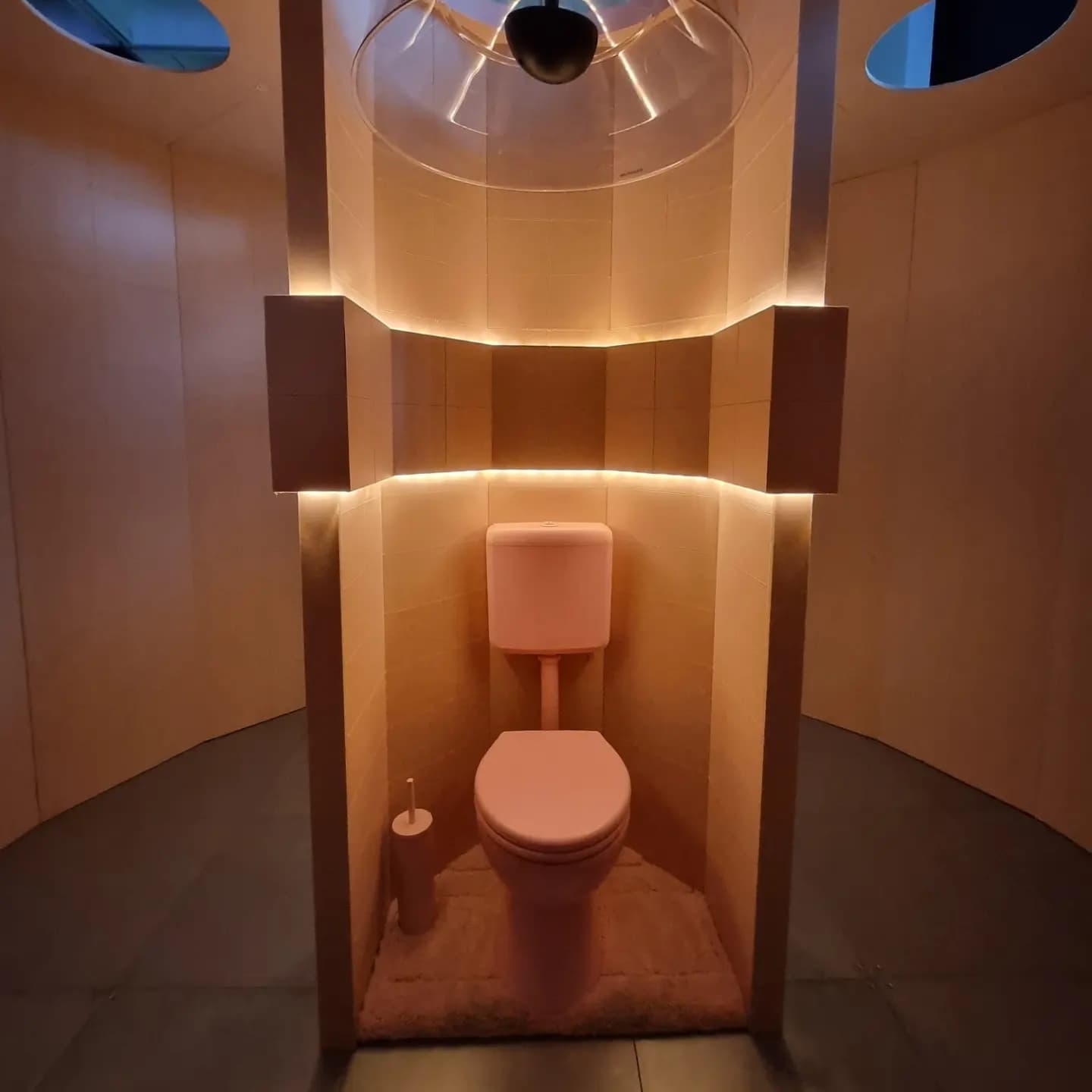
A lament for what we give over to the bots. A mourning poem for the late capitalist hell that makes even the worst of us valuable. A cringe tour of the digital graveyard we make day by day. A sweet little drown in the doom scroll. A comedic monologue starring you and only you. All you need to hand over is your handle. All you will leave with is the OMG echo.
-
- February 2022 ‘Small Data is Beautiful: Analytics, Art and Narrative’This interdisciplinary symposium sought to nurture and advance our understanding of small data that involves human-scale analyses, thinking about aesthetics, and exploring how narratives emerge from data patterns and their anomalies. Key questions guiding the event are: how do interactions with small data shape and inspire transformations of knowledge in the twenty-first century? Who collects, owns and curates small data? And when and where does small data hold power? What kind of actions, or play, are possible with small data? Which stories can be told with small data?
- April 2022 ANAT SPECTRA: Art, AI and Digital Ethics Panel
This panel reported on findings from our launch event, which brought together artists, curators and academics. ANAT SPECTRA is Australia’s premiere event exploring experimental, interdisciplinary art-science practices. - March 2022 Creating New Codes: How can art explore digital ethics? NGV Melbourne Design Week.
This event documented work in progress from the winners of our 2021 Seed fund project Interrogating the Ethics of Biometric Capture in Immersive Musical Performance. Melbourne Design Week (MDW) is an annual 11-day program of talks, tours, exhibitions and workshops that celebrate and critically interrogate design through its varied disciplines.
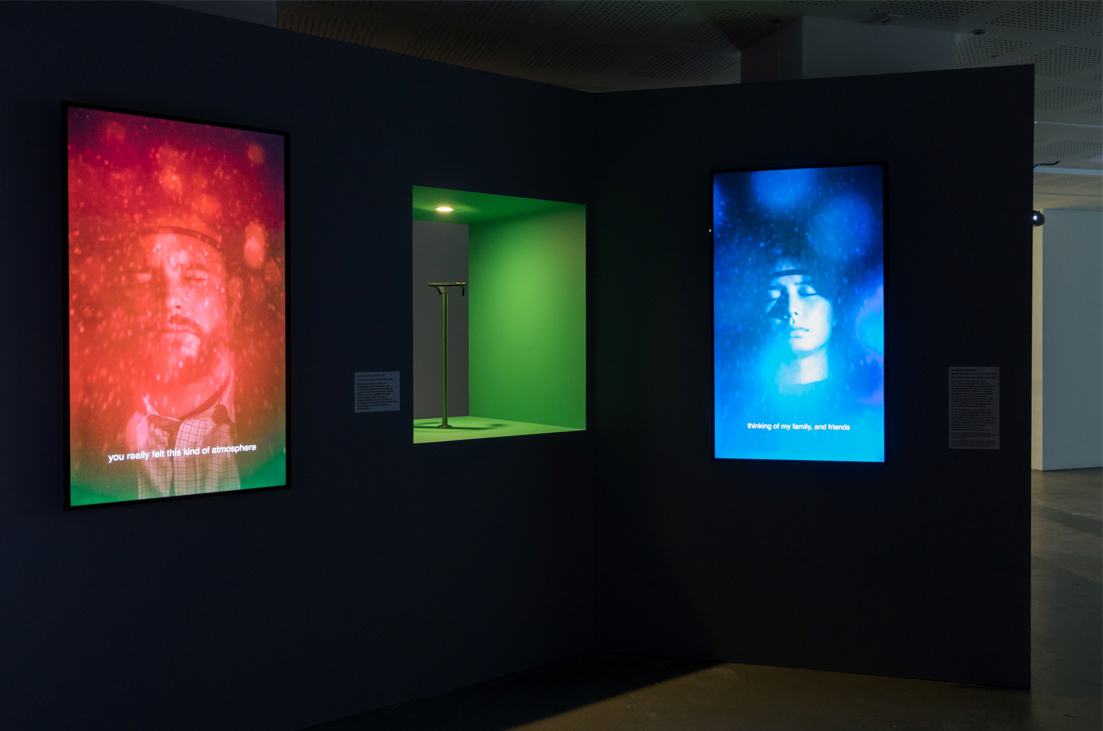
Behind Your Eyes, Between Your Ears (2015) by George Khut. Exhibited in Group Therapy curated by Vanessa Bartlett. With thanks to the artist.
Decentering Ethics with AI Art Book
The Art, AI and Digital Ethics research collective is currently working on an edited volume, titled Decentring Ethics with AI Art. This book argues that artists and cultural institutions are a vital force in the construction of a relational, collectively held ethics of human-machine assemblages. Technological change always out-paces ethical governance, producing an uncertain zone between what machines can do, and what is upheld as ethical by diverse publics. Working quickly and often provocatively, artists trace ethical tensions as they are emerging in public consciousness, providing a vital speculative approach to AI futures.
AI ethics developed by big tech has been critiqued for its performativity and lack of equity. Artists have proposed more radical visions for who or what requires ethical protection, pushing past regulation toward ethics as a way of being in the world. To date, there has been no single volume that explicitly explores art as a way of doing AI ethics with complex human-machine entanglements. Taking AI art as a method, rather than an autonomous generative output, this edited collection explores the relationship between artistic practices, ethics and AI.

People
Our steering committee is an interdisciplinary team with expertise across visual art and curating, music and music psychology, literature, data analytics and digital humanities. We welcome expressions of interest from new members, particularly practicing artists
-
Dr Vanessa Bartlett
How do technologies shape wellbeing? How does art help us home in on the emotional and experiential implications of this question, in ways that escape the grasp of other disciplines? These questions drive Vanessa’s curatorial practice, in ways that influence not just what she curates, but how she researchers and develops her interdisciplinary projects. Her exhibitions at major international arts spaces, such as FACT (Foundation for Art and Creative Technology), UNSW Galleries and Furtherfield, have been seen by over 40,000 people and have featured in The Guardian, Creative Review and BBC Radio 4. She has edited two books for award-winning academic publisher Liverpool University Press (UK), the most recent of which was co-edited with neuroscientist Henrietta Bowden-Jones. Vanessa is currently McKenzie Postdoctoral Fellow in the School of Culture and Communication, University of Melbourne. www.vanessabartlett.com
-
Dr Kristal Spreadborough
Kristal Spreadborough is an interdisciplinary researcher with an interest in music, psychology, digital and data ethics, and data driven research. In her current role as Research Data Specialist at the Melbourne Data Analytics Platform, Kristal has worked across a range of disciplines including the creative industries, law, education, and the health sciences. For more information on her current activities, please visit: https://kristalspreadborough.github.io/
-
Dr Tyne Sumner
Tyne is an ARC DECRA Fellow in English & Digital Humanities at The Australian National University (ANU), working on a project titled Beyond Big Brother: New Narratives for Understanding Surveillance. Her research is at the intersection of surveillance studies, digital culture and the humanities, with an emphasis on how literary texts help us understand human subjectivity under conditions of datafication. She also has expertise in poetry and poetics, digital humanities, cultural data, facial recognition technology, and digital research infrastructures. Tyne’s recent books include Small Data is Beautiful (co-edited, Grattan Street Press 2023) and Lyric Eye: The Poetics of Twentieth-Century Surveillance (Routledge 2021). She has published widely on topics ranging from contemporary fiction, art and film to cultural databases and virtual learning environments. Her current book project is a study of emergent forms of ‘surveillant subjectivity’ in global contemporary fiction. She is also President of the Australasian Association for Digital Humanities (aaDH).
-
Dr Jasmin Pfefferkorn
Jasmin is a Melbourne Postdoctoral Fellow in Culture and Communication at The University of Melbourne. She is currently researching the impact of generative technologies on museums’ practice. Her research is at the intersection of critical AI and museum studies, with an emphasis on the relation between technics and culture in emerging socio-cultural milieus. She also has expertise in affect theory, assemblage systems theory, media studies, aesthetic theory, and visual culture. Jasmin is the author of the monograph Museums as Assemblage (Routledge, 2023). She is also the co-founder and director of the research group CODED AESTHETICS, which takes an experimental approach to exploring human-machine entanglement in sensing and sense-making.
-
Gabby Bush
Gabby was previously the program manager at the Centre for AI and Digital Ethics (CAIDE). In this role, she coordinated the work of CAIDE, including engagement, research dissemination, grants and projects, including work on monitoring and surveillance, bias in algorithms and the CAIDE research stream in Art, AI and Digital Ethics. Gabby joined the Centre from Canberra, where she spearheaded engagement and partnerships in technology and development. Prior to that Gabby ran the eGovernance and Digitisation project for the United Nations Development Program in Samoa. Gabby hails from Aotearoa, New Zealand and has postgraduate qualifications in International Development and Religious Studies.
-
Monica Lim
Monica is a Melbourne-based pianist and composer of classical contemporary and experimental music. Born in Malaysia and then migrating to Australia in her teens, Monica has produced work for theatre, contemporary dance, installations and film, as well as solo and ensemble instrumental pieces. She is interested in new cross-disciplinary genres and forms as well as combinations of new technology with music. Her work has been presented at White Night, Melbourne Fringe and Arts Centre Melbourne. Current projects include Universe, a multiform project with live video, music and contemporary dance for Arts House, Mental Dance, an art-science collaboration with cognitive neuroscience at the University of Melbourne, and the Electromagnetic Piano Project, a series of compositions and recordings for electromagnetic resonator piano supported by the APRA Amcos Art Music Fund. Monica is currently undertaking postgraduate research at the Faculty of Fine Arts and Music, University of Melbourne in gesture-led composition.
-
Willoh S. Weiland
Willoh S. Weiland is an artist, writer and curator. Her work is concerned with creating epic impossible ideas and trying to fulfil them, working with non-artists, the possibilities of liveness and destroying the white male patriarchy. Over 2010–18 she was artistic director/CEO of the artist-led experimental arts organisation Aphids, Melbourne. Currently she is a Creative Associate of the MONA Foma festival, Hobart, and an Honorary Fellow at the Microsoft Centre for Social Natural User Interfaces, University of Melbourne. Her works Forever Now, Void Love and Yelling at Stars (2008–15) explore the relationship between art and infinity by sending artworks into outer space.
-
Emilie K. Sunde
Emilie K. Sunde is a PhD candidate in the School of Culture and Communication at The University of Melbourne. Her dissertation is a conceptual thesis photography theory, computation, and AI-images. She is currently developing a project that draws on an eco-critical approach to the latent spaces of Generative AI models, to develop a shared language of latent space between STEM and HASS disciplines. She is also the co-founder and director of the research group CODED AESTHETICS.
-
Scrape Elegy
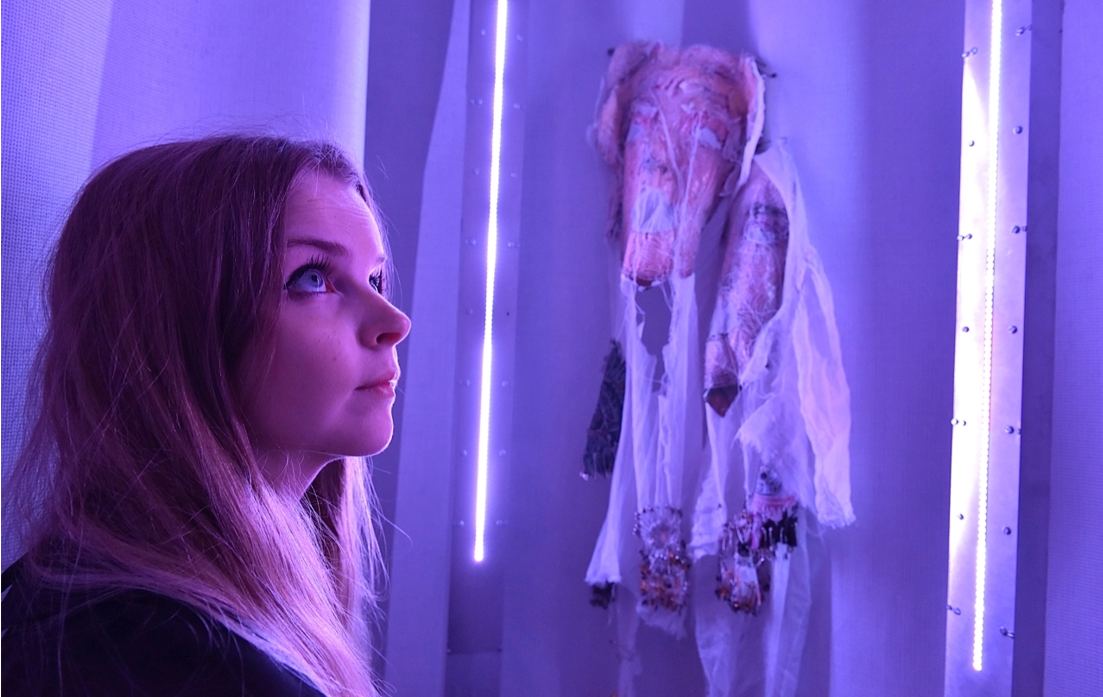
Labyrinth Pyschotical (2012) Jennifer Kanary Niklov(a). Exhibited in Group Therapy curated by Vanessa Bartlett. With thanks to the Artist
Relevant Member Publications
We draw on a wide range of theory and art practice to guide our investigation of Art, AI and Digital Ethics. Our list of resources is growing and we welcome contributions
Tiquia, A., V. Bartlett, and J. Pfefferkorn. 2025, September 23. ‘Rethinking ethics in the age of AI art’. State Library of Victoria Lab. Podcast available at: https://lab.slv.vic.gov.au/articles/ai-art-ethics-glam
Bartlett V (2019) ‘Digital Design and Time on Device: How Aesthetic Experience Can Help to Illuminate the Psychological Impact of Living in a Digital Culture.’ Digital Creativity 30(3): 177–195. DOI: 10.1080/14626268.2019.1637898.
Papastergiadis, N., S. Cubitt, C. Lury, S. McQuire, D. Palmer, J. Pfefferkorn, E. K. Sunde. 2021. ‘Ambient Images’ in The Nordic Journal of Aesthetics Vol. 61-62 pp. 68-77
Pfefferkorn, J. and E. K. Sunde. ‘The Model Museum: AI at the museum-museum interface’. In Z. Papacharissi (ed.) Connective AI (forthcoming, Routledge 2025).
Pfefferkorn, J. ‘Fortified Walls and Digital Flows’. In N.Papastergiadis and D. Wyatt (eds.) Arts Precinct Anthology. (forthcoming, Surpluss 2024).
Pfefferkorn, J. and E. K. Sunde. 2023. ‘Haunted AI’. Published conference proceedings, 11th Conference on Computation, Communication, Aesthetics & X (xCoAx) DOI: 10.34626/xcoax.2023.11th.222.
Pfefferkorn, J. (26 July 2023) ‘Computer written scripts and deepfake actors: what’s at the heart of the Hollywood strikes against generative AI.‘ The Conversation.
Pfefferkorn, J. 2021. ‘Art Museums and Digital Solidarity: a case study of Rediscovering Black Portraiture’. In H. Barranha and J.S. Henriques (eds.) Art, Museums and Digital Cultures. Lisbon: IHA/ MAAT.
Sumner, T. (2020). ‘Beyond Bigness: Can Big Data Have an Ethical Future?’ Data and Inequity: Who’s Missing in Big Data? Ed. Ruth Desouza. 21-27
Sumner, T.D. Cultural Data: The Intimate Analytics of Digital Collections (with Rachel Fensham and Nat Cutter) (forthcoming, Routledge 2025)
Sumner, T.D. Small Data is Beautiful, Eds Rachel Fensham, Tyne Daile Sumner, Signe Ravn, Ashley Barnwell & Danny Butt (Melbourne: Grattan Street Press, 2023)
Sumner, T.D. “The Way the Portal Wrote: Datafication and Subjectivity in Patricia Lockwood’s No One Is Talking About This.” Special Issue: Literature and Culture and/as Intelligent Systems. Interdisciplinary Science Reviews. (forthcoming)
Sumner, T.D. “Pixel, Partition, Persona: Machine Vision and Face Recognition in Kazuo Ishiguro’s Klara and the Sun.” Special Issue: Cultural Representations of Machine Vision. Open Library of Humanities 9.2 (2023): 1-23.
Sumner, T.D. “The Slipperiness of Name: Biography and Gender in Australian Cultural Databases.” (with Rachel Fensham and Nat Cutter). Gender & History (2023): 1-18.
Sumner, T.D. “Zoom Face: Self-Surveillance, Performance and Display.” Journal of Intercultural Studies 43.6 (2022): 865-879.
Sumner, T.D. “A Game with the Devil: Voyeuristic Surveillance and Cruel Optimism in Christian Boltanski’s The Life of C.B. (2010)” Art/Surveillance. (forthcoming)
Sumner, T.D. “Scale Poetics: Crisis, Data and the Literary Imagination.” Small Data is Beautiful, Eds Rachel Fensham, Tyne Daile Sumner, Signe Ravn, Ashley Barnwell and Danny Butt (Melbourne: Grattan Street Press, 2023): 284-300.
Sunde, E.K. (2024) ‘From Outer Space to Latent Space’, Philosophy of Photography,15 (Expanded Visualities: Photography and Emerging Technologies).
Wyatt, D. and J. Pfefferkorn. 2023. ‘Echoes in Metadata: Scanning the Refuge Archive Across Time, Texts, and Space’. In R. Fensham, T. D. Sumner, S. Ravn, A. Barnwell and D. Butt (eds.) Small Data is Beautiful. Melbourne: Grattan Street Press. Pp. 261-283.