Tomorrow’s Robot Reporters: is AI panacea or parasite for modern journalism?
Alternately considered a solution for ill-funded and dying local newspapers and an existential threat to the nature of fact-checked journalistic truth, what does AI mean for reporting in the modern age? And how are media organisations already using (or abusing) it?

With local news sources slowly dying, could AI be the answer?
Composite: The Guardian, News Corp & Marcus Spikse/Pexels
The typewriters have stopped clacking. The printing presses no longer turn. Across the world, the local news as we know it seems to be swiftly slipping into its grave.
Here in Australia, hundreds of newspapers have closed in the past few years alone. Over in America, an average of two newspapers shut their doors every week. It’s no mere academic concern, either. Studies have shown that when local news outlets close, communities lose out. Government costs blow out, and bonds become pricier – no bank trusts a place where nobody’s watching the store. Political polarisation grows as people lose trusted barometers of the community. Voting participation drops as we become disenfranchised with democratic processes.
But who, or what, could possibly save local journalism today? Billionaire buyouts, perhaps? Or maybe social media revenues? Not exactly.
Instead, enter generative AI, stage left.
AI: an unusual saviour?
 The New York Times’ first website in 1996. It took over a decade – until 2006 – for the paper to publish stories online without waiting for the print edition. nytimes.com/Internet Archive
There is no small irony in this choice of saviour – the demise of local news is often attributed to the early days of the internet, where, with more people getting news from more diffuse sources, the town newspaper funding model broke down. But ChatGPT, Bard and generative models like them have prompted a swathe of interest among journalists who, having missed the proverbial boat thirty years ago, hope to catch the headwinds of AI-related change.
Many a think-piece has presented the case for AI in local journalism over recent months, whether touting its ability to tailor “hyper-local content” to audiences or taking over menial, copywriting tasks and data analysis work, allowing newspapers to continue to run with fewer reporters. A 2023 study surveying newsrooms across 46 countries, including Australia, found that around 73% of respondents felt generative AI presented new opportunities for journalism.
So too has there emerged inevitable opposition, with many highlighting concerns about news attribution (perhaps best expressed in the New York Times’ lawsuit against OpenAI for allegedly using its articles for ChatGPT training data). Others too have emphasised the way tailored algorithms and news echo chambers have helped distort common notions of truth – particularly given Facebook’s general disregard for traditional media outlets and disclaiming of any role as a news aggregator (recent Australian legal developments notwithstanding).

A widely shared deepfake video of the late Indonesian President Suharto has sparked concerns about the use of AI in political spin and election influence operations. Edwin Aksa/X
Indeed, such examples give rise to fears of a new era in political spin, with otherwise-neutral reports able to be swiftly rewritten into subtly biased partisan pieces. Indeed, in the recent Indonesian elections, deepfake videos and audio clips reached a fever pitch – with even cruder examples of faked content from 2019 being enough to provoke bouts of post-election violence that left ten dead. With political hackery already at record levels (no thanks to figures that show more than six PR professionals for every one journalist in the US alone in recent years), misinformation, disinformation and spin are only set to increase.
What's happening now?
These developments, for better or for worse, are no longer theoretical. Tech companies have recently jumped on the bandwagon, with Microsoft in February announcing new collaborations within the journalism industry, from GenAI masterclasses and assistive writing tools to local newsroom positions and automated article curation. Some digital media companies have attempted to completely replace traditional journalists, to little success: last year alone, news websites CNET, Gizmodo and Sports Illustrated were all caught out writing AI-generated articles (on topics as varied as sports, financial advice and the Star Wars franchise) replete with factual errors and AI ‘hallucinations’.

Fully-AI-generated articles (and authors) have led to embarrassment for news websites.
Composite: CNET, Gizmodo & Sports Illustrated/Futurism
That said, less comprehensive attempts to integrate GenAI into journalism are already making an impact. Filipino journalist Jaemark Tordecilla recently developed a custom GPT, “COA Beat Assistant”, able to scan .pdf copies of Philippines government audit reports for potential investigative corruption stories. Meanwhile, generative AI tools have helped power ‘Realtime’, a platform turning public data trends into easily digestible stories as and when they occur.
Indeed, machine learning has already been in widespread use by journalists for years, with pattern identification powering investigations into everything from tax avoidance schemes in Mauritius and spy planes in Florida to bomb sites in Gaza and lead cabling in New Jersey.
Perhaps, then, it is no surprise that in December 2023, the New York Times appointed an ‘Editorial Director of AI Initiatives’ to look at ways of incorporating generative AI tools into the newspaper’s content more broadly. It seems almost inevitable that these tools will become commonplace in the newsroom – the only questions are how and when.
What comes next?
In that way, then, the use of AI in journalism proves something of a quandary – neither able to be completely ignored nor wholly embraced. If a thoughtless replacement of traditional fact-checked journalism with robotic reporters would be a travesty for the truth, ushering in an age of spin exponentially worse than today, so too would ignoring generative AI tools altogether. With spreaders of misinformation already taking advantage of these tools, the first shot in the AI arms race for truth has been fired – it is incumbent on journalists to respond.
Let us be clear, though – AI is not a cure-all. It cannot wholly reverse trends of decline that have been decades in the making. The GroundTruth Project, one of the not-for-profit news organisations that Microsoft began partnering with in February to place AI in newsrooms across the world, draws its name from the concept of ‘ground truth’. Used by NASA, the term refers to measurements made by hand on the ground, used to check and calibrate satellite calculations. The idea is that even the best new technologies require a human with one hand on the steering wheel, dealing with the situation on the ground. In its case, this reflects an emphasis on revitalising local news with reporters on the ground and in the community.

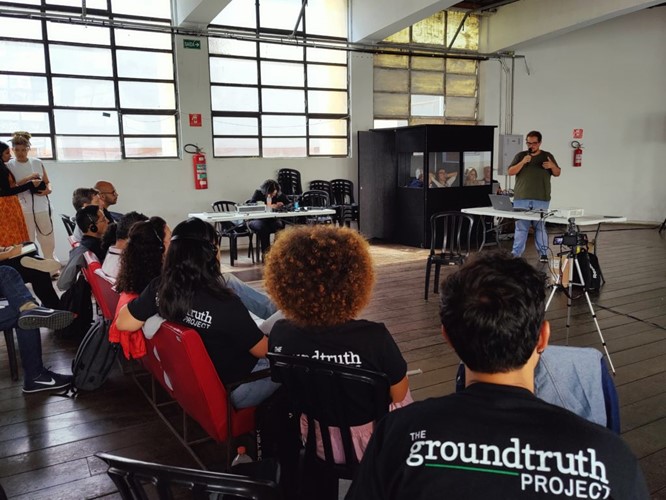
Microsoft has partnered with global news organisations like The GroundTruth Project, to help train young journalists in responsible AI usage. Source: Wilson Liévano/GroundTruth
But, on a larger scale, the idea behind 'ground truth' - that, however useful, technology must be tempered by human experience, perhaps speaks to something more fundamental. After all, the tragedy of local news is, if exacerbated by technology, a fundamentally human one. It speaks of a narrow view of the vitality of news in a busy world and an even narrower willingness to support it.
The rarity of any action in the public interest was perhaps why, some two and a half millennia ago, Aristotle still had greater faith in the monarchy of good philosopher-kings than the democracy of the common man as a tool for advancing common good. Public interest journalism can only thrive if the public fights for that interest – and far too often, we don’t.
Yes, AI can help. It can prioritise resources, allow for more meaningful analysis, and help in a world of increasingly-easy-to-manufacture lies and spin. But it cannot undo public apathy. It cannot solve problems of funding and profit models. It cannot, in and of itself, save us from the crisis in local news. Those solutions must come from the grassroots: from us as readers, as truth-seekers, as common citizens. Will they?
Only time can tell.
_______
Andrew Lim is a CAIDE Research Assistant, currently in his final year of a Bachelor of Science in Physics and a Diploma of Languages in Latin. This article is based on a guest lecture he gave on 24 April 2024 to Truth: A Short History [JOUR2256], a journalism seminar at Boston College.
_______
Author's Note (October 2024)
Between this article being written in April and now published in October, the trends it identifies have only continued at breakneck speed. AI-generated imagery and text have continued to be deployed for political purposes, especially in the US Presidential election campaign, quickly enabling the creation of content to accompany political messaging. Large news outlets have not stopped their pursuit of GenAI tools either, with a multi-year partnership between OpenAI and News Corp, unveiled in May, leading some to question what space is being left for smaller news outlets. But, perhaps most of all, our big question - how a public engages with news and what role it plays in the public interest - has not changed at all, and dealing with it seems as tough a needle to thread as ever before.