Collective generosity is making music therapy accessible
In 2019, the support of 350 donors to the University enabled the development of a mobile app prototype that gives more people living with dementia access to the benefits of music therapy in their everyday lives.

Their generosity went on to inspire international support – including from tech giant Google – in turn leading to more technological advancements and potential industry partnerships than previously foreseen.
The Music Attuned Technology - Care via eHealth (MATCH) application provides music alongside an embedded training program.
“It teaches carers how to use music in really intentional ways, such as helping people living with dementia when they’re in the shower, giving them activities to do, and providing meaningful connection,” explained Principal Investigator of the MATCH Project Professor Felicity Baker.
Professor Baker first conceived the idea of a scalable mobile application in 2018 to help address a critical gap in dementia care internationally.
“Music therapy is a non-pharmacological intervention that is proven to calm people when they’re distressed, but also to provide meaningful opportunities for a person with dementia and their caregiver to interact,” she said.
“Not only does music enable that person to regulate, but it also stimulates positive memories, giving the person with dementia an opportunity to meaningfully talk about those memories.”
Music therapy for people with dementia is also a powerful intervention as it can mitigate the need for medicine which can have adverse effects, including increasing people’s confusion.
The MATCH app was first piloted in 2023 among a select group of home caregivers who reported that the app provided much- needed support to both them and the person with dementia.
One caregiver explained “because there’s less agitation, less care is required. It’s less strain on them and less strain on us. It’s a win- win for everybody – the resident wins, the caregiver wins.”
Another family caregiver said the app helped ease the stress of caring for their mother.
“I was trying random things, and they weren’t working and I’d sort of given up … having the app … gave me the confidence and means of starting afresh and having some things that mum actually enjoyed,” they said.
Inspiring support
Beyond having a practical impact on patients already, the initial version of the app also demonstrates growth potential and enabled Professor Baker’s team to pitch for further funding.
These pitches were successful, with the MATCH app attracting a $2 million grant from the federal government’s Medical Research Future Fund and endorsement from the World Health Organization (WHO).
“WHO are always about supporting those who can’t access quality care, so they see the potential for MATCH to be scaled up and be implemented in the global south,” said Professor Baker.
This momentum in support led to Google’s philanthropic arm granting a visionary $2 million to develop an AI-driven version of the app called MATCHPlus, complete with corresponding wearable technology.
This technology will detect the early physiological signs of distress that aren’t visibly recognisable well before they manifest as outward distressing behaviours, providing intervention in a timelier manner than ever before.
Professor Baker and her team are aiming to have a MATCHPlus prototype developed by mid-2025.
“For people with dementia, physiological signs such as increased heart rate or perspiration indicate that they are starting to get over aroused, stressed or confused – and that can lead to events like attempts to abscond or a fall,” said Professor Baker.
“The AI technology will learn what a person’s typical behaviour patterns are, as everybody’s own marker of agitation is different.”
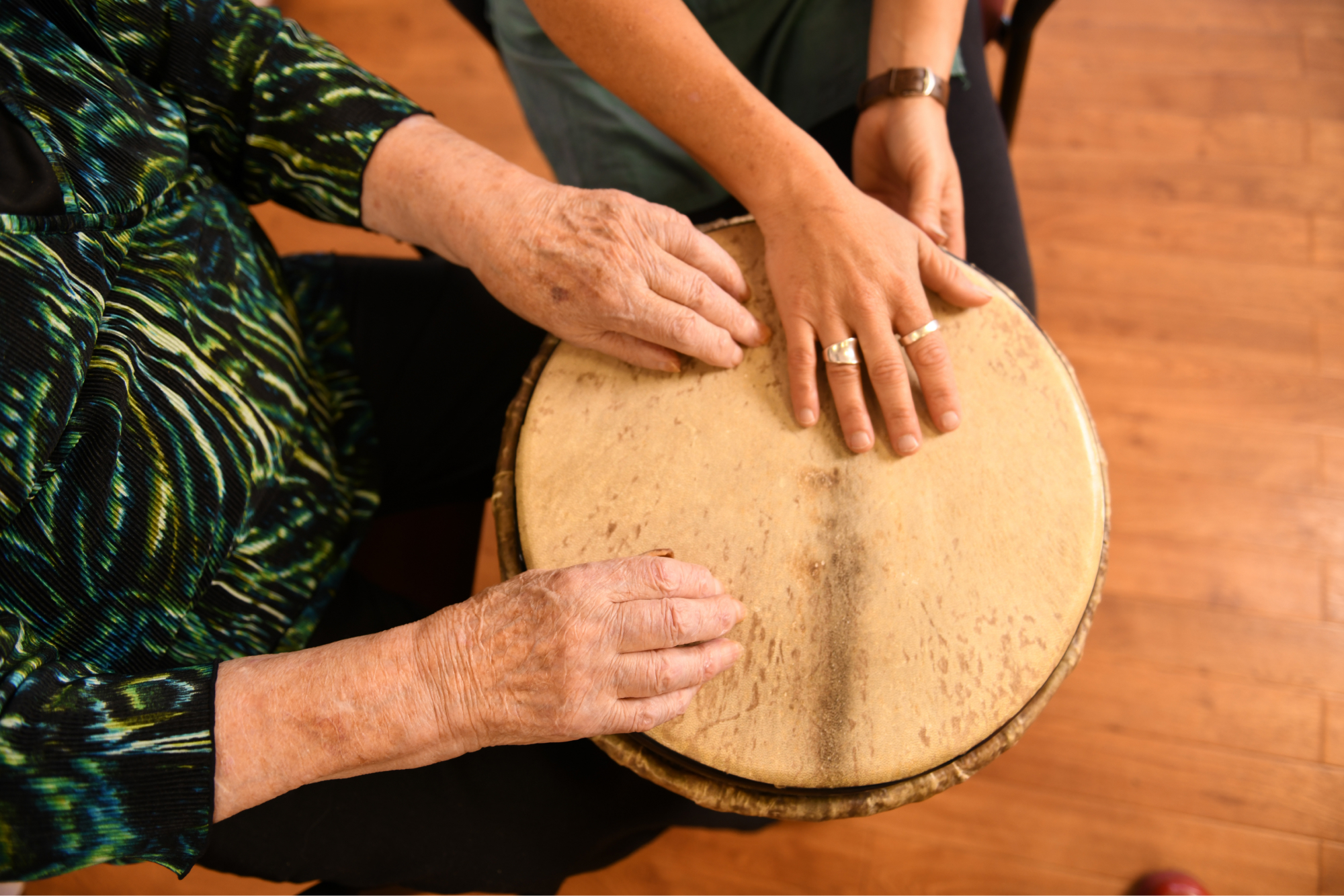
Music can help calm a person with dementia when they are distressed, and provide meaningful opportunities to interact with others.
Upon detecting distress, the wearable component will activate music that is based both on personal preference and the music’s meta-data – such as tempo, beats per minute, complexity and emotional valence.
This information will be matched to the person’s level of stress and agitation and assist in regulation within a short period of time.
“If someone doesn’t respond to a piece of music, the system will fade it out, and introduce something else until it finds what works. It begins to understand what musical parameters have the desired effect. In other words, the music is personalised.”
Google’s grant will also fund the development of MATCHPro – a program leveraging the technology of MATCHPlus that can be used in residential aged care settings to observe multiple people’s distress levels at once.
“Imagine a dashboard set up in the nurses’ station at a care home that could alert the staff to go and see Mrs Jones in room three because her physiological data indicates she is distressed and may benefit from some music,” said Professor Baker.
Relief without borders
Professor Baker’s vision is to make this technology broadly accessible.
“My driver is my wish to scale up this technology so that it can reach as many people as possible, irrespective of geographical location, socioeconomic status, language, or culture,” she said.
“I’d like to get it to places like Brazil, Indonesia, and India that have no funding for a music therapist to provide music interventions to support them.”

Professor Felicity Baker.
The first steps towards this goal are in motion, with the app recently receiving a grant from The Shaw Foundation to develop its first language translation and culturally informed training videos for the Singaporean market.
While Professor Baker is focused on creating the best possible versions of MATCHPlus and MATCHPro for those facing dementia in the short-term, she can’t help but envisage the potential of this technology more broadly.
“There are other possible applications for this technology, for example, easing stress in war veterans, people with ADHD, those with depression and anxiety, children with autism – there are lots of ways we could take it in the future.”
Having the backing of global tech powerhouse Google has also expanded the possibilities of what could be possible down the line.
“All of a sudden, I’m having conversations with the Head of Research at Spotify and the Director of Public Health at YouTube. People just take more notice when your project’s been funded by Google,” said Professor Baker.
Reflecting on the generosity of the donors that made it all possible, Professor Baker is humbled by the support of the University community that paved the way for innovative and accessible dementia care.
“How amazing is it that people feel this is so important that they’re happy to put their hand in their pocket and support it?” she said.
“I gain a great sense of pride from this because it shows that people care about giving people with dementia a better life.”
Stay connected
Your diverse alumni network offers unique opportunities for you to grow personally and professionally. Explore events, lectures, inspiring stories, global groups, and so much more.
-
Find an alumni event
From public lectures to alumni events that keep your community connected across the globe, see what’s on at the University of Melbourne.
-
Find a group
Join a vibrant alumni network in your local area to boost your career, build friendships, or connect with like-minded individuals.
-
Alumni Council
The Alumni Council champions your community worldwide, shaping events, student experience and more. Learn how to get involved.
How can we help?
FAQs and contact details
Find helpful answers to common questions or contact the alumni office.
Stay in the know
Learn how to set up your UniMelb account to access perks and discounts.
UniMelb account log in
Access your account to update your personal details and access benefits.