Given her Kurdish heritage, the concept of statelessness is all too familiar to Hanna, who was inspired to apply as a Juris Doctor student to work in the Stateless Legal Clinic at the Peter McMullin Centre on Statelessness.
“Growing up, I have always been around the idea of statelessness and the many implications that entails,” she said. “My parents made the journey to Australia as stateless Kurdish refugees. Applying for a position with the Clinic was driven by my lived experiences.”
Hanna is one of 24 University of Melbourne students who have participated in the Clinic, the only legal service of its kind in Australia. They take part through a unique elective subject offered in the Juris Doctor, within the Melbourne Law School Clinics program.
The Peter McMullin Centre on Statelessness was established at Melbourne Law School in 2018 with the generous support of Peter and Ruth McMullin.
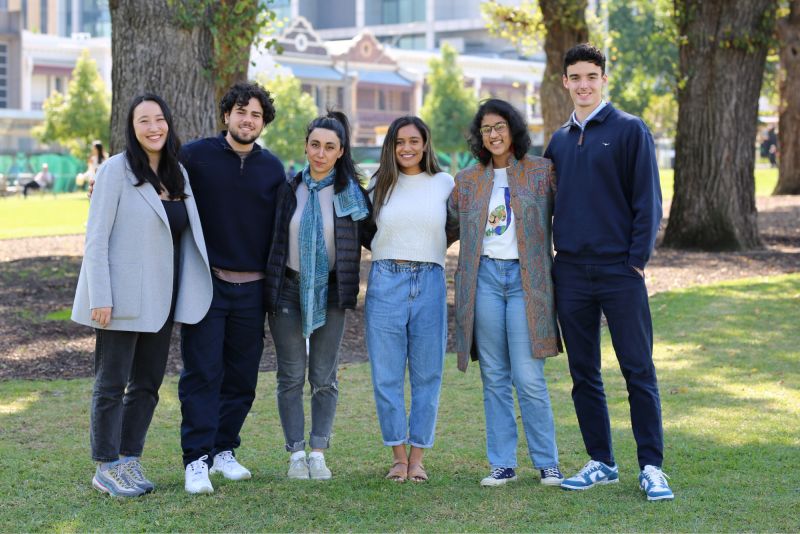
Students of the Stateless Legal Clinic (L-R: Nuria Khasim, Michael Armanois, Hanna Amin, Thenu Herath, Neha Sakar and Karrison Driver).
Directed by Professor Michelle Foster, a leading global expert on statelessness, refugee law and human rights, the Peter McMullin Centre on Statelessness is the world’s only university- based interdisciplinary centre dedicated to studying and finding solutions to statelessness.
In addition to the McMullins’ visionary founding gift, the Clinic gratefully received additional philanthropic support from John Cameron, director of the Cameron Foundation and co-founder of Talent Beyond Boundaries, a not-for-profit group that finds jobs for skilled refugees and stateless people globally.
Since its founding in 2021, the Clinic has made more than 60 applications for Australian citizenship on behalf of stateless children. “I cannot overstate the life-changing difference it makes to people when they hear that their child has been granted citizenship and is no longer stateless,” said Katie Robertson, Associate Director of the Peter McMullin Centre on Statelessness and the Clinic’s Director and Founder.
“For most parents we work with, it’s the first time for generations in that family that somebody has been granted nationality and been given that sense of recognition and belonging. And that’s why we do the work we do. It’s the Clinic’s reason for being.”
The burden of being stateless
To be stateless means that no country recognises you as a national. Statelessness has multiple causes, primarily discrimination, Katie explained.
For example, Rohingya people are not recognised as citizens in Myanmar because of their ethnicity. Laws in Lebanon discriminate on gender, stating that citizenship can only be passed to a child through their father. If a child’s father is unknown or stateless, the child too becomes stateless.
Without nationality, people can face huge barriers accessing many of the basic rights and entitlements that most people take for granted, such as access to education, healthcare, freedom of movement and the ability to seek employment.
Since 2013, Katie, a human rights lawyer, has focused primarily on assisting refugee and asylum seekers in Australia, where she first encountered stateless children. She represented numerous newborn babies and children detained on Christmas Island and around Australia.
She often worked closely with Sarah Dale, Centre Director and Principal Solicitor at the Refugee Advice and Casework Service in Sydney (RACS). The pair had long spoken about the idea of establishing a legal service for stateless children.
Katie and Sarah were granted seed funding from the Peter McMullin Centre on Statelessness to conduct research on the gap in legal services for stateless children.
They found there was little data about stateless people in Australia. Significant gaps exist in the protection of stateless people, without any specific visa category or other pathways to permanency.
Australian law does, however, provide for stateless children born in its territory to apply for citizenship, but few stateless families are aware of this entitlement and require assistance to navigate the application process.
Philanthropy drives change
This is where the idea of the Stateless Legal Clinic – established at the Peter McMullin Centre on Statelessness in partnership with RACS and the Melbourne Law School Clinics – was born, with a pilot project in 2021 taking on two law students.
“The critical support of the McMullins and the Cameron Foundation has enabled the Clinic’s growth and expansion, both in terms of the number of students we can take on, but more significantly the number of clients we are able to assist,” Katie said. “We hope to grow the service to support clients nationally.”
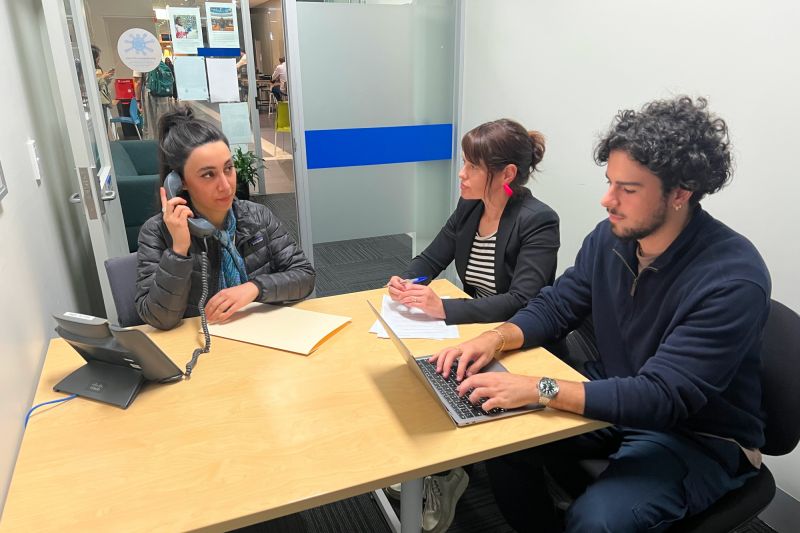
Members of the Stateless Legal Clinic call clients (L-R: student Hanna Amin, Clinic Director Katie Robertson and student Michael Armanois).
With that essential philanthropic support, the Stateless Legal Clinic now works with a second community partner, Refugee Legal in Melbourne, enabling it to assist stateless adults.
If it receives more funding, the Clinic is poised to expand further nationally to meet the exponential demand for its services and to expand the number of law students involved – an experience that teaches invaluable skills.
“The students learn about the law and theory of statelessness,
but it’s so powerful for them to also work face-to-face with clients and understand the inherent importance of learning from lived experience while developing their practical legal skills,” said Katie.
Empowering students to become advocates
Through the Cameron Foundation, Katie met Fadi Chalouhy, who was born in Lebanon to a Lebanese Christian mother and a Syrian Muslim father. He spent the first 28 years of his life stateless. Talent Beyond Boundaries sponsored Fadi as the first stateless person to come to Australia on a Temporary Skill Shortage visa.
The grant from the Cameron Foundation that supports the Clinic is named in honour of Fadi’s mother Hiam, who fought tirelessly for her son to have access to education and basic human rights.
Fadi is the Clinic’s Ambassador and spends time with each new intake of students, generously sharing his life experience of living stateless.
“For 25 years my mother and I struggled to find answers or even understand what statelessness is, and how to fight it,” he said. “This Clinic gives every mother and child currently in this situation a fighting chance.”
The Clinic prioritises applications from students who have lived experience of statelessness or refugee heritage in their families.
“Empowering these students with the skills and training, supports them as the rightful future leaders and advocates on this issue,” Katie said.
Nouda, a second-year Juris Doctor student at Melbourne Law School who is of Lebanese heritage, was inspired to apply to the Clinic to gain practical legal experience.
“I have witnessed the devastating impacts that statelessness has on marginalised and displaced individuals,” she said.
“Meeting my client in the Clinic for the first time was an incredibly rewarding experience that humanised the entire process for me. It truly underscored the significance of the work we do in the Stateless Legal Clinic and the profound effect it has on people’s lives.”
Stay connected
Your diverse alumni network offers unique opportunities for you to grow personally and professionally. Explore events, lectures, inspiring stories, global groups, and so much more.
-
Find an alumni event
From public lectures to alumni events that keep your community connected across the globe, see what’s on at the University of Melbourne.
-
Find a group
Join a vibrant alumni network in your local area to boost your career, build friendships, or connect with like-minded individuals.
-
Alumni Council
The Alumni Council champions your community worldwide, shaping events, student experience and more. Learn how to get involved.
How can we help?
FAQs and contact details
Find helpful answers to common questions or contact the alumni office.
Stay in the know
Learn how to set up your UniMelb account to access perks and discounts.
UniMelb account log in
Access your account to update your personal details and access benefits.