The future of music performance in virtual reality, redefining how musicians train, create, and engage with audiences.
The Virtual Performance Simulation Project is a multi award-winning, bespoke performance experience developed by a cross-faculty research team in conjunction with the Video and Media team. The 3D concert hall used in the application is modelled on the Hanson Dyer Hall in the Ian Potter Southbank Centre performance space.
The technology presents an innovative solution to the diverse challenges of performance anxiety and stress for performers, as well as equitable access to performance and training opportunities for those from diverse backgrounds, abilities, and career stages.
🏆 The Virtual Performance Simulation Project received an Innovation Award Commendation at the 2025 Australasian Simulation Congress. The promotional video also received a 2026 Circle of Excellence award in the news and research category.
This project was supported by the Faculty of Fine Arts and Music at The University of Melbourne.
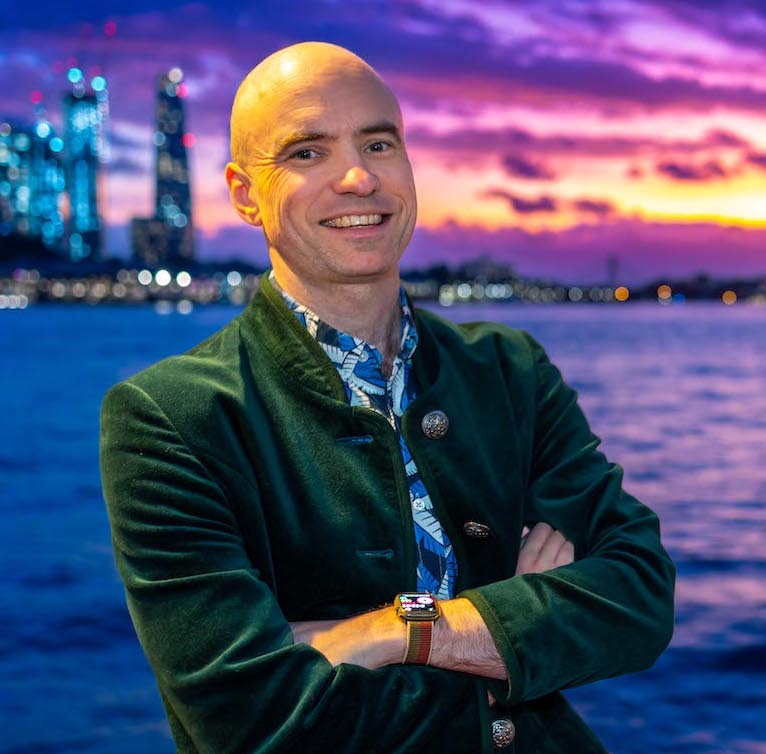 Ben Loveridge is the Immersive Media Coordinator at the University of Melbourne, assisting with the integration of spatial and experiential technology across teaching and research. He obtained his Bachelor of Music at the University of Melbourne with studies in guitar and composition at the Conservatorium of Music.
Ben has worked across a variety of technical and creative fields such as film and television post-production, audio engineering and photography. He holds a Master of Music (Research) from the University of Melbourne and is currently undertaking a PhD at the Faculty of Fine Arts and Music, exploring music performance simulation in immersive reality.
 Dr. Solange Glasser is a Senior Lecturer in Music Psychology at the Melbourne Conservatorium of Music, University of Melbourne. Her interdisciplinary teaching areas include music psychology, performance science, expertise and creativity, and in 2023 she received the ‘Excellence in Teaching at the Conservatorium’ award.
Solange has spent more than two decades researching multisensory perception and the impact of synaesthesia and absolute pitch on musical development. Her current research collaborations explore immersive realities, digital ethics, and artificial intelligence. She holds degrees from the University of Paris IV Sorbonne (France), Queensland Conservatorium of Music, and University of Melbourne.
 Margaret Osborne is a psychologist and Associate Professor at the University of Melbourne with a special interest in research and teaching in performance science, anxiety, music psychology, as well as training innovative, highly effective professional psychologists. She also works in private clinical practice providing therapy for anxiety, tinnitus, and performance coaching.
As a result of her academic and professional practice, she is committed to providing evidence-based therapy that assists people to behave in ways that lead them to live full and satisfying lives. Her specialities include performance psychology: integrating cognitive, behavioural and neuroscience research to formulate best-practice methods to build resilience, reduce debilitating anxiety and maximise performance potential in young, developing and professional performers; anxiety, mood and pain management
About the project
-
The Virtual Performance Simulation Project utilises a performance environment that harnesses the unique affordances of immersive virtual reality technology for artists of all disciplines to develop their performance artistry, foster their ethical know-how, and expand creative potentials.
The work encompasses aspects of music performance anxiety training and audience feedback in practice, the development of 3D digital performance venues, and incorporation of biometric capture in immersive musical performance.
-
The opportunity for students to perform in concert halls, and to experience the associated pressure of a live audience, is limited. However, immersive reality technology can be an effective way for musicians to develop their performance techniques and skills under pressure (Osborne et al., 2022). For this work, we received a TLI grant ($29,935; 2022-2023) to develop an evidence-based intervention for music performance students. We found that the use of immersive virtual reality can provide opportunities for students to manage the stresses of live performance more effectively.
Work was initiated in 2023 to build 3D reconstructions of both the Hanson Dyer Hall and Kenneth Myer Auditorium as part of Glasser’s Researcher Development Grant ($9,967; 2022). The visualisations were expertly crafted by Isabel Solin and imported into Unreal Engine to create the VR training application. These virtual reconstructions of performance spaces offer a high degree of realism and are being further developed over time with the IP held by the University.
Related publications:
Loveridge, B., Glasser, S., Osborne, M. S., & Genay, A. (2026). Understanding Musicians’ Experience in a Virtual Reality Concert Hall Performance Simulation. In Designing Interactive Systems Conference (DIS ’26), June 13–17, 2026, Singapore, Singapore. ACM, New York, NY, USA, 20 pages. https://doi.org/10.1145/3800645.3813039
Osborne, M.S., Glasser, S., & Loveridge, B. (2022). ‘It’s not so scary anymore. It’s actually exhilarating’: A proof-of-concept study using virtual reality technology for music performance training under pressure. ASCILITE Publications, e22116–e22116. https://doi.org/10.14742/apubs.2022.116
-
Immersive environments provide opportunities for new forms of musical performance co-created by humans and artificial intelligence (AI), while at the same time raising significant questions concerning ethics and ownership of performance.
Our research critically examines these issues, resulting in a framework for the ethical collection and use of biometric data in performance settings, especially within immersive environments (Sparrow et al., 2024). This work was the result of the inaugural CAIDE AAIDE Grant ($20,000; 2022).
Glasser, S., Osborne, M. S., Loveridge, B., Sparrow, L., & Kelly, R. (2025). Consent, connection, and creativity: Navigating the ethical boundaries of using biometric data in artistic performance. In E. K. Sunde, V. Bartlett, & J. Pfefferkorn (Eds.), Decentring ethics: AI art as method (pp. 259–278). Open Humanities Press. https://www.openhumanitiespress.org/books/titles/decentring-ethics
L.A. Sparrow, C. Galwey, B. Loveridge, S. Glasser, M. S. Osborne, & R. M. Kelly. (2024). Heart and Soul: The Ethics of Biometric Capture in Immersive Artistic Performance. In Proceedings of the 2024 CHI Conference on Human Factors in Computing Systems, May 11-16, Honolulu, Hawaiʻi.
-
The 3D concert hall was created using 2D floorplans in Revit. This was then imported into Unreal Engine where the lighting and interactions were created and exported to a virtual reality application.
The simulation runs on a PC VR using Airlink to provide a tether-free experience.
-
Our team of experts can help you explore what’s possible via consultation, research, in-house production, and by connecting you with others in this space at the University. Visit the Immersive Media page for more information.